

Hanoi continues to record record high temperatures.
In recent days, Hanoi has recorded the highest temperatures in the country, consistently exceeding 40 degrees Celsius. The perceived temperature can reach up to 45 degrees Celsius, disrupting the lives of outdoor workers and affecting their health.
On May 25th, eight provinces and cities in the Northern Delta and Central regions experienced the highest temperatures nationwide, exceeding 40 degrees Celsius. This temperature was measured in a standard meteorological shelter placed 2 meters above the ground. The actual perceived outdoor temperature is usually 2-4 degrees Celsius higher, especially in urban areas with many heat-absorbing surfaces such as concrete and asphalt.
In Hanoi, four out of five weather stations recorded temperatures of 40 degrees Celsius or higher. The Lang station reached 40.7 degrees Celsius – the highest in the country, while the Ba Vi station recorded the lowest at 39.8 degrees Celsius. On May 26th, Hanoi, along with Nghe An, were the two localities with the highest temperatures reaching 41.1 degrees Celsius.
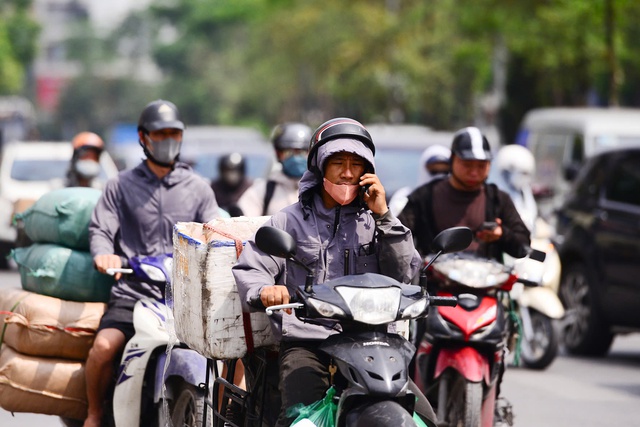
Hanoi is a "furnace" of scorching heat.
Why is Hanoi the hottest place? Dr. Truong Ba Kien, Deputy Director of the Center for Meteorological and Climate Research, Institute of Meteorology, Hydrology, Environment and Marine Sciences , said that the heatwave in Hanoi is the result of a combination of weather and urban factors. From around Thursday and Friday of last week, the rainy season weakened and ended, after which the hot low-pressure area in the West expanded to the Northern and Central regions, causing the heatwave to intensify over a wide area.
Simultaneously, the southwest monsoon begins to become more active (starting from mid-May). When this southwest monsoon crosses the Truong Son mountain range, causing a Foehn effect, the Central and North Central regions become noticeably hot and dry. In the North, especially the Northwest and parts of the northern mountainous areas, the Foehn effect also appears when the air current crosses the Hoang Lien Son mountain range and the western mountain ranges, contributing to a rise in temperature.

Dr. Truong Ba Kien, Deputy Executive Director of the Center for Meteorological and Climatological Research, Institute of Meteorology, Hydrology, Environment and Marine Sciences.
Hanoi, in particular, besides the impact of general weather patterns, is strongly affected by the urban heat island effect. The density of concrete, asphalt roads, high-rise buildings, traffic, air conditioning, and energy-consuming activities cause the urban surface to absorb heat strongly during the day, then dissipate heat slowly in the evening and at night. Meanwhile, when there is little or no wind, and high humidity, the body has difficulty dissipating heat, making the feeling of stuffiness and heat even more pronounced.
"Therefore, Hanoi becoming one of the hotspots of this heatwave is due to the expanding hot low-pressure system, combined with the strong urbanization characteristics of the capital," Dr. Truong Ba Kien commented.
Why is the sweltering heat outside so uncomfortable?
Dr. Truong Ba Kien explained that the urban heat island effect is a phenomenon where urban areas have higher temperatures than suburban areas due to significant changes in surface characteristics and energy balance. In Hanoi, concrete surfaces, asphalt, roofs, glass walls, and high-rise buildings have a greater capacity to absorb and store solar radiation than natural surfaces such as moist soil, trees, and water. During the day, these materials absorb heat strongly; in the evening and at night, they release heat slowly, causing the temperature in the inner city to decrease more slowly than in the suburbs.
Furthermore, high building density reduces natural ventilation, limiting the dispersion of heat from the air layer near the ground. The reduction in green spaces and bodies of water also decreases evaporation – that is, reduces a very important natural cooling mechanism of urban areas. Along with heat emitted from traffic, air conditioning, industry, and daily life activities, these factors cause the inner city to form a distinct "heat accumulation."
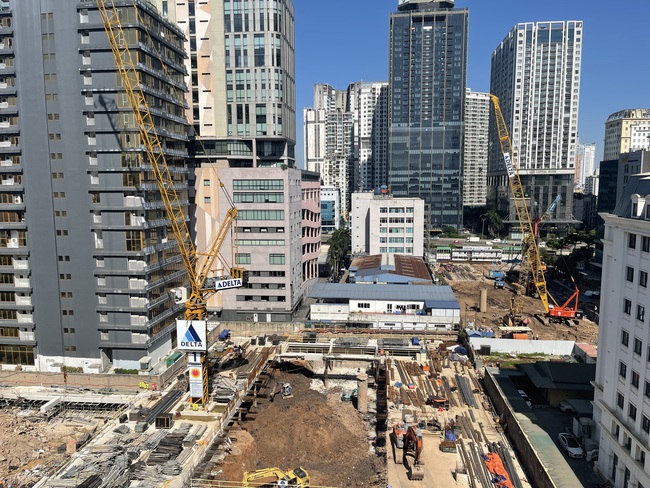
High building density combined with the urban effect
"Therefore, during the same heatwave, the inner city of Hanoi often has higher air and perceived temperatures than the suburbs, especially in the late afternoon and at night. This is also why people in densely populated areas with few trees, lots of concrete, and heavy traffic often feel prolonged stuffiness, even when the meteorological temperature begins to drop," Dr. Truong Ba Kien commented.
From a climatological perspective, the period from late May to July is typically the peak of hot weather in Northern Vietnam, so the occurrence of hot weather during this time is not unusual. However, the noteworthy aspect of the current heatwave is the rapid increase in temperature intensity, the wide area of impact, and the pronounced oppressive heat in urban areas, especially with Hanoi recording high temperatures, sometimes exceeding 40 degrees Celsius, such as 40.7 degrees Celsius at the Lang weather station on May 25th.
From a meteorological perspective, this heatwave is a combination of an expanding hot low-pressure area in the west, a Foehn effect making the air drier and hotter, strong solar radiation, few clouds, and weak winds. These factors increase the maximum daytime temperatures. However, the severity lies not only in the highest daily temperatures, but also in the prolonged accumulation of heat over several days, causing nighttime temperatures to drop slowly, making it difficult for the human body to recover after prolonged daytime heat exposure.
In Hanoi specifically, urban factors exacerbate the heatwave compared to many surrounding areas. Concrete and asphalt surfaces, high building density, heavy traffic, and human-generated heat emissions increase the perceived temperature, especially in narrow streets with few trees and poor ventilation. Therefore, compared to typical heatwaves, this one is noteworthy not only for the high meteorological temperature but also for the combined heat risks: intense daytime heat, prolonged muggy nights, pressure on public health, urban life, and electricity consumption.
Extreme heatwaves may become more frequent in Hanoi.
According to Dr. Truong Ba Kien, based on the results of the Climate Change 2025 Scenario, expected to be released this June by the Institute of Meteorology, Hydrology, Environment and Marine Sciences, urban climate change will be analyzed in a separate chapter, focusing on Hanoi and Ho Chi Minh City. This is a very important new point, because large cities are not only affected by the global warming trend, but also by the combined impact of urbanization.
Projected results indicate that in Hanoi, average temperature, maximum temperature, and minimum temperature all tend to increase in the 21st century. The increase is more pronounced towards the end of the century compared to the middle, higher in high-emission scenarios, and particularly prominent in the inner city area. The increase in nighttime temperatures is a significant indicator, as it reflects heat accumulation in the urban environment, making it difficult for the human body to recover from daytime heatwaves.
Regarding extreme weather indicators, the scenario shows that the number of hot days, the intensity of heatwaves, and the duration of heatwaves all tend to increase. This means that in the future, Hanoi may face more frequent, prolonged, and intense heatwaves, causing greater heat stress for its residents.
It's important to emphasize that this is a double impact: climate change is causing a general increase in temperature, while the urban heat island effect is making the inner city hotter and cooling down more slowly. Therefore, without planning solutions, increased green spaces and water bodies, improved urban ventilation, and reduced concrete construction, the risk of extreme heat in Hanoi will become increasingly apparent in the coming decades.
Source: https://suckhoedoisong.vn/vi-sao-ha-noi-la-chao-lua-trong-dot-nang-nong-lan-nay-169260527062911813.htm



![[Photo] Standing Committee member of the Party Central Committee Tran Cam Tu working with the Central Inspection Committee](https://vphoto.vietnam.vn/thumb/1200x675/vietnam/resource/IMAGE/2026/05/28/1779969579668_ndo_br_bnd-2495-jpg.webp)





































































































Comment (0)