

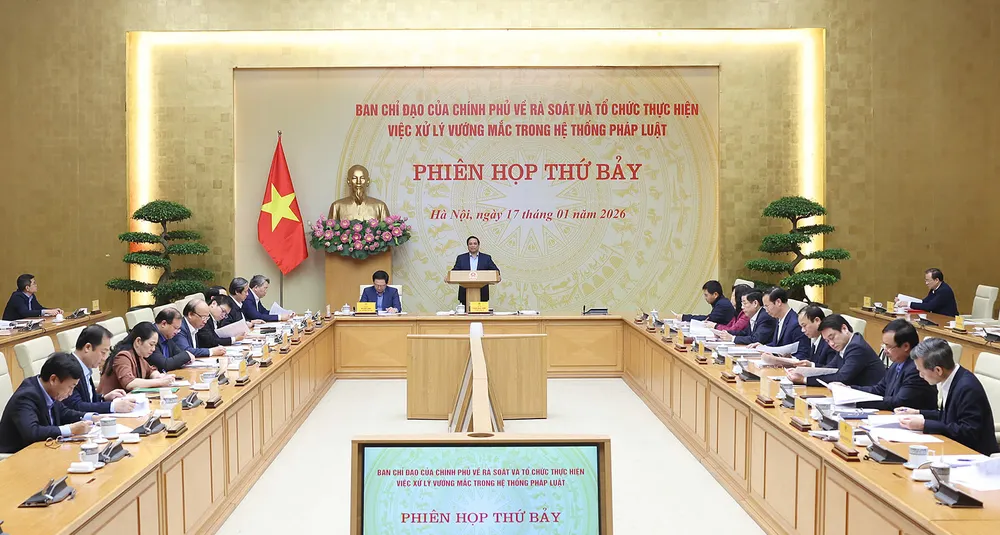
Speaking at the session, Prime Minister Pham Minh Chinh emphasized that the work of building and perfecting institutions is the "breakthrough of breakthroughs" in the three strategic breakthroughs; it is both a goal, a driving force, and a resource for development.
Over the past period, the Party, the National Assembly , and the Government have been determined to thoroughly remove legal barriers, transforming the situation from a "bottleneck of bottlenecks" into a "breakthrough of breakthroughs," a national competitive advantage, in order to unlock resources, create a legal framework, and a foundation for development.
According to the Prime Minister, in implementing Resolution No. 66-NQ/TW of the Politburo (on reforming the work of drafting and enforcing laws to meet the requirements of national development in the new era), by 2025, the removal of "bottlenecks" caused by legal regulations had been basically completed, reaching 98.3%.
Therefore, the goal is to achieve a growth rate of 8% or higher by 2025, while maintaining macroeconomic stability, controlling inflation, and ensuring the major balances of the economy; to achieve rapid and sustainable development, harmonious development between the economy and society, environmental protection, and national defense and security.
In the coming period, the Prime Minister requested the Deputy Prime Ministers and leaders of ministries, sectors, and localities to focus on directing the implementation of tasks to improve institutions and laws based on the review results, proposing solutions to overcome difficulties and obstacles caused by legal regulations; and to continue to identify institutions as the breakthrough of breakthroughs.
The Prime Minister particularly emphasized that institutional breakthroughs must transform the situation from a "bottleneck" of "bottlenecks" into a national competitive advantage; it must shift the situation in mobilizing resources from the people, businesses, and society... to serve double-digit growth. The Prime Minister noted that the mindset in lawmaking should shift from centralized management to creation and service; the spirit should be to decentralize and delegate power to the maximum extent, assigning tasks to those who can do them best.
Earlier, on the morning of January 17th, Prime Minister Pham Minh Chinh chaired a meeting of the Government Standing Committee to discuss and provide feedback on the following issues: the development of a national strategy on rare earth elements; the draft resolution of the Government on mechanisms to remove difficulties and obstacles for transitional BT (build-transfer) projects; and the draft decree detailing the handling of obstacles in BT transportation projects, as well as other matters.
Regarding the development of the National Rare Earth Strategy, Prime Minister Pham Minh Chinh emphasized the need to strengthen state management in this field, develop the rare earth industry, and contribute to strategic self-reliance. Simultaneously, he stressed the importance of building and perfecting institutions, mechanisms, and policies on rare earths, prioritizing deep processing; financial investment, mobilizing state resources, public-private partnership resources, and investor resources; building and developing infrastructure; transferring and mastering advanced and appropriate technologies; promoting public-private partnerships; and smart governance based on digital transformation. The Prime Minister requested the Ministry of Agriculture and Environment to finalize draft reports and proposals for submission to competent authorities for consideration and feedback.
Regarding the mechanism for resolving difficulties and obstacles with transitional BT projects, the Prime Minister directed the Ministry of Finance and relevant agencies to incorporate feedback, finalize, and submit a Government resolution for promulgation using a streamlined procedure. The Prime Minister requested adherence to regulations, application of the law, and proper authority, while harmonizing benefits and risk sharing between the State, businesses, and the people.
Based on that, review and handle projects that have already received inspection conclusions. For projects that have not yet received inspection conclusions, the provincial People's Committee shall conduct inspections and handle them according to its authority, in the spirit of "the locality decides, the locality acts, the locality is responsible."
Source: https://www.sggp.org.vn/viet-nam-xay-dung-chien-luoc-quoc-gia-ve-dat-hiem-post834007.html
![[Photo] First session of the 14th Congress of the Vietnam Trade Union](https://vphoto.vietnam.vn/thumb/1200x675/vietnam/resource/IMAGE/2026/06/03/1780465947883_ndo_br_img-3852-jpg.webp)

![[Photo] Secretary of the National Assembly Party Committee, Chairman of the National Assembly presides over the meeting of the Standing Committee and Executive Committee of the National Assembly Party Committee.](https://vphoto.vietnam.vn/thumb/1200x675/vietnam/resource/IMAGE/2026/06/03/1780480353201_ndo_br_bnd-2585-jpg.webp)
![[Photo] General Secretary and President To Lam presides over a meeting with the Central Organizing Committee.](https://vphoto.vietnam.vn/thumb/1200x675/vietnam/resource/IMAGE/2026/06/03/1780482764658_a1-bnd-4741-3342-jpg.webp)






































![[Video] Sunset at Lap An Lagoon – Where the sun sets over the fishing nets](https://vphoto.vietnam.vn/thumb/1200x675/vietnam/resource/IMAGE/2026/05/31/1780192137701_beach-landscape-sea-water-nature-grass-745871-pxhere-com.jpeg)























Comment (0)