Minister of Construction Tran Hong Minh recently chaired a meeting to implement strategic technology development tasks in the field of high-speed railway construction.
Reporting at the meeting, Director of the Department of Science , Technology, Environment and Construction Materials Le Van Duong stated that the program was developed with the goal of forming endogenous technological capacity for the high-speed rail sector. Vietnam will gradually master the entire value chain, from surveying, design, construction, component manufacturing to operation and maintenance.
Currently, Vietnam's limitations mainly lie in its incomplete system of specialized standards and regulations; its dependence on foreign countries for ballastless pavement construction technology; and its lack of a testing and inspection system and specialized human resources.
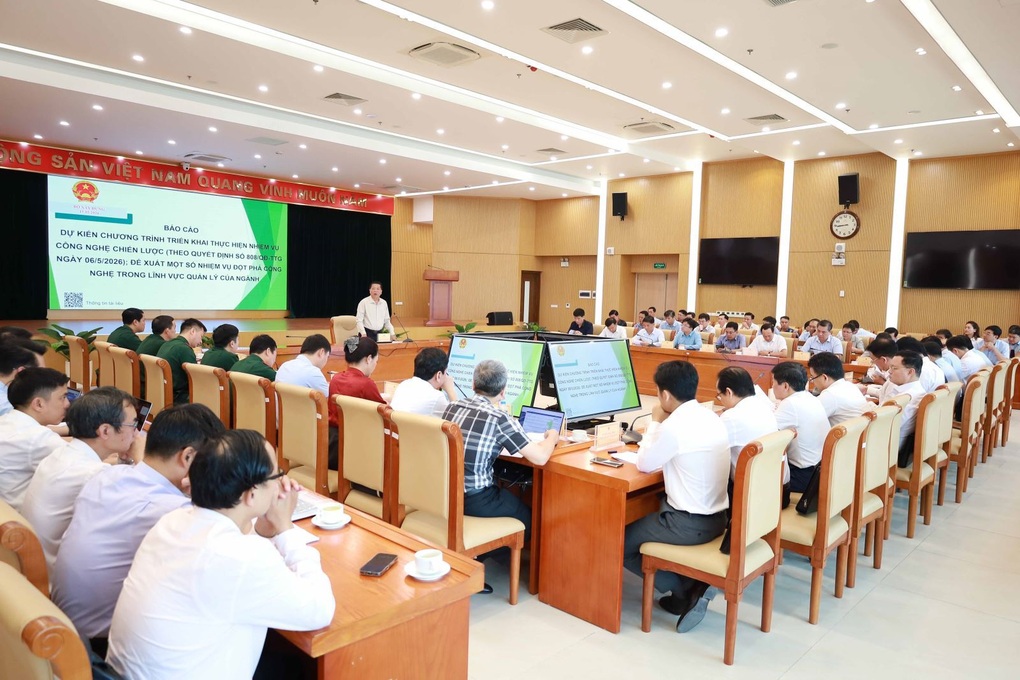

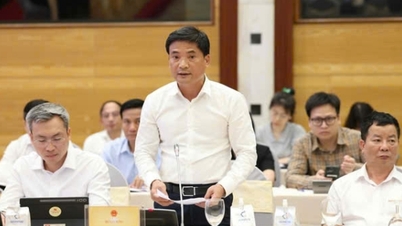
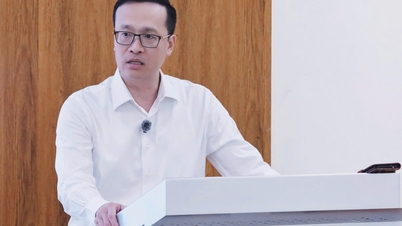
Overview of the meeting (Photo: Ministry of Construction).
In this context, the Ministry of Construction recognizes that the development of high-speed rail technology should be implemented as a key national science and technology program, with the synchronized participation of management agencies, research institutes, universities, and businesses.
The business sector is identified as playing a central role in the process of technology adoption, localization, and commercialization, while the State plays a facilitating and coordinating role.
Speaking at the meeting, a representative from Viettel Military Industrial and Telecommunications Group stated that the company has the capability to participate in the research and development of centralized operating systems, signaling, control, OCC centers, as well as intelligent management platforms to support high-speed rail operations.
Meanwhile, representatives from Hoa Phat Group also proposed participating in the research and production of rails, large-span steel components, and mechanical materials for construction and maintenance of the project.
Several research institutes, universities, and consulting firms have recommended that the Ministry promptly assign specific tasks to establish specialized research groups focusing on high-precision surveying technology, structural design of bridges, tunnels, roadbeds, and ballastless pavements, and to build a national key laboratory for testing structures, materials, and engineering systems.
Concluding the meeting, Minister Tran Hong Minh requested that all units finalize the list of tasks within a short period, clearly define the outputs, the lead and coordinating units, and mobilize maximum resources for implementation. Relevant agencies, businesses, and research institutes must assign highly qualified personnel to directly participate and complete task registration before May 25th for compilation and reporting to the Government.
The Ministry of Construction will establish a sector-level Steering Committee and a specialized Scientific Council to coordinate the entire program. Between May 25th and 30th, the Ministry's leadership and relevant units will conduct surveys of several defense industry facilities and enterprises to assess the potential for collaboration in research, manufacturing, and technology integration.
As requested by the Minister, the key task groups include: developing a system of standards and regulations; mastering surveying and design technology; researching and manufacturing rails, sleepers, and ballastless track slabs; constructing bridges, tunnels, and stations; developing traction and signaling electrical systems; training human resources; and developing software for structural design, simulation, and calculation.
Source: https://dantri.com.vn/bat-dong-san/viettel-hoa-phat-cung-muan-nhap-cuoc-lam-duong-sat-cao-toc-bac-nam-20260518164345493.htm


![[Photo] First session of the 14th Congress of the Vietnam Trade Union](https://vphoto.vietnam.vn/thumb/1200x675/vietnam/resource/IMAGE/2026/06/03/1780465947883_ndo_br_img-3852-jpg.webp)

![[Photo] General Secretary and President To Lam presides over a meeting with the Central Organizing Committee.](https://vphoto.vietnam.vn/thumb/1200x675/vietnam/resource/IMAGE/2026/06/03/1780482764658_a1-bnd-4741-3342-jpg.webp)


![[Photo] Secretary of the National Assembly Party Committee, Chairman of the National Assembly presides over the meeting of the Standing Committee and Executive Committee of the National Assembly Party Committee.](https://vphoto.vietnam.vn/thumb/1200x675/vietnam/resource/IMAGE/2026/06/03/1780480353201_ndo_br_bnd-2585-jpg.webp)

















































![[Video] Sunset at Lap An Lagoon – Where the sun sets over the fishing nets](https://vphoto.vietnam.vn/thumb/1200x675/vietnam/resource/IMAGE/2026/05/31/1780192137701_beach-landscape-sea-water-nature-grass-745871-pxhere-com.jpeg)






























Comment (0)