

Dreams and harsh reality
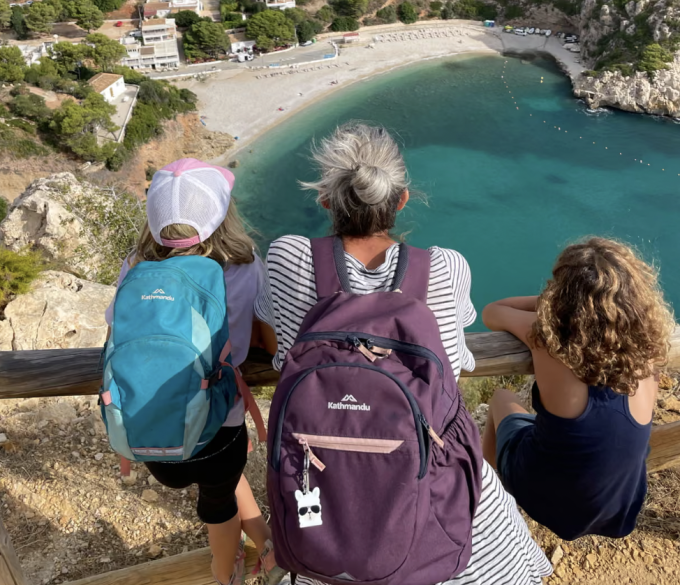
In 2020, Sharon Ward, 44, and her husband Mike, 46, from New Zealand, gave up their stable life in Dubai to embark on a round- the-world trip with their two daughters (ages 5 and 8). However, reality quickly turned harsh when they had to live entirely on their savings.
Their frugal spending habits forced them to live in cheap, unsuitable accommodations for children. At one point, two girls had to share a bed in a dormitory in Marrakech (Morocco), or an entire family of four crammed onto a bunk bed in Turkey. When money ran out, they had to take on manual labor to pay for housing, while also teaching their children and managing daily expenses themselves.
"What was supposed to be a year of relaxation gradually turned into a heavy burden," Sharon shared. Constant traveling, packing, and searching for food left them with no time to rest.
Psychological impact on children
Constant change has the most negative impact on children. Sharon's youngest daughter becomes irritable and upset every time they move to a new place. Many plans have to be canceled, and the family has to stay for months at a time just so the child can recover emotionally.
The crisis peaked in the summer of 2022 in Morocco. Under the scorching 40°C heat of the Sahara Desert, with no access to clean water or air conditioning, Sharon's husband and two children fell ill one after another. "For the first time, I wondered if I was putting my children in danger," she lamented. Following this ordeal, they decided to move to Bali, Indonesia, and enroll their children in an international school to find stability.
The dark side of the digital nomad lifestyle.
Sharon's case is not unique. There are currently around 40 million people globally who follow a "digital nomad" lifestyle. This lifestyle is linked to the concept of "worldschooling" —educating children through travel experiences—and is widely promoted on social media with beautiful images.
However, a survey by Bunq Bank (Netherlands) of 4,729 digital nomads revealed that 38% experience mental health problems. Loneliness, lack of community support, and the pressure of working across time zones are common issues. This burden is compounded when young children are also present.

The Davis Family Story
The family of Josy and Joe Davis, 35, from Gloucestershire, England, is another example. At the end of 2023, they sold their house, took their two children (ages 4 and 6) out of school, and set off on a journey, hoping to escape the exhausting work routine.
After just a few weeks, freedom turned into suffocation as the whole family had to be together 24/7 without a specific schedule. In Sri Lanka, despite efforts to keep the children's education going, the unfamiliar environment and unappetizing food often left them exhausted.
A major tragedy struck while they were in Thailand: Joe received news of his father's sudden death. After rushing back to England for the funeral and then returning to Sri Lanka, they realized everything had fallen apart. Their eldest daughter had lost interest in exploring, and when asked about their next destination, both children just wanted to "go home."
In July, after traveling through seven countries with 14 flights, the Davis family decided to return to England. "Nomadic life isn't as glamorous as it appears on Instagram. Kids are kids, no matter where you are," Josy concluded.
Source: https://baodanang.vn/vo-mong-om-con-di-khap-the-gioi-ap-luc-va-trai-dang-3315442.html


![[Image] Central Party Office summarizes work in 2025](/_next/image?url=https%3A%2F%2Fvphoto.vietnam.vn%2Fthumb%2F1200x675%2Fvietnam%2Fresource%2FIMAGE%2F2025%2F12%2F18%2F1766065572073_vptw-hoi-nghi-tong-ket-89-1204-jpg.webp&w=3840&q=75)




























































































Comment (0)