

Is it a cause for concern to mix E10 gasoline with regular gasoline?
On a weekend morning, Mr. Tran Van Dong (residing in An Phu Dong Ward, Ho Chi Minh City) took his large-displacement motorcycle out to "test" biofuel. He filled the tank with E10 gasoline, started the engine, revved the throttle, and sped off on the highway as usual. "The bike still operates efficiently and there are no instances of stalling or difficulty starting, as rumored online," Mr. Dong concluded.
Having tried E10 gasoline before its official nationwide distribution, Mr. Lam Van Dung (residing in Dong Nai ) said that currently, gas stations near his home no longer sell Ron95 gasoline, only E10. "After three weeks of trying the bio-gasoline, I feel my engine runs more powerfully, and the engine starts without the 'delay' that was rumored. However, the fuel consumption seems to be faster; I measured the distance and speed I travel daily, which is comparable to when I used Ron95 gasoline. Besides that, I haven't noticed any other unusual issues compared to using Ron95," Mr. Dung shared.
Ms. Truong Thi Thai Hoa (residing in An Phu Dong Ward, Ho Chi Minh City), who uses an old Wave motorcycle, still has some questions before switching to E10 gasoline: "I don't know if E10 gasoline is any different from traditional gasoline. Do I need to drain all the old gasoline before adding E10, or can I mix it in?" Similarly, Ms. Nguyen Thuy Linh (Ho Chi Minh City), currently using a Toyota Raize, is also wondering if mixing traditional A95 gasoline (still in the tank) and E10 gasoline will lead to any unusual phenomena. In general, according to a survey by Thanh Nien newspaper, most current questions revolve around whether E10 gasoline will affect the engine, durability, and lifespan of the vehicle.
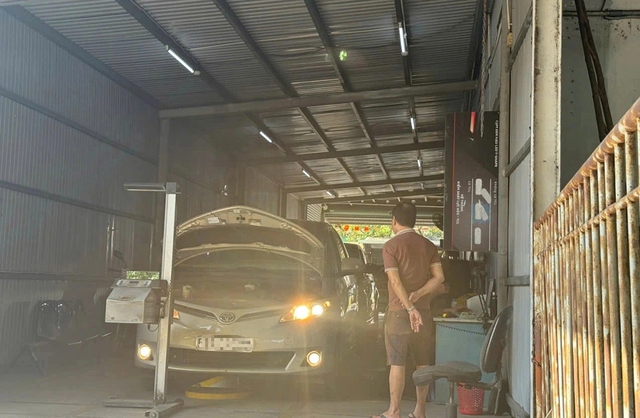
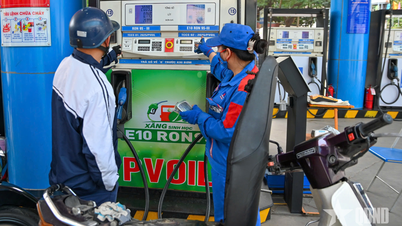
Vehicle owners need to maintain their vehicles, filter the fuel, and clean the fuel tank when switching to E10 gasoline.
PHOTO: QUANG THUAN
In response to these questions, a technical officer from the Ho Chi Minh City Vehicle Inspection Center stated that rumors such as E10 gasoline causing punctured fuel tanks, corroding fuel lines, fires, explosions, or "damaging vehicles" are exaggerated and inaccurate. It's possible that vehicles manufactured before the 1990s may have incompatible materials and technology, with rubber seals, gaskets, iron fuel tanks, and iron fuel lines being easily corroded by alcohol, leading to aging and hardening. However, in reality, very old vehicles, over 30 years old, are no longer common; if they do exist, they are usually collector's items that have been used infrequently. With newer vehicles manufactured after 2000, motorcycle and car manufacturers have completely redesigned their structures to adapt to ethanol-blended gasoline, such as replacing standard rubber gaskets with ethanol-resistant gaskets (advanced corrosion-resistant materials), replacing iron fuel tanks with multi-layered plastic or aluminum tanks, and upgrading iron fuel lines to completely rust-resistant aluminum alloy pipes.
Regarding recent misleading information, representatives from car manufacturers have officially stated that current technology, including electronic fuel injection systems and fuel/pipe materials, is designed to be compatible with commonly available ethanol-containing gasoline such as E10. Furthermore, vehicle owners can even fill up with E10 while still having A95 in the tank without draining it completely, as mixing A95 and E10 does not cause significant harm thanks to the vehicle's ECU automatically adjusting the air-fuel ratio.
Toyota Vietnam stated that all vehicles manufactured after 1997 can use E10 gasoline, without affecting performance, safety, or incurring additional maintenance costs. Honda Vietnam affirmed that its car models only require gasoline with an octane rating of 91 or higher and are fully compatible with E10. The Civic Type R, however, requires gasoline with an octane rating of 95 or higher, meaning it should use E10 RON95. Other manufacturers such as Mitsubishi, Hyundai, and Ford also confirmed that most of their current models can use E10. Similarly, European car manufacturers such as Mercedes-Benz, BMW, Audi, and Skoda have clearly stated their compatibility with ethanol-blended gasoline.
Regarding motorcycles, Honda, Yamaha, Piaggio, and Suzuki affirm that all models currently on sale are compatible with E10 gasoline, except for some very old models.
Why do I feel like the engine is losing power?
On the other hand, Ms. Nguyen Ngu Ha (Tan Hoa Ward, Ho Chi Minh City) said that she has been filling her Yamaha hybrid motorbike with E10 gasoline since May 15th. On average, she travels about 10 km per day. However, during a long weekend trip, when she wanted to accelerate faster, she felt the engine wasn't as responsive as when using A95 gasoline, sometimes feeling like it was losing power. This is also a question many people using E10 gasoline have. In a comment sent to Thanh Nien Newspaper seeking clarification, reader Minh Khuyen stated: "I have filled up with E10 for the second time, but I'm still wondering if the 10% ethanol blend will make the engine sluggish or affect its durability?"

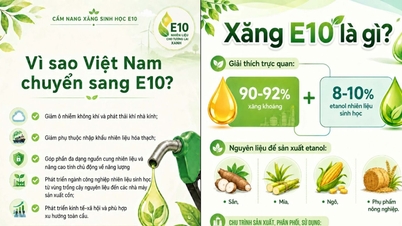
Instructions for using E10 gasoline
PHOTO: QUANG THUAN, CREATED BY AI
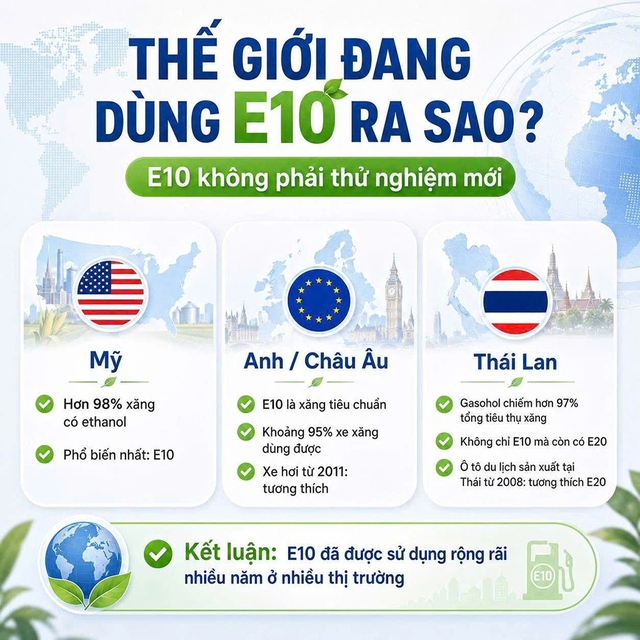
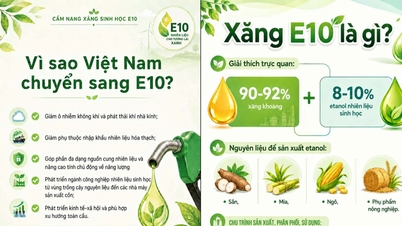
E10 gasoline is very popular in many countries around the world.
PHOTO: QUANG THUAN, CREATED BY AI
Associate Professor Dr. Do Van Dung, Chairman of the Ho Chi Minh City Automobile and Power Equipment Association, said that the feeling of reduced acceleration or increased fuel consumption when using E10 is "obvious". The reason is that ethanol contains oxygen, so when burned, it reduces the amount of carbon and hydrogen participating in the reaction, resulting in lower heat generation, and thus a slight decrease in engine power, about 2-3%.
According to technical experts at the Ho Chi Minh City Vehicle Inspection Center, E10 gasoline contains ethanol, an alcohol with strong cleaning properties that breaks down dirt and deposits. If a vehicle has traveled over 40,000-60,000 km or hasn't had its fuel system cleaned in two years, the bottom of the fuel tank may have accumulated a lot of dirt and deposits. When E10 is added, this dirt is dislodged, carried up to the fuel pump, and clogs the fuel injectors. Many people believe that "E10 gasoline causes vehicle damage." In reality, many drivers do not perform regular maintenance, nor do they pay attention to replacing the fuel filter and flushing the fuel tank. The coarse fuel filter is located right at the pump assembly at the bottom of the tank, where a lot of sludge and deposits accumulate over time. Cleaning it thoroughly will help reduce the risk of clogging the system when using E10 gasoline. For motorcycles, the fuel injectors have extremely small nozzles; if they are clogged with deposits, the vehicle will easily experience engine hesitation, jerking, and poor fuel combustion. Therefore, regular cleaning will help the engine run more smoothly and reduce the feeling of "the car being weak" when changing fuel.
Biofuels should become even cheaper.
Dr. Do Thien Anh Tuan, a lecturer at Fulbright University Vietnam, believes that the policy of switching from fossil fuels to biofuels is in line with the trend of reducing emissions and diversifying energy sources. On the other hand, solutions are also needed to support those who drive older vehicles, especially in rural or disadvantaged areas, who cannot immediately upgrade to new cars, such as maintaining the use of fossil fuels for a reasonable period.
In addition, Mr. Nguyen Minh Dong, an automotive engine expert in Germany, suggested that the government could subsidize the price of biofuels, and if it becomes cheaper, people will voluntarily switch.
Source: https://thanhnien.vn/xang-e10-giai-dap-nhung-ban-khoan-truoc-gio-g-185260524180739492.htm



![[Image] Pleasant weather helps students enter the 10th grade entrance exam with confidence.](https://vphoto.vietnam.vn/thumb/1200x675/vietnam/resource/IMAGE/2026/05/29/1780034401612_ngay-1-thi-lop-10-minh-duy-8-5009-jpg.webp)
![[Photo] Ba Lang An Lighthouse - the "eye of the sea" amidst the "rock museum" of Quang Ngai province.](https://vphoto.vietnam.vn/thumb/1200x675/vietnam/resource/IMAGE/2026/05/29/1780038698840_anh-man-hinh-2026-05-29-luc-14-10-42.png)





























































































Comment (0)