

Getting plenty of rest, drinking enough water, eating healthy meals, and practicing pursed-lip breathing can help reduce coughing and throat discomfort in people with bronchitis.
Rest and drink plenty of water.
The main symptoms of bronchitis are fatigue due to infection and a persistent cough. Meanwhile, sleep can boost immunity, support recovery after illness, repair tissue damage, and create new tissue. At the same time, sufficient sleep helps release important hormones and regenerate the body's energy. Therefore, people with bronchitis should rest a lot and get enough sleep.
Adults need 7-8 hours of sleep, while children need 10-12 hours a day; this is no different for those with bronchitis. When sleeping, people should use a pillow to elevate their heads, which helps with breathing and reduces mucus in the chest.
Bronchitis is a lower respiratory tract infection that can cause significant dehydration due to fever, rapid breathing, runny nose, vomiting, and diarrhea. Severe dehydration can lead to dizziness, confusion, headache, and increased discomfort in the mouth and throat. Therefore, people with bronchitis are advised to drink plenty of fluids.
Drinking enough water also helps reduce mucus in the chest and nose, and moistens the throat. Patients should alternate between water, fruit juice, herbal tea, soup, and broth to avoid boredom from drinking too much.
Use a humidifier.
Low humidity and cold temperatures create favorable conditions for respiratory infections. Low humidity irritates the nose and throat, and also causes itchy eyes and dry skin. Warm, humid air, on the other hand, helps loosen mucus in the chest during bronchitis, making it easier for the body to expel.
However, humidifiers can also harbor mold and bacteria if not properly maintained and cleaned. When humidifiers produce excessively high humidity, it can cause respiratory problems and trigger allergy attacks or asthma.
If you don't want to use a humidifier, you can humidify the air by boiling water on the stove for 5 minutes, once every hour. Alternatively, you can add a few drops of peppermint or eucalyptus essential oil to the boiling water and inhale the steam for a few minutes to alleviate symptoms.
Quit smoking
Tobacco is the leading cause of chronic bronchitis. Smoking damages the bronchial tubes in the lungs, disrupting the body's ability to defend against infection. Inhaling secondhand smoke causes bronchitis patients to cough violently.
Quitting smoking will reduce lung damage and decrease the likelihood of developing acute bronchitis in the future. In addition, people should avoid dust and chemicals by wearing masks, staying away from air-polluted areas, and cleaning their home air conditioning systems as recommended.
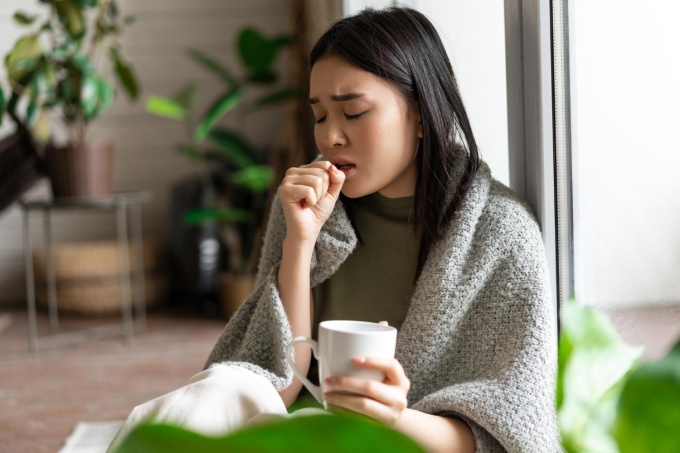
Bronchitis causes coughing and fatigue, requiring plenty of rest and adequate hydration. (Image: Freepik)
Relieves general body aches and pains.
People can use over-the-counter pain relievers like acetaminophen to reduce symptoms of bronchitis, such as fever, headache, and aches. Families should avoid giving aspirin to children and teenagers due to the risk of Reye's syndrome. Nonsteroidal anti-inflammatory drugs (NSAIDs), such as aspirin and ibuprofen, can be dangerous for people with asthma.
Avoid using over-the-counter cough suppressants.
There are two types of over-the-counter cough suppressants: cough suppressants and expectorants, which thin and expel mucus from the airways. People should not use cough suppressants when they have phlegm. When the lining of the bronchial tubes is inflamed by irritants, excess mucus is produced, causing frequent coughing to remove pathogens from the lungs and airways.
There is little scientific evidence to suggest that cough medicine is more effective than other folk remedies, such as honey and lemon. However, infants or children under one year old should not consume honey due to the potential for poisoning.
Pursed-lip breathing
People with chronic bronchitis often breathe rapidly. Pursed-lip breathing can help slow breathing and control shortness of breath. This technique reduces the frequency of inhalations, keeps the airways open for longer periods, and increases physical activity.
To practice pursed-lip breathing, people should inhale through their nose for two counts, then exhale slowly and gently through slightly pursed lips, while counting to four.
Soothe a sore throat
Sore throat is a common symptom of bronchitis. People can soothe a sore throat by gargling with salt water, drinking cool or warm water, eating soft foods; using cough drops, hard candy, ice cubes, or over-the-counter throat sprays. Cough drops should not be given to children under 4 years old to avoid choking.
Eat healthily
An unhealthy diet weakens the immune system because the body doesn't receive enough energy, macronutrients, and specific micronutrients. For example, a lack of vitamin C prevents the body from producing enough white blood cells to fight infections.
A healthy meal includes plenty of fruits, vegetables, whole grains, lean meats, poultry, fish, beans, eggs, and nuts; non-fat and low-fat dairy; and limits saturated fat, trans fat, and cholesterol, while reducing salt and sugar.
People should also consider supplementing with probiotics. When consumed as food or supplements, probiotics help boost immunity, prevent respiratory infections, and reduce the severity of chronic bronchitis symptoms.
Acute bronchitis usually resolves on its own and can be treated at home with rest, non-steroidal anti-inflammatory drugs (NSAIDs), and plenty of fluids for about 3 weeks. However, if you experience a cough lasting longer than 3 weeks, or blood in your mucus, shortness of breath, chest pain, drowsiness, or a fever lasting more than 3 days, you should see a doctor for prompt treatment.
Chile (According to Medical News Today )
Source link


























![[Photo] Reception to welcome General Secretary and President To Lam and his wife on their State visit to the Philippines](https://vphoto.vietnam.vn/thumb/1200x675/vietnam/resource/IMAGE/2026/06/01/1780295488620_vna-potal-chieu-dai-chao-mung-tong-bi-thu-chu-tich-nuoc-to-lam-va-phu-nhan-tham-cap-nha-nuoc-toi-philippines-8798060-7855-jpg.webp)







































































Comment (0)