


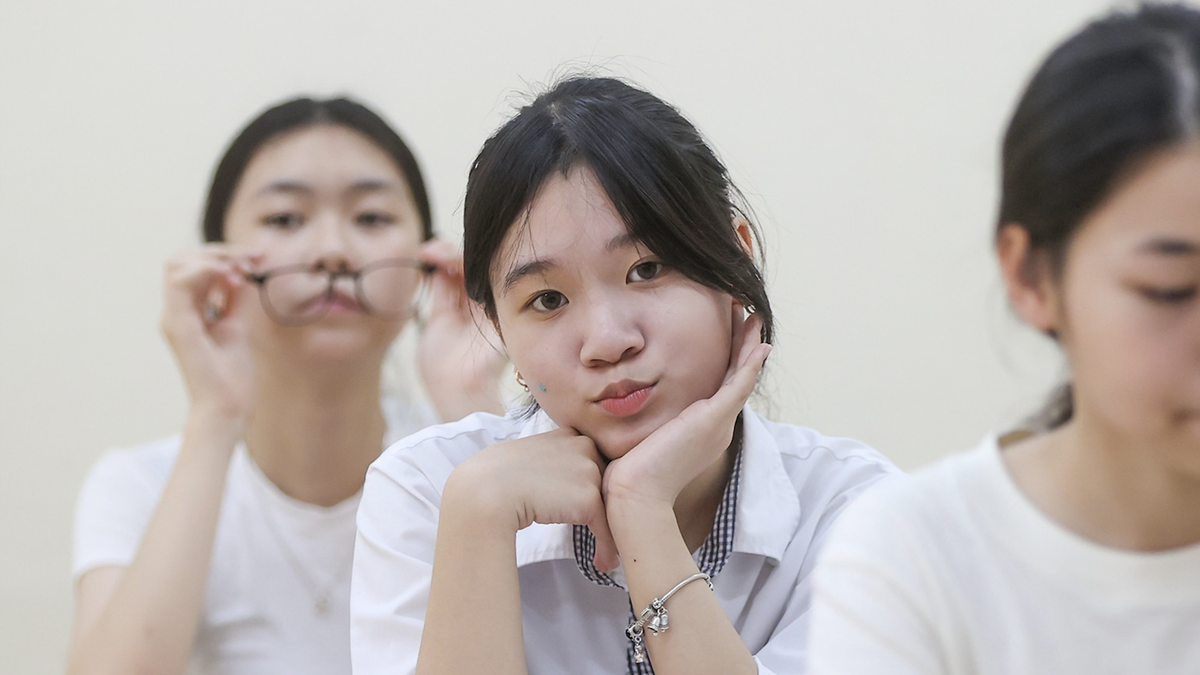
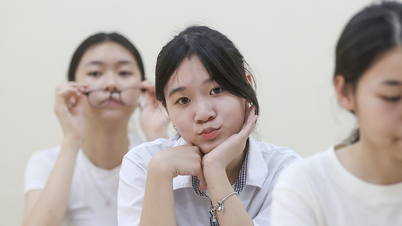
The girls are studying at a UNICEF accelerated learning center in western Afghanistan.
In its newly released report, "The Cost of Inaction on Girls' Education and Women's Participation in the Workforce in Afghanistan," UNICEF warns that each year Afghanistan restricts girls from attending secondary school will cause another generation of women to miss out on the opportunity to join the skilled workforce. This leads to serious social and economic consequences.
Consequences of no change: Long-term economic and social collapse.
Wahida, 14, had to drop out of school in the sixth grade due to a ban on secondary education for girls in Afghanistan, imposed by the government in September 2021. “Sometimes, I try to study at home, but it’s very difficult without classes, teachers, and friends,” Wahida shared, adding that she dreams of becoming a doctor and helping people. Wahida’s mother is a sanitation worker, working at the school during the day and at the hospital at night. Because she herself lacked the opportunity to study, she hopes her daughter can go to school and succeed. “Now, thinking about her not being able to finish her education breaks my heart. Girls’ time is being wasted,” she said.
According to UNICEF Innocenti, if this ban continues, by 2030 2 million girls will be deprived of post-primary education. The UN agency also estimates that around 600,000 skilled women will leave the workforce in the next 35 years. The report states: “The large proportion of girls not receiving education, work, or training is a potential economic burden with negative impacts on the resilience of the economy.”
According to the report, the ban on education for girls after grade 6, as well as restrictions on their access to training and employment, causes an estimated 0.5% loss in Gross Domestic Product (GDP). UNICEF recommends that the Afghan government lift the ban on secondary and higher education for women to avoid further economic damage.
According to forecasts, approximately 40 out of 129 universities in Afghanistan are at risk of closure due to declining revenue as well as a decrease in the number of students and faculty, especially women. Two key sectors requiring women with education are education and healthcare, but with no new candidates being trained, both sectors face a serious shortage of personnel.
UNICEF is working to support Afghan girls.
UNICEF supports community education in Afghanistan, a solution that provides alternative learning pathways for those excluded from the formal education system, including adolescent girls. These initiatives were implemented before the ban, helping to address the inability of students (especially girls) to attend school due to safety concerns or long distances from home.
Last year, UNICEF reported providing education to 445,000 children, about two-thirds of whom were girls. Girls under 15 who have not completed primary education can attend UNICEF's accelerated learning centers and are provided with backpacks, notebooks, pens, and other essential school supplies. There are currently 3,500 such centers across Afghanistan, funded by partners such as the German Commission for UNICEF and the Asian Development Bank (ADB).
In addition, UNICEF also supports skills development programs, expanding vocational training and skills opportunities for young people and young women across Afghanistan who are facing extreme poverty.
The tragic situation in Afghanistan
In recent years, Afghanistan has suffered a series of disasters: a prolonged drought threatening food security; earthquakes in 2022 and 2025 causing numerous casualties. In addition, the Southwest Asian nation faces a wave of repatriations from Iran and Pakistan. By December 2025, nearly 3 million people, mostly of school age, had returned home, further increasing pressure on already overloaded social services.
An estimated 45% of Afghanistan's population – equivalent to 22 million people, including 8 million children – will need humanitarian assistance by 2026. Acute malnutrition among children is also widespread.
THANH TRUC (UNICEF USA)
Source: https://baocantho.com.vn/afghanistan-doi-mat-tuong-lai-bat-on-xa-hoi-a205858.html




![[Photo] Admire the coral "masterpiece" amidst the million-year-old heritage of Dak Lak province.](https://vphoto.vietnam.vn/thumb/1200x675/vietnam/resource/IMAGE/2026/05/30/1780107638639_y25-jpg.webp)

























































































Comment (0)