

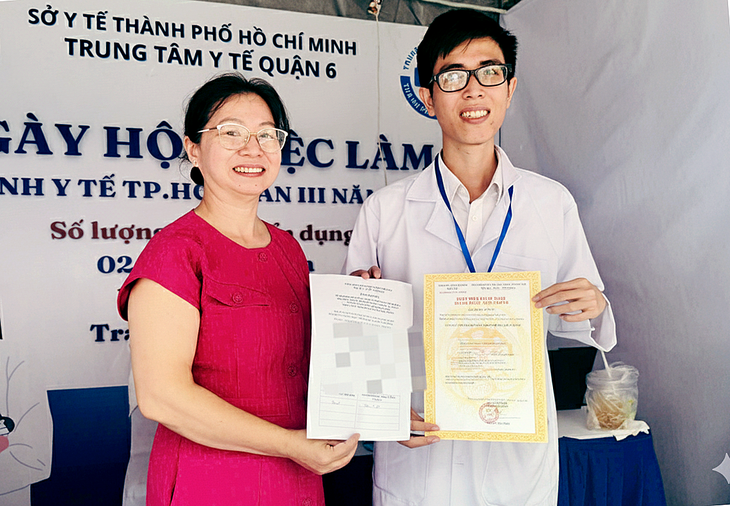
The number of young doctors registering to work at medical centers and health stations in Ho Chi Minh City is increasing - Photo: THU HIEN
Statistics from the Ho Chi Minh City Department of Health show that the percentage of young doctors registering to work at the grassroots level is expected to increase from 21% in 2024 to 37% in 2025.
This demonstrates the growing appeal of the primary healthcare system to young doctors – who not only possess enthusiasm but also a desire to create a new approach to patient care.
Primary healthcare is no longer a second choice for young doctors.
Speaking to Tuổi Trẻ newspaper, Dr. Lê Thảo Vy, a recent graduate of the pediatrics program at Phạm Ngọc Thạch University of Medicine, shared that she chose to apply immediately to the Tân Bình Regional Medical Center (Ho Chi Minh City) to work there after graduation.
Something she had never considered while sitting in the lecture hall, but after 18 months of practice at the hospital, witnessing the overcrowding and pressure at the tertiary hospitals made this young doctor realize the extremely important role of primary healthcare.
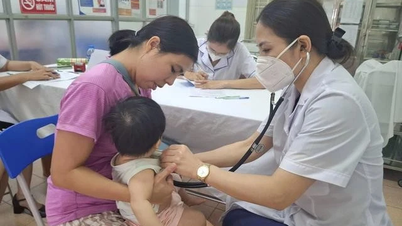
For Dr. Vy, the work at the medical center is very suitable for young doctors, as she gets to deal with a wide variety of illnesses because the field of pediatric healthcare at medical centers today is quite diverse.
Regarding concerns about a "lack of professional skills" when returning to primary healthcare, Dr. Vy further shared that she is not overly worried because this is still a place for young doctors to hone their skills. According to Dr. Vy, it is never too late to gain exposure to and understanding of various diseases, thereby improving one's expertise.
Having worked at the health station for over 3 years, Dr. Ngo Minh Nhat (28 years old), who works at the Binh Hung Commune Health Station (formerly Binh Chanh District), also shared that when he was a medical student, the idea of working in grassroots healthcare was almost non-existent.
It was only after participating in a pilot program for practical training at a hospital affiliated with a health center for newly graduated doctors that Nhat realized the crucial role of doctors at health centers in "intercepting" diseases from afar. Therefore, in 2022, after graduating, Dr. Nhat immediately applied to work at a health center.
"My perspective on health centers has completely changed. While practicing at a health center, I realized that there is a severe shortage of doctors, which puts the people at a great disadvantage. The number of people coming to the health center for examinations is increasing, and they confide that they receive better care from the doctors there, from treatment to disease prevention."
"Besides that, I was also given the opportunity to pursue further specialization. Primary healthcare is truly an environment that every medical student needs to experience," said Dr. Nhat.
Changing perceptions about primary healthcare.
Since 2022, Ho Chi Minh City's health sector has implemented a pilot program for newly graduated doctors to practice for 18 months at hospitals in conjunction with health centers. Doctors will practice for 12 months at health centers under the professional guidance and training of hospital doctors, and the remaining 6 months will be spent in the hospital for further training.
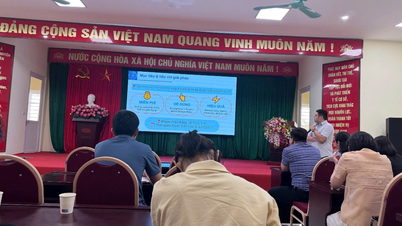
The city has held its third job fair for doctors participating in this program, opening up opportunities for them to choose long-term employment. To date, 547 young doctors have completed the program in time to supplement the workforce at public health facilities, especially at the grassroots level.
Dr. Nguyen Trong Nghia, Deputy Director of Cu Chi Medical Center, said that compared to previous years, the number of young doctors interested in working at the medical center has increased, and there is growing attention to grassroots healthcare.
This shows that the Department of Health's policy of attracting doctors to grassroots healthcare is entirely correct, contributing to enhancing the role of grassroots healthcare and reducing the burden on higher-level hospitals.
Doctors have shifted their mindset from focusing solely on treatment to prevention, no longer desiring to work in large hospitals for professional development upon graduation. Similarly, in remote areas with long distances and difficult access, doctors often feel intimidated by the prospect of "fewer patients, less interaction" and fear becoming "out of practice."
Mr. Tang Chi Thuong, Director of the Ho Chi Minh City Department of Health, said that the pilot program for practical training at hospitals linked with health stations for newly graduated doctors is an effort by the health sector in the training of doctors.
This aims to help young doctors gain closer access to the realities of community health, understand the operation of the primary healthcare system, and thereby develop a mindset of serving the people comprehensively, from prevention to treatment.
The head of the city's health department said that in 2024, 74 doctors chose to work long-term at the grassroots level, an increase of 26 doctors compared to 2024.
In 2025, Ho Chi Minh City's health sector will continue to allocate 274 young doctors to health stations to strengthen grassroots healthcare support immediately after the merger. Unlike the previous three cohorts, the fourth cohort is the first to apply the 6-3-3-3-3 rotation model, consisting of the first 6 months at the general hospital, 3 months at the health station, followed by 3 months at the hospital, 3 months at the health station, and the final 3 months at the hospital.
Notably, 21 young doctors proactively applied to work at health stations in the former Binh Duong and Ba Ria - Vung Tau provinces, with two of them choosing a health station belonging to the Con Dao Military-Civilian Medical Center.
Throughout the training period, the training hospital will cover 100% of the training fees, equivalent to 3 million VND per month. When practicing at a health station, doctors will receive a living allowance of 10 million VND per month, according to the specific policy stipulated in Resolution No. 01/2022/NQ-HĐND of the City People's Council.
The Ministry of Health has requested that localities rotate doctors to work at the commune level.
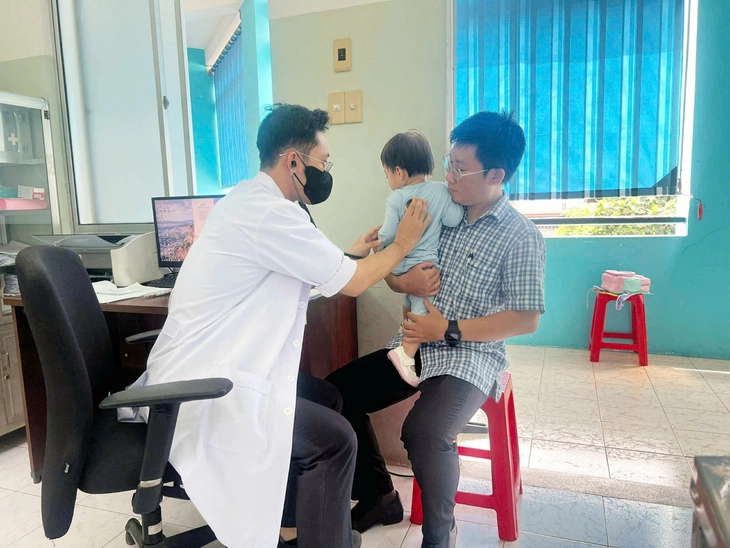
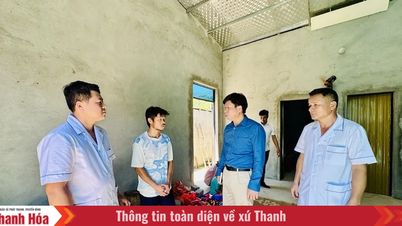
Doctor Ngo Minh Nhat (28 years old) volunteered to work at Binh Hung Commune Health Station (formerly Binh Chanh District) immediately after graduation - Photo: Provided by the interviewee.
Recently, the Ministry of Health sent a document to the People's Committees and health departments of provinces and centrally-administered cities requesting them to develop plans for the rotation, transfer, and deployment of medical personnel from health departments, hospitals, and health centers under the health departments to commune-level facilities.
Local authorities are requested to rotate at least one medical professional to the commune-level culture and social affairs department, and one doctor to the commune health station, ensuring the provision of adequate professional and technical services as required by the new organizational model.
In addition, the Ministry of Health is developing a plan to send 1,000 doctors to commune-level healthcare facilities in the near future, as directed by the Prime Minister, gradually strengthening the role of grassroots healthcare.
Source: https://tuoitre.vn/bac-si-tre-chon-ve-y-te-co-so-20250907232007825.htm
![[Photo] General Secretary and President To Lam presides over a meeting with the Central Organizing Committee.](https://vphoto.vietnam.vn/thumb/1200x675/vietnam/resource/IMAGE/2026/06/03/1780482764658_a1-bnd-4741-3342-jpg.webp)


![[Photo] Secretary of the National Assembly Party Committee, Chairman of the National Assembly presides over the meeting of the Standing Committee and Executive Committee of the National Assembly Party Committee.](https://vphoto.vietnam.vn/thumb/1200x675/vietnam/resource/IMAGE/2026/06/03/1780480353201_ndo_br_bnd-2585-jpg.webp)






















![[Photo] General Secretary and President To Lam attends the 14th Congress of the Vietnam Trade Union](https://vphoto.vietnam.vn/thumb/1200x675/vietnam/resource/IMAGE/2026/06/04/1780543339765_anh-man-hinh-2026-06-04-luc-10-22-07.png)
























![[Video] Sunset at Lap An Lagoon – Where the sun sets over the fishing nets](https://vphoto.vietnam.vn/thumb/1200x675/vietnam/resource/IMAGE/2026/05/31/1780192137701_beach-landscape-sea-water-nature-grass-745871-pxhere-com.jpeg)































Comment (0)