

Folk culture is divided into two types: tangible culture and intangible culture. Tangible culture includes items such as stilt houses, rice mortars, baskets, bows and arrows, traditional musical instruments, etc.; intangible culture includes legends, fairy tales, folk songs, folk art performances, rituals such as the Giang worship ceremony, the new rice worship ceremony, etc.
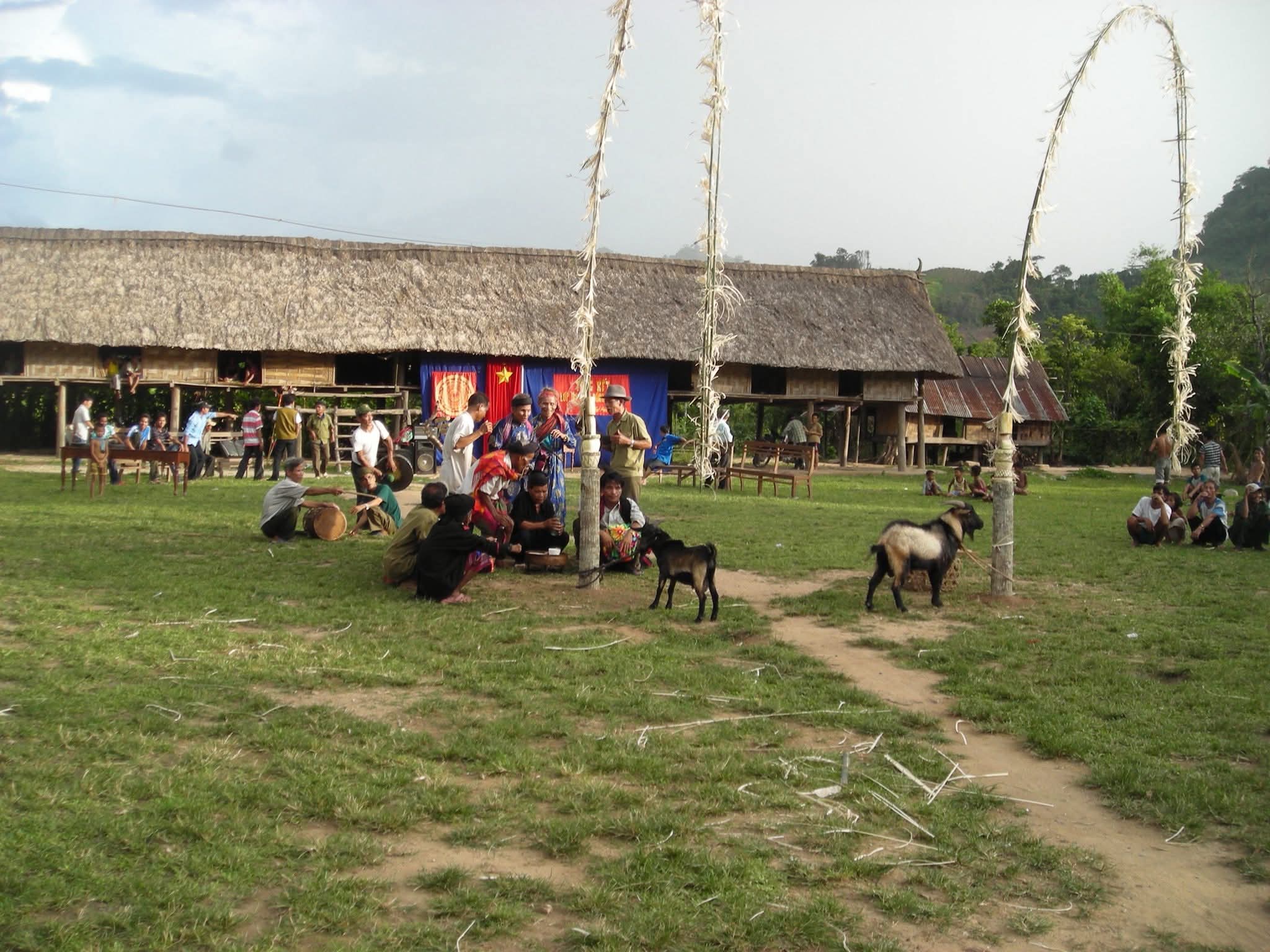 |
| The housewarming ceremony of the Pa Kô people in Quang Tri province - Photo: PXD |
Despite its richness and uniqueness, research and study of the folklore of the Van Kieu ethnic group remain limited. Previously, writer Mai Van Tan collected and compiled the book "Van Kieu Folk Tales"; poet and researcher Luong An also contributed several articles; and some research on the folklore of the Van Kieu people has been conducted. However, overall, this is still not commensurate with the cultural heritage of the people in the mountainous region of Quang Tri.
Everywhere, cultural identity is often influenced by geographical features, primarily the shape of rivers and mountains. This is even more evident for ethnic minorities in the highlands, as for generations their lives have been closely intertwined with nature, immersed in the scenery of the mountains and forests. And their culture is born from that.
For example, in the mountainous southern region of Quang Tri, many villages in the former Dakrong and Huong Hoa districts have long been closely associated with the Dakrong River—a river steeped in legends. According to researcher Le Duc Tho, this river: “…In reality, from ancient times to the present, in the upstream area, where the Van Kieu, Pa Ko, and Pa Hy ethnic groups reside, the river is named Dakrong; in the Ba Long valley downstream to the sea, the river is named Thach Han. The name Dakrong River in the Mon-Khmer language means "clear water" (Dak: River, water; rong: Clear).”
It is from the material and spiritual life closely intertwined with the beloved and mysterious Dakrong River that the illustrious Dakrong Legend was formed, cherished by the local people and highly valued by researchers. The Dakrong Legend tells of a faithful and unwavering love between a young couple who vowed to be together for life, but were cruelly separated and abducted by an evil man who used every means possible. After enduring many harsh trials, the lovers were reunited, while the villain met a tragic end.
The legend of Dakrong is a love song celebrating sacred love and eternal freedom in the highlands of Quang Tri. Poet and researcher Luong An, a native of Quang Tri, has studied this legend with empathy and respect.
Legend has it that, when captured and imprisoned by a wicked man, despite the fierce threats, the girl sang heartfelt words even at a high price: "If you don't come, I'm afraid / If tonight I hear your a-ren trumpet calling from the front of the house, I'll wait / Mother won't tie my skirt to the post / Mother will even give me a pair of necklaces / Because she knows you are a-loong pa roi (a-long pa roi means a strong young man)."
Let's experience the final part of the legend through the retelling of researcher Luong An: "...Da Krong's husband, believing him to be telling the truth, headed east. As he walked, he played the a-ren horn so that she could hear him sing and find him... They loved each other with a pure, unending love, like the stream that, after they had stopped, continued to flow along the foot of the mountain, clear, ceaseless, forever protecting their lives and keeping them peaceful..."
In this region lives Mr. Ho Phuong, an official who has worked for many years in the mountainous area of Southern Quang Tri. Currently the Deputy Director of the Dakrong Commune General Service Center, he is very passionate about researching and collecting artifacts of the ethnic minorities in the highlands. From leaf-woven clothing and traditional musical instruments to wooden sculptures, his house is like a "private museum," attracting many locals and researchers to visit.
Mr. Phuong shared: “The cultural heritage of the mountainous region of Quang Tri is truly rich and valuable, and needs to be preserved and promoted in today's life. Not only me, but many people hope that the State will have more specific and practical policies to effectively preserve the folk cultural values of the mountainous region.”
We believe that in the near future, Quang Tri province will soon have practical policies to contribute to the preservation of folk culture in the highlands.
Pham Xuan Dung
Source: https://baoquangtri.vn/van-hoa/202605/bao-ton-van-hoa-dan-gian-vung-cao-80d29c6/

![[Photo] General Secretary and President To Lam receives Amazon's Senior Vice President David Zapolsky](https://vphoto.vietnam.vn/thumb/1200x675/vietnam/resource/IMAGE/2026/05/22/1779466547770_a1-bnd-3513-6601-jpg.webp)





















































Comment (0)