(AI)
The early morning sun shone gently and softly.
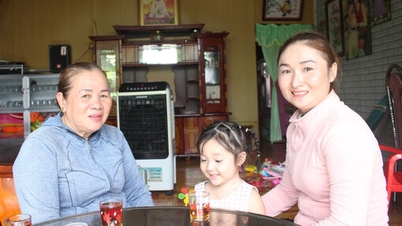
His eldest grandson brought his girlfriend home to introduce her to the family. It was clearly their first meeting, yet... Mr. Ba Banh found her strangely familiar. Upon inquiring, he learned that Thao was the granddaughter of Mrs. Hai Muoi, an old acquaintance he hadn't seen in years. Hearing the name of an old acquaintance, he felt a little happy, but then a thought crossed his mind, and he tensed up. He tried to appear calm, but his voice trembled more than a stringed instrument:
How are your grandparents doing these days?
Thảo paused slightly but politely replied, "She's still well, but he passed away a long time ago." Clearly, as soon as she finished speaking, he breathed a sigh of relief. Ông Ba Bánh knew he was old, Hai Muối was old too, and that separation and death were inevitable for the elderly, but deep down, he still hoped she was well.
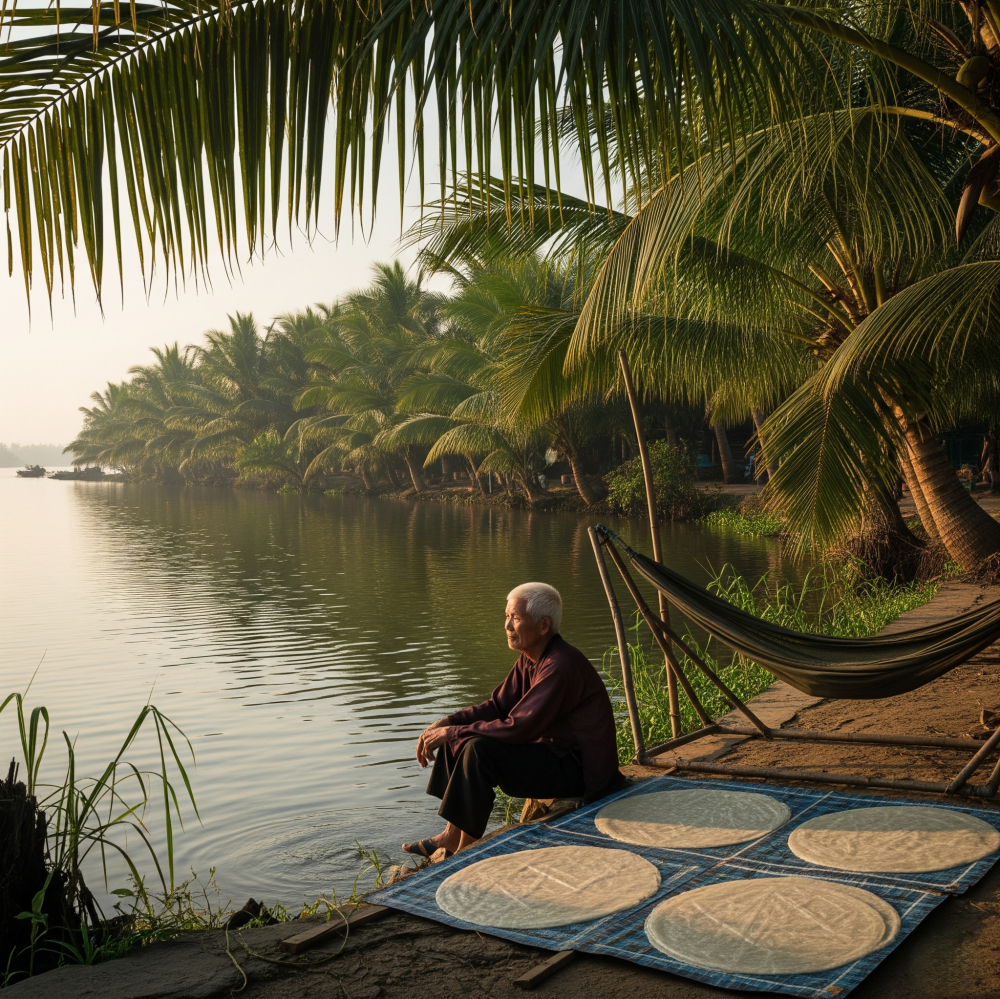
Remembering Hai Muoi, remembering their broken childhood romance, he felt his soul wander, his eyes blurred, his gaze vaguely following the drifting water hyacinths, as if he were slowly walking along a vast path of memories. He recounted that he and Hai Muoi had known each other since childhood, their homes both situated by the Vam Co River, its waters constantly rippling. Back then, people were still very poor; a family that had enough to eat and wasn't starving was considered well-off…
It was just dawn, the mist still thick in the sky, the orange rays of light from the east as thin as embroidery threads on the deep, dark gray fabric of the night. As a child born into a family that made rice paper, from this day forward, Ba Banh had to wake up early to help his parents take the rice paper out to dry.
This process wasn't particularly strenuous or difficult, but for a young child who was still eating and sleeping, it was certainly not pleasant. Ba Banh, while spreading the rice paper on the rack, was half-asleep, yawning, his eyes and nose squinting like a curtain pulled down, struggling to finish. As soon as the last rice paper left his hands, he dashed onto the porch, climbed into the hammock, and began snoring loudly.
It wasn't until the sun rose, its harsh rays hitting his face, that Ba Banh woke up. He rubbed his eyes, stretched, and yawned contentedly, then opened his eyes, his face turning pale as he saw dozens of rice crackers scattered across the yard, some perched precariously on blades of grass and branches, others dangling from water hyacinths, or drifting further and further away on the water's surface. The rest, still lying neatly on the rack, were also dried out by the sun.
When Mom came home from the market, Bánh had already received a beating. The pain was so intense it felt like the world was collapsing, but before she could even scream, she heard a burst of raucous laughter coming from the fence. Through her tears, Bánh clearly saw a short, dark-skinned girl with bowl-cut hair standing on the guava tree by the fence, grinning like a monkey. She knew it was Muối, the annoying neighbor girl who had recently moved in. Bánh had held a grudge against Muối ever since.
From then on, Bánh sought revenge against Muối for over a decade, but rarely succeeded. Year after year, the resentment piled up, growing ever larger. For so many years, they clung to each other like shadows, their feelings like the waters of the Vàm River—seemingly indifferent yet surging, calm yet turbulent, seemingly confined yet indistinguishable from shore, careless for so long, only to find themselves overflowing without a trace.
Yet, at the age of eighteen, having just finished school, Muoi hastily told Banh that she had to get married. Banh agreed, saying, "If Muoi wants to get married, then go ahead." Banh was also preparing to ask for a wife's hand in marriage. After the conversation, the two fell silent, looking at each other, then at the shimmering river surface bathed in sunlight. Their congratulations were awkwardly uttered, sounding as hard to swallow as chewing on a rotten potato, and then… they bowed their heads, turned their backs, and went their separate ways.


A back turned, a face never seen again in over half a century.
Before Muoi's husband's family came to pick her up for the wedding, Banh disappeared without a trace, vanishing into the pitch-black night to join the liberation army, leaving Muoi only a congratulatory letter and a fountain pen with a name he had personally engraved on it.
Many years later, the country was at peace, and Bánh returned, his hair tinged with gray, his limbs mostly intact except for two missing fingers. Seeing his parents, siblings, and house still standing, he knew he was much happier than many others. The only thing he regretted was that beyond the fence, only wild grass and weeds grew lush and green. Muối's family had disappeared. His parents said they moved out of the small house not long after Bánh left. Bánh wanted to ask about Muối's wedding, but the words were swallowed back. Almost ten years had passed; even if there were lingering feelings, they had already settled down and started their own families.
The past should just be left to drift away with the water; there's nothing left to bring up again.
A few years later, Banh got married, and when his son was eight years old, his parents passed away one after another. He and his family continued living by the river, doing their old job, until his son grew up, got married, and had children. Now, Banh's father is well past the age of "ancient wisdom," becoming "Grandpa Ba" waiting to hold his great-grandchild. His wife passed away several years ago, and it seemed as if the old memories had been dormant. But then his "future granddaughter-in-law" appeared, and the memories of the past came alive again, surging like waves in his heart.
I wonder if she would still recognize him if we met again now?
More than six months later, Minh and Thao got married. On the wedding day, he finally had the chance to visit Mrs. Hai Muoi's house. He woke up at dawn, dressed in a stylish Western suit, his hair neatly combed, a rose pinned to his lapel – he looked like a true gentleman. His daughter-in-law giggled softly, while his son pouted and teased him.
- Are the three of you planning to marry Mrs. Hai?
Ba Bánh snorted, in lieu of an answer.
The wedding procession rolled along, the journey wasn't long, but the anticipation stretched on endlessly.
Once seated in the place of honor, he still didn't see her. The ceremony was over, and she was still nowhere to be seen. She must have been busy and couldn't attend his grandson's wedding. He was slightly annoyed, but it was a joyous occasion, and he didn't feel comfortable saying much. Lost in thought, he glanced at Minh and his wife, respectfully offering incense at the ancestral altar.
And yet… I came across that all-too-familiar smile from my memory. The smile in the portrait he himself had painted and given to her. The painting, slightly faded, lay silently behind the glass.
She's so young!
It turned out that Thao was the granddaughter of her younger brother. As for her, she was unmarried and childless. That year, after using the excuse of parting ways with her husband, she quietly joined the Liberation Army with her younger brother. Thao's grandmother recounted with great pride that her sister-in-law, Mrs. Hai Muoi, from the day she joined the army until she went through the fierce sweeps, always kept her solemn oath with her comrades: "To die defending Go Dau," to protect the land, the people, her compatriots, and her homeland.
After the defeat in the Tet Offensive, the enemy escalated the war with a barrage of heavy weapons, launching fierce attacks that caused immense hardship for our people and soldiers. She sacrificed herself in a battle to hold back the majority of our troops, allowing them to retreat to the Thanh Duc base. Her only remaining possessions are a portrait she left at home and a fountain pen engraved with her name, which she still keeps tucked away in her shirt.

Without a word to each other, he and she chose to answer the call of their country. Only after all these years did he finally confess his feelings to her. When she fell, the war was still raging, and what she longed for remained unfulfilled. But he had already seen it clearly for her, a sight that lasted for decades.
After the ceremony, he reached out and lit an incense stick on the altar, then turned his back once more, certain that they would meet again someday.
Outside, the sunlight was a golden hue, casting a gentle glow on the lush green coconut leaves. Watching the newlyweds walk hand in hand against the sun, he felt as if he saw himself, along with her, in a different light.
The Vam River, its waves still gently caress the shore…/.
Dang Phuc Nhat
Source: https://baolongan.vn/ben-dong-vam-co-a198977.html



![[Photo] General Secretary and President To Lam working with the Technical and Professional Center, Ministry of Public Security](https://vphoto.vietnam.vn/thumb/1200x675/vietnam/resource/IMAGE/2026/07/06/1783318005842_a1-bnd-1129-2263-jpg.webp)