

From July 1st, 2025, e-wallets will be officially recognized as a payment method similar to bank accounts. Users can easily transfer money between wallets, or from wallets to bank accounts and vice versa. However, this convenience has also become fertile ground for cybercriminals to devise various scams to steal assets. Many victims are e-wallet users and even the entities operating e-wallets for intermediary payment services.
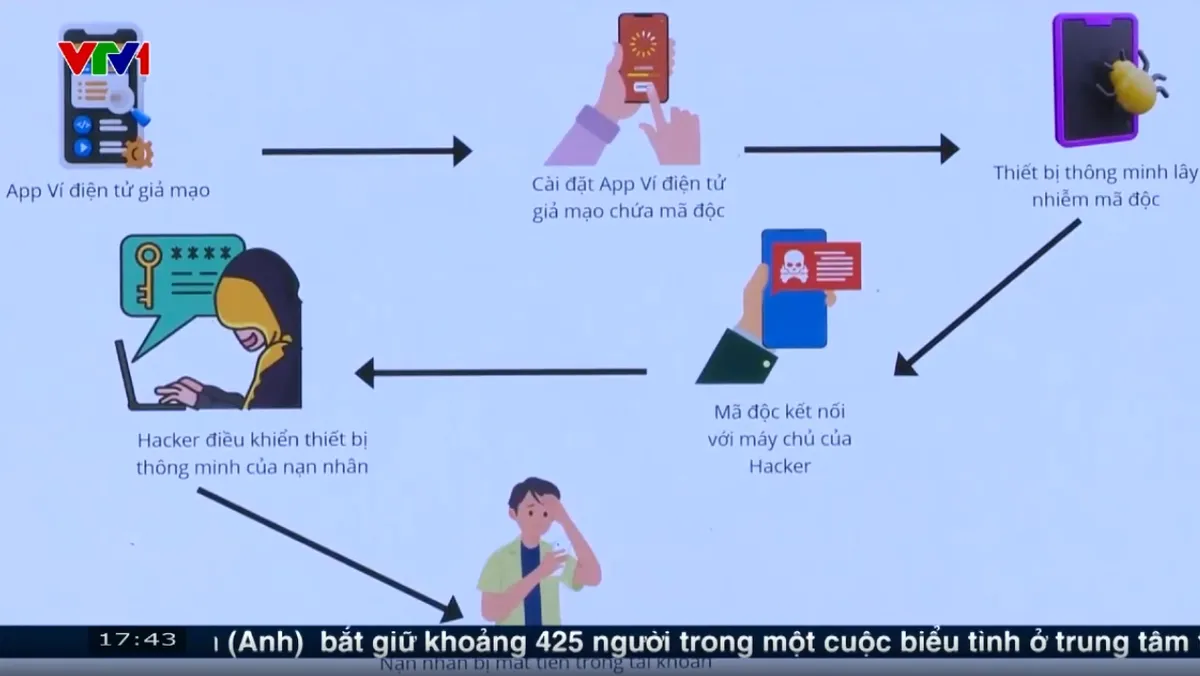
A citizen received a call from someone claiming to be an employee of an e-wallet company, informing them about e-wallets that could be used for transactions like a bank account. The caller correctly stated the citizen's ID number and the type of e-wallet the citizen was using; they also offered to help the citizen reinstall the application on their phone to upgrade to a new version with many new features and gifts from the e-wallet.
She trusted the instructions and accessed the link she received from this person via text message without realizing she was being scammed.
"They said that if I upgraded the software, I would get 1 million VND added to my wallet. When I updated the software, the interface was exactly the same, no difference at all. In the afternoon, when I took out my phone to pay for a taxi, I discovered that nearly 5 million VND in my wallet was gone," the victim shared.
Cybersecurity experts believe that hackers sent links containing fake e-wallet applications with embedded malware. Users downloading these fake e-wallet applications allowed the malware to infect their smart devices.
According to Vu Viet Tien (a cybersecurity expert at the Vietnam National Cybersecurity Company): "These malware programs connect to the hacker's command and control server. Through this, the hacker can send control commands to monitor and take control of the victim's smart device. From there, the hacker will steal the OTP code and drain all the money from the victim's account."
Businesses operating e-wallets can also become targets for criminals. Recently, the police received a report from a company representative about being defrauded while collaborating with multiple banks to integrate a ride-hailing app into the bank's application.
"Our company still advances money to customers; however, we recently discovered that many individual accounts have received advances for taxi fares, but have not repaid the money to us within the stipulated time," a company representative said.
The investigation revealed that the three arrested individuals had illegally acquired numerous bank accounts. Their purpose was to use these empty accounts to book and withdraw taxi fares from fraudulent rides using the following method: the mastermind would book taxis through an e-wallet that advanced fare payments, integrated into the banking application. Upon completion of the ride, the e-wallet provider would immediately pay the driver the advance fare. The driver and the mastermind would then split the total amount of 60 million VND stolen, as agreed upon.
"The taxi drivers in this gang moved their vehicles to secluded locations with few other taxis. Then, the drivers sent their location data to the mastermind, Chu Anh Quan, who used a taxi booking service on a mobile app and bank account to book taxis belonging to other drivers in the gang," Major Pham Thai Duong (Cyber Security and High-Tech Crime Prevention Department, Ninh Binh Provincial Police) informed.
Safe use of e-wallets
Cybersecurity experts also warn that malicious actors can launch scams through e-wallets in several common forms, such as: luring users into participating in "missions" to receive rewards, assisting in loan disbursements through transferring and receiving money via multiple wallets. As a result, victims not only lose money but also risk being implicated in money laundering schemes. They may also use online shopping groups to launch fake promotional programs, such as "transfer between wallets and get 50% cashback," forcing victims to transfer money in advance to "confirm the transaction," but the real purpose is to defraud them. So, what measures can be taken to prevent these e-wallet scams?
Linking e-wallets with banks, supporting prepaid payments for account holders, offers many conveniences but also poses risks of exploitation by malicious actors, especially since the illegal buying and selling of bank accounts has not yet been completely eradicated.
People should always be vigilant about calls from strangers and suspicious links received via text messages; be cautious when installing applications on their phones and only download applications from official sources to avoid the leakage of personal data.
Colonel Hoang Ngoc Bach (Head of Department 4, Cyber Security and High-Tech Crime Prevention Department, Ministry of Public Security ) stated: "Citizens are not allowed to buy, sell, rent, or lend e-wallets. This is one of the reasons why individuals can use these wallets to facilitate the illegal transfer of money. Individuals who rent or lend e-wallets will be held criminally liable."
People should immediately uninstall unreliable applications installed from unofficial sources. This is because during the installation process, malicious actors may trick users into granting access to sensitive data on their phones for fraudulent purposes.
From scams via fake links to sophisticated fraudulent schemes in payment services, users need to remain vigilant. To protect their assets, people should only download applications from official sources, not trust strange calls, not click on suspicious links, and absolutely not buy or sell e-wallets. Digital payment security is the responsibility of every user.
Source: https://baolaocai.vn/canh-giac-bay-lua-qua-vi-dien-tu-post881554.html






































































































Comment (0)