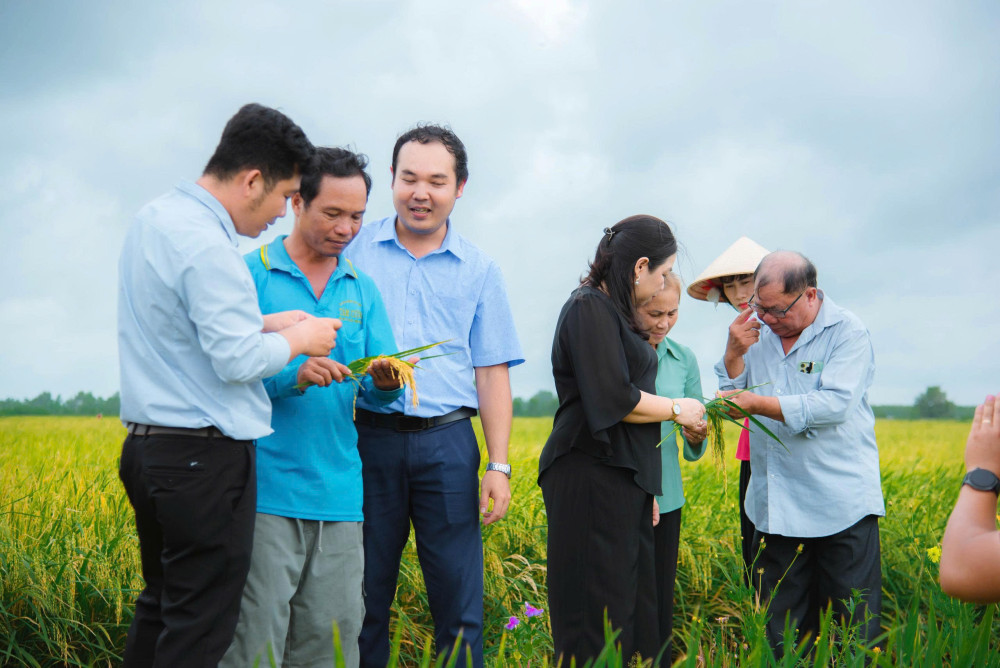
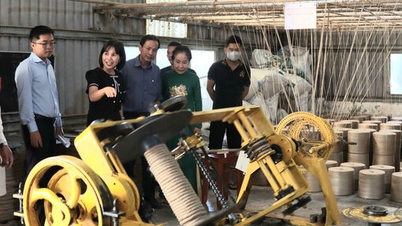
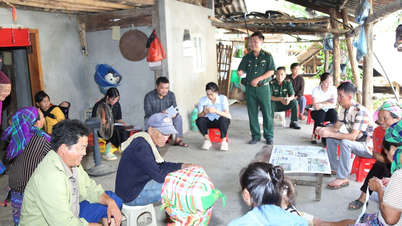
Farmers visit the IPHM model.
Return organic matter to the soil.
Ms. Le Thi Minh Nguyet, representative of the Mekong Lab Testing Institute in Can Tho City, stated: “In agricultural production, soil plays a crucial role in increasing productivity and profit per unit of cultivated land. However, continuous intensive farming and the overuse of fertilizers and chemical pesticides have depleted soil nutrients and eliminated beneficial microorganisms. Therefore, farmers need to pay attention to soil health, limit the use of fertilizers and chemical pesticides, and increase the application of organic fertilizers and microbial pesticides. If possible, farmers should take soil samples for testing to determine which active substances the soil lacks or has in excess, so that they can replenish and nourish the soil.”
Tay Ninh province has over 600,000 hectares of rice-growing land, of which the Dong Thap Muoi region accounts for 347,000 hectares. The province's rice production is approximately 3.5 million tons per year, equivalent to 3.5 million tons of straw. To dispose of straw after harvest, most farmers burn the fields, while the rest is used for organic fertilizer, mushroom cultivation, animal feed, etc. However, burning the fields causes many negative consequences such as environmental pollution, resource waste, and the death of beneficial microorganisms.
According to Vo Thanh Nghia, Deputy Director of the Provincial Agricultural Extension and Services Center: “Instead of burning rice straw, farmers should use biological products to decompose the straw into organic fertilizer, returning nutrients to the soil. In addition, using biological products also helps farmers eliminate weeds, reducing production costs. Currently, the market offers many types of biological products that can decompose rice straw and kill weeds within just 7 days of spraying.”
Ms. Tran Thi Thu Lam's family (residing in Thanh Phuoc commune) cultivates 2 hectares of rice. Every year, after harvesting the winter-spring crop, she sells the straw at a price of 500,000-700,000 VND/hectare. During the summer-autumn or autumn-winter seasons, due to rain and a shortage of straw, traders often don't buy it. To dispose of the straw, Ms. Lam chose to burn the fields, but rainy weather made the process extremely difficult. Ms. Lam said: "Since using the biological product, I no longer have to worry about the straw not burning properly when it rains, or having to throw it away on the dike like before. Now, after harvesting the rice, I mix the biological product and hire a drone to spray it for a few days, and the straw decomposes into organic fertilizer, and all the weeds die off."
Effectiveness of the IPHM model
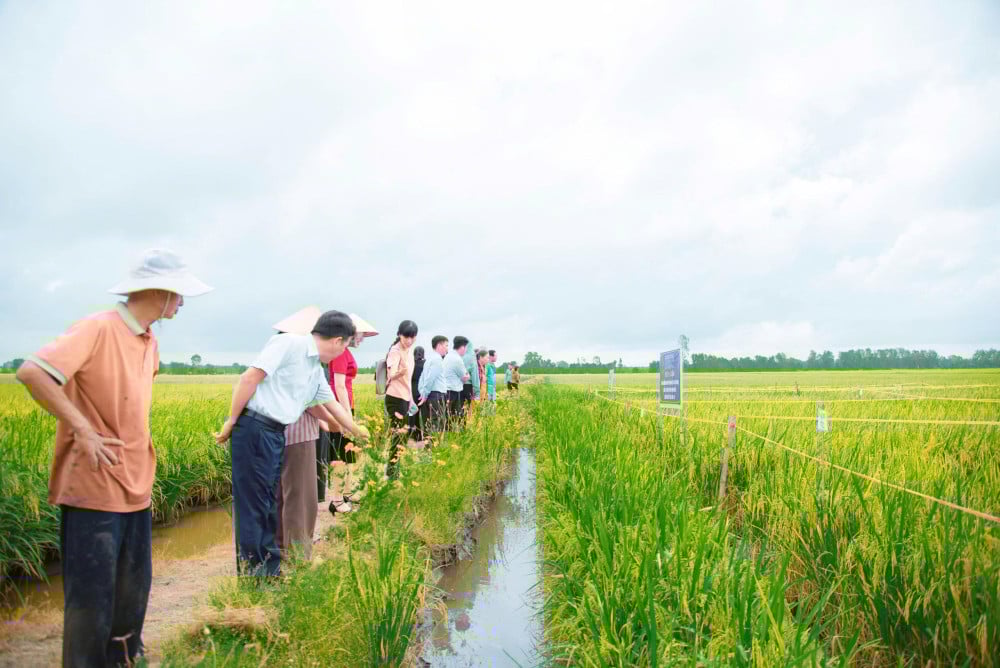
For the 2025 Summer-Autumn crop season, the Southern Center for Crop Production and Plant Protection (TT&BVTV), in coordination with the Thạnh Hóa Regional Agricultural Extension and Service Station, selected Thạnh Hóa commune as a demonstration site for the Integrated Crop Health Management (IPHM) model for rice, covering an area of 5 hectares and using the OM18 rice variety.
Here, 100 farmers participating in and outside the model received training on topics such as: production organization, cultivation techniques according to IPHM (Integrated Pest Management System), environmental protection, and community pest control. Simultaneously, agricultural experts conducted numerous experiments, including: the effect of applying organic microbial fertilizers and reducing nitrogen fertilizer on the yield of OM18 rice; the effect of simulated rice leaf roller at different growth stages on the yield of OM18 rice; and the effect of sowing density on the yield of OM18 rice.
According to Huynh Thi Ngoc Diem, Deputy Director of the Southern Plant Protection and Quarantine Center: “The goal of the IPHM model is to enhance plant health, helping plants to withstand adverse environmental factors, pests, and diseases; thereby increasing production efficiency, maintaining biodiversity, ensuring food safety, and protecting the ecological environment. Specifically, economically , the IPHM model on rice in Thanh Hoa commune yields a profit 6.7 million VND higher than fields outside the model on the same cultivated area, due to reduced production costs. In particular, farmers have changed their production practices, using fertilizers rationally and using pesticides safely according to the "4 correct principles". Applying IPHM is a suitable solution in sustainable agricultural development, meeting the requirements of international integration and improving the Vietnamese rice industry.”
The misuse of pesticides, disregarding the "four correct principles," has led to numerous negative consequences such as unsafe agricultural products due to pesticide residues, ecological imbalance, and environmental pollution. Therefore, cultivating rice organically, reducing the use of inorganic fertilizers and pesticides, and prioritizing soil health are considered essential directions for modern agriculture. Organic production not only benefits the soil but also ensures productivity and profitability comparable to inorganic production.
Minh Thu
Source: https://baolongan.vn/canh-tac-lua-theo-huong-an-toan-a201068.html



![[Photo] Solemn bathing ceremony and Buddha procession in Hue](https://vphoto.vietnam.vn/thumb/1200x675/vietnam/resource/IMAGE/2026/05/31/1780228263543_1-jpg.webp)
![[Photo] Admire the coral "masterpiece" amidst the million-year-old heritage of Dak Lak province.](https://vphoto.vietnam.vn/thumb/1200x675/vietnam/resource/IMAGE/2026/05/31/1780221235105_anh-man-hinh-2026-05-31-luc-16-53-27.png)
![[Photo] The General Secretary, President and his wife begin their state visit to the Philippines.](https://vphoto.vietnam.vn/thumb/1200x675/vietnam/resource/IMAGE/2026/05/31/1780230559452_anh-man-hinh-2026-05-31-luc-19-28-11.png)
![[Image] Hanoi Police officially crowned champions of V-League 2025/2026](https://vphoto.vietnam.vn/thumb/1200x675/vietnam/resource/IMAGE/2026/05/31/1780244769054_ndo_br_039d561b692be875b13a-jpg.webp)















![[Video] Sunset at Lap An Lagoon – Where the sun sets over the fishing nets](https://vphoto.vietnam.vn/thumb/340x192/vietnam/resource/IMAGE/2026/05/31/1780192137701_beach-landscape-sea-water-nature-grass-745871-pxhere-com.jpeg)






























![[Photo] Admire the coral "masterpiece" amidst the million-year-old heritage of Dak Lak province.](https://vphoto.vietnam.vn/thumb/402x226/vietnam/resource/IMAGE/2026/05/31/1780221235105_anh-man-hinh-2026-05-31-luc-16-53-27.png)






























Comment (0)