

According to the 2023 Wood Industry Overview Report by the Vietnam Wood and Forest Products Association, 2023 was a challenging year for Vietnam's wood industry as consumers tightened their spending. However, exports of wood chips and pellets still brought in nearly $2.9 billion.
Specifically, Vietnam exported nearly 14.42 million tons of wood chips, valued at US$2.22 billion, accounting for 16.8% of the total export turnover of the entire wood industry. Compared to 2022, wood chip exports decreased by 8.8% in volume and 20.4% in value, but increased by 5.9% in volume and a sharp increase of 27.7% in value compared to 2021.
Vietnam exports wood chips to 13 markets. China and Japan are the two largest import markets for Vietnam, accounting for 92.4% of total volume and 92.2% of total export value.
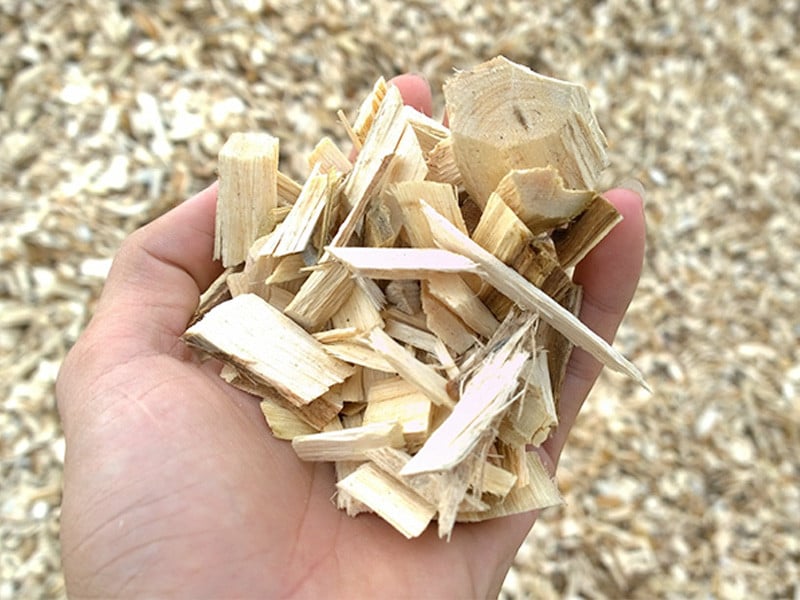
Regarding wood pellets, Vietnam exported 4.67 million tons last year, earning nearly $680 million, a decrease of 4.3% in volume and 13.7% in value compared to 2022, accounting for 5.2% of the total export turnover of the wood industry.
Vietnamese wood pellet products were exported to 22 countries and territories in 2023. Japan and South Korea remained the two largest customers for Vietnamese wood pellets.
Specifically, Japan imported over 2.8 million tons of wood pellets from Vietnam, valued at $438 million, an increase of 12.4% in volume and 14.3% in value compared to 2022. Conversely, South Korea imported only over 1.7 million tons of wood pellets, valued at nearly $214 million, a decrease of 24.5% in volume and 43.3% in value compared to 2022.
Commenting on the market outlook for these products this year, Mr. To Xuan Phuc - Executive Director of the Forest Products Trade Policy Program, Forest Trends Organization - believes that wood pellets still have many opportunities to boost exports to the Japanese market. The wood pellet market in South Korea is not expected to see much change in the near future because importers there prioritize cheaper wood pellet sources.
Regarding wood chips, according to Mr. Phuc, China's import demand is expected to continue declining in the near future, leading to a decrease in wood chip export prices in this market.
According to the Forestry Department, in 2023, the entire industry harvested approximately 19 million ster of firewood (a unit of volume for firewood). This is the main input material for the production of wood chips and pellets.
In addition, by-products of the wood processing and manufacturing industry, such as wood scraps, wood chips, wood shavings, sawdust, etc., are also used to produce wood pellets and wood chips.
Earlier this year, wood exports recovered strongly. In January, wood chip exports reached $217.5 million, a 21.7% increase compared to the same month last year; wood pellet exports reached $73.5 million, a 24.1% increase.
Experts predict that wood chips and wood pellets still have significant potential and room for growth. In particular, wood pellet exports could reach $1 billion in the near future. Businesses should consider investing in developing their own raw material sources to ensure a stable supply for production and export.

Source
![[Photo] Life on both banks of the river returns to its bustling pace on the day the Long Bien Bridge opens to traffic.](https://vphoto.vietnam.vn/thumb/1200x675/vietnam/resource/IMAGE/2026/05/28/1779949763708_cau-long-bien-minh-duy-7-3610-jpg.webp)




![[Photo] The heat at the fireworks display site on the opening night of the Da Nang International Fireworks Festival 2026](https://vphoto.vietnam.vn/thumb/1200x675/vietnam/resource/IMAGE/2026/05/27/1779889741485_ndo_br_z7872039145157-fecaba5112f39e8352544099d7ef4738-5140-jpg.webp)




































































































Comment (0)