

CRIMINAL PROSECUTION INITIATED FOR USING PERSONS TO CHEAT ON GRADUATION EXAMS
While the 2025 high school graduation exam was still underway, information spread on social media about candidates using AI to get help solving problems during the math exam. The Ministry of Public Security immediately investigated the source of the information and determined that three candidates at two examination centers had used AI to cheat during the exam, less than a day after the allegations were made. All three candidates admitted to the wrongdoing.
In early July, Hanoi police reported that a candidate had secretly brought a phone into the exam room, taken pictures of the exam questions, and used two AI applications, Gemini and StudyX, to ask for help solving them. Additionally, in late June, police in the former Lam Dong province also discovered a candidate using a button camera to livestream the official Literature exam, asking a friend outside to solve the questions for them using ChatGPT and read the answers aloud.
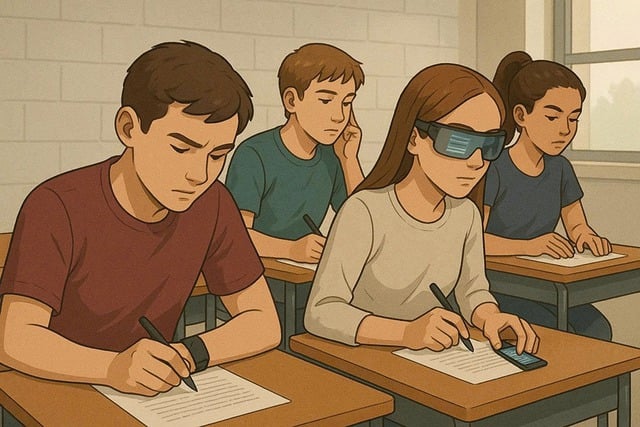
Besides using technological devices, some candidates are now using AI applications to cheat in important exams - PHOTO: CHATGPT
In the aforementioned cases, the police initiated criminal proceedings against the violators because the high school graduation exam questions are classified as "top secret" state secrets.
Speaking at a press conference concluding the 2025 high school graduation exam, Major General Tran Dinh Chung, Deputy Director of the Internal Political Security Department (PA03) under the Ministry of Public Security, affirmed that this exam cheating incident occurred on a small scale and there was no leakage of exam questions. This did not affect the security and safety of the entire exam, General Chung emphasized. He also predicted that the use of AI for cheating will become increasingly sophisticated in the future.
THE MORE AI DEVELOPS, THE MORE AI-BASED FRAUD WILL SPREAD.
A high school student in Ho Chi Minh City, who is entering 12th grade this year, shared that she and her peers are using AI in almost all subjects, especially when searching for information for presentations.
"There are cases where students use AI to cheat on exams, but it's not common, because AI only really helps with theoretical social science subjects, while it often fails to solve or provides many incorrect solutions for natural science subjects," this student recounted, adding, "Therefore, I think that as AI develops, cheating using AI may also spread."
The Ministry of Education and Training could collaborate with AI experts – those who understand the capabilities and limitations of AI – to receive advice on effective exam question design methods in the AI era.
Nguyen Gia Hy, M.Sc., lecturer in AI at Swinburne University (Australia)
According to Major General Tran Dinh Chung, this situation requires comprehensive solutions for prevention and deterrence, such as continuing to apply more advanced technologies to detect cheating using AI or strengthening coordination among all parties. General Chung also suggested that all parties should raise awareness and educate candidates and those involved about the consequences of exam cheating to prevent this problem from the outset.
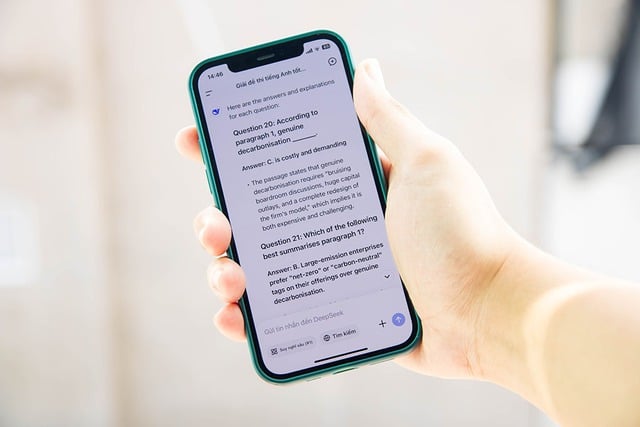
Students use DeepSeek, a popular AI tool from China, to solve English questions for the 2025 high school graduation exam - PHOTO: NGOC LONG
CAN YOU PAUSE OR LIMIT THE FEATURES OF THE TOOL DURING THE EXAM?
Master Bui Manh Hung, founder and CEO of the educational application Aiducation, recounted the story of many Chinese technology companies that temporarily suspended services or restricted certain features of AI-generated tools such as DeepSeek and Doubao... to prevent cheating in the country's university entrance exams.
Therefore, Mr. Hung suggested that Vietnam could implement similar regulations during the high school graduation exam period. This is an effective method because it helps prevent the problem at its root. Mr. Hung added that the Education app temporarily disabled AI features related to problem-solving during the recent high school graduation exam days to prevent the tool from being misused for cheating purposes.
"I hope there will soon be a mechanism for technology companies like ours to coordinate with the Ministry of Education and Training and relevant agencies, so that we can simultaneously suspend the provision of related AI services to ensure the integrity and seriousness of the exam," Hung confided.
However, Nguyen Gia Hy, a lecturer in AI at Swinburne University (Australia) and co-founder and CEO of two AI-focused businesses in Vietnam, SkillPixel and AIFicient, argues that banning highly effective AI tools is only suitable for countries with strong domestic AI products like the US and China. In Vietnam, if PhD candidates want to cheat, they primarily use foreign AI tools rather than domestic ones.
"China implemented this strategy effectively because they blocked almost all American technology products, including ChatGPT. If we block the IP addresses of those tools during the exam, we can better limit cheating, but it will greatly affect other users because they will also be unable to access them. And even with IP blocking, it is still possible to bypass it if candidates use VPN software to change regions," Mr. Hy shared.
Furthermore, if we ask foreign AI companies to disable the homework-solving feature, they are unlikely to do so because it is not under the control of the Vietnamese government, Mr. Hy added.
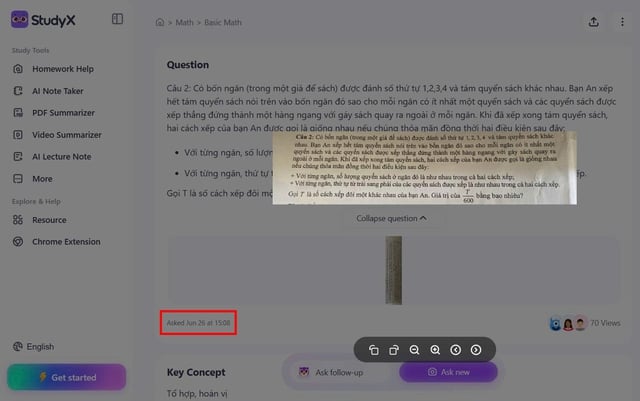
A post on the AI platform StudyX matched a question from the high school graduation math exam on June 26th - PHOTO: SCREENSHOT
CHANGE NEEDS TO START WITH THE EXAM.
Based on the above reality, Master Hy proposed a three-level action model. At the lowest level, which is the awareness of the candidates, we need to strengthen the dissemination and education of ethics when using AI. In addition, we need to define specific penalties and strictly handle cases of cheating using AI to set an example. "While we cannot change the intentions of stubborn candidates who are cheating, for those candidates who are on the verge of violating the rules, thorough dissemination and education will yield great results," Master Hy stated.
The next level involves redesigning the question format, because multiple-choice questions provide "very good conditions" for AI to solve problems with high accuracy. Conversely, if questions are essay-style, analytical, and situational problem-solving, "it will greatly limit the capabilities of AI," Mr. Hy stated. "The Ministry of Education and Training could collaborate with AI experts – those who understand the capabilities and limitations of AI – to receive advice on effective question-setting methods in the age of AI," Mr. Hy suggested.
"At the university where I teach in Australia, students are allowed to take their final exams at home, but they won't get high marks if they use ChatGPT to solve them because the questions are designed to be situational. Students need to thoroughly understand the material and know how to apply the learned content and knowledge to their work. Even with a support tool, students still need to truly understand the material to be able to use the tool effectively," Professor Hy added.
The final level is to enhance monitoring capabilities through technology, because if AI is a tool to facilitate cheating, it can also become a tool to prevent cheating. Pilot testing of intelligent monitoring systems at examination sites is needed, such as AI cameras that can detect unusual behavior of candidates during the exam. This is a very common application in the field of computer vision using AI, according to Master Hy.
Regarding this issue, the aforementioned high school student in Ho Chi Minh City, who is entering 12th grade this year, believes that the proliferation of AI does not necessarily affect the fairness and integrity of the high school graduation exam. During the review process, many teachers have given students "anti-AI" exercises – questions that teachers create themselves or take from unreliable sources that are neither available on the internet nor easy for AI to solve. According to the student, applying these questions in the exam would render the use of AI useless.
The world is grappling with AI-powered fraud.
Vietnam is not alone; developed countries are also facing considerable difficulties in dealing with AI.
A survey by The Guardian published in June revealed that nearly 7,000 university students in the UK were caught cheating using AI, such as ChatGPT, during the 2023-2024 academic year. This means that for every 1,000 students in the UK, there were 5.1 cases of AI-based cheating, a significant increase from the 1.6/1,000 figure in the 2022-2023 academic year.
In Singapore, while there have been cases of students being found to have plagiarized or submitted work generated by AI tools, universities consider this to be a small number and not a widespread phenomenon.
Meanwhile, an investigation by Nikkei Asia revealed that many research papers from 14 universities in countries such as Japan, South Korea, China, and the United States contained hidden prompts so that if AI-generated comments were used, reviewers would receive only positive feedback. These hidden prompts were often highlighted in white or made extremely small so they were invisible to the naked eye.
Source: https://thanhnien.vn/chong-gian-lan-bang-ai-trong-thi-cu-185250710195249068.htm
























































































Comment (0)