The western highland region of the province is entering the peak of the rainy season, which leads to a decrease in sunny days, affecting photosynthesis and the resistance of crops.
Pests and diseases attack many types of crops.
Coffee is the crop most adversely affected by this weather pattern. According to statistics, the entire province has over 106,400 hectares of coffee plants currently in the young fruit development stage. However, approximately 1,163 hectares are currently attacked by mealybugs, with damage rates ranging from 12.5% to 25%, and in some areas reaching up to 50%. In addition, coffee plants are also affected by rust (1,634 hectares) and branch dieback (621 hectares). Severely affected areas include: Kbang, Ia Grai, Chu Se, Duc Co, Ia Hrung…
Mr. Bui Trung Hung (Tan An village, Ia Hrung commune) shared: “My 3-hectare coffee garden is bearing young fruit, but due to prolonged rain, the trees are showing many diseases such as whiteflies, branch dieback, rust… I have pruned diseased branches, used biological products and applied balanced fertilizer to maintain stable yields.”
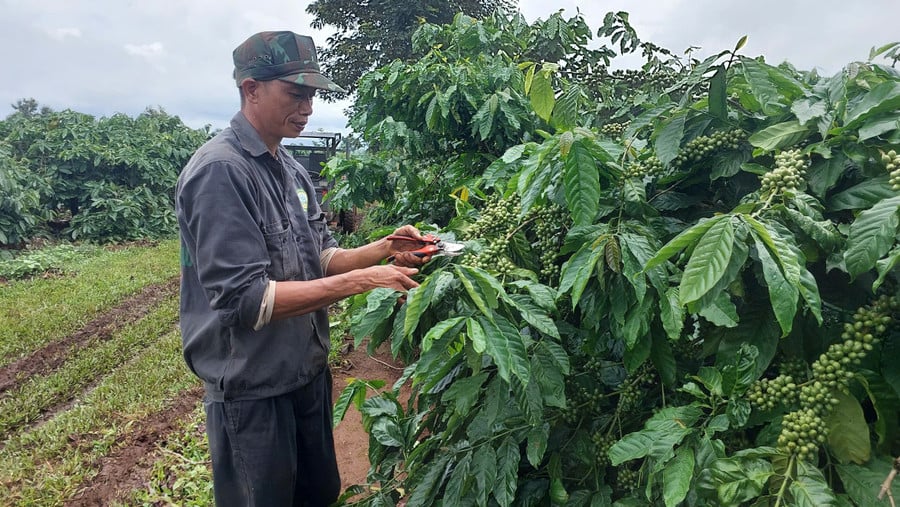
Mr. Bui Trung Hung (Tan An village, Ia Hrung commune) prunes diseased coffee branches. Photo: Nguyen Diep
Several communes with high pepper cultivation, such as Mang Yang, Duc Co, and Chu Puh, have also experienced slow wilting yellow leaf disease, affecting 5-10% of their crops. An estimated 391 hectares of pepper plants are infected, with 125 hectares lightly infected, 166 hectares moderately infected, and 100 hectares severely infected. Meanwhile, passion fruit plants are also showing signs of viral disease, affecting 5-17% of their crops, with approximately 8 hectares infected, mainly in Duc Co commune. In addition, brown spot disease, downy mildew, and thrips are causing localized damage.
In the eastern plains of the province, the prolonged hot weather has made the autumn and summer rice crops susceptible to stem borers, leaf rollers, and brown spot disease. The province has over 36,200 hectares of autumn rice and 41,900 hectares of summer rice. Brown spot disease alone has appeared on over 20 hectares of autumn rice in the heading-milk stage, with a damage rate of 10-20%. In addition, leaf rollers, root rot, thrips, brown spot disease, etc., are causing localized damage to summer rice in the 3-leaf stage; and grain discoloration disease is causing localized damage to autumn rice in the heading-green grain stage in Bong Son, Hoai Nhon Tay, and Hoai Nhon Nam wards.
In addition, peanuts were affected by leaf spot disease (9 ha), cassava by red spider mites, and vegetables by armyworms and flea beetles... were also recorded in many communes such as Hoai Nhon Tay, Cat Tien, De Gi...
Proactive monitoring and pest control
Mr. Tran Van Dang, the officer in charge of the Crop Cultivation and Plant Protection Station in Area 8, said: The area under the station's management includes communes in the western highlands of the province, which currently have a large area planted with long-term industrial crops such as coffee, pepper, and durian. Coffee alone covers 32,100 hectares, of which about 26,100 hectares are in the production stage and ready for harvest. Currently, coffee plants are showing signs of some pests and diseases such as green scale insects, rust, branch dieback, and premature fruit drop. However, the level of damage remains mild to moderate.
“The station regularly sends technical staff to monitor the fields and guide people on appropriate pest control methods for each stage. We encourage the use of biological products and balanced fertilization, instead of overusing chemical pesticides,” Mr. Dang emphasized.
According to Mr. Kieu Van Cang, Deputy Head of the Department of Crop Production and Plant Protection, the unit has directed the stations to coordinate with the People's Committees of communes and wards to inspect, forecast pests and diseases, and guide appropriate control measures.
"People should apply integrated pest management (IPM) measures, produce safe vegetables according to VietGAP procedures, prioritize the use of biological and herbal pesticides, and adhere to the quarantine period," Mr. Cang advised.
The Department of Crop Production and Plant Protection forecasts that pest and disease outbreaks will continue to intensify in the coming period. Rice crops are at risk of the appearance of the two-spotted stem borer, brown spot disease, root rot, grain discoloration, nematodes, etc. On coffee plants, mealybugs, rust, and premature fruit drop will continue to cause damage. In addition, vegetables and short-term industrial crops are also affected by diseases such as powdery mildew, anthracnose, and root rot.
To protect crops, specialized agencies recommend that farmers increase field and garden inspections, monitor weather developments, apply biological control measures, and combine this with technical guidance from experts to handle problems promptly and effectively. For example, on coffee plants, farmers need to prune branches to create a well-ventilated canopy, collect diseased branches from the garden for disposal, and reduce the accumulation of harmful substances. Regularly inspect the orchards, monitor the emergence and damage caused by pests and diseases to manage and control them promptly.
Source: https://baogialai.com.vn/chu-dong-phong-tru-sau-benh-cho-cay-trong-post560605.html





























































![[Video] Sunset at Lap An Lagoon – Where the sun sets over the fishing nets](https://vphoto.vietnam.vn/thumb/1200x675/vietnam/resource/IMAGE/2026/05/31/1780192137701_beach-landscape-sea-water-nature-grass-745871-pxhere-com.jpeg)



































Comment (0)