(CMO) If Hue has the Perfume River winding through the romantic city, and the majestic Ngu Binh Mountain acting as a screen protecting this peaceful land, then a spiritual destination that cannot be overlooked is Linh Mu Pagoda (on Ha Khe hill, next to the Perfume River), a unique highlight of this dreamy land.
Báo Cà Mau•17/08/2023
Legend has it that when Lord Nguyen Hoang became the governor of Thuan Hoa and Quang Nam, he personally surveyed the terrain to prepare for expanding his kingdom and establishing a future empire for the Nguyen dynasty. During one of his horseback rides along the Perfume River upstream, he encountered a small hill rising beside the winding, clear waters. The land resembled a dragon turning its head to look back; this hill was named Ha Khe Hill.
Local people say that at night, an old woman wearing a red áo (traditional Vietnamese tunic) and green trousers often appears on the hill and tells everyone: "Soon, a true ruler will come to build a temple here to gather spiritual energy, strengthen the dragon vein, and make Vietnam strong." Therefore, this place is also known as Thien Mu Mountain.
Lord Nguyen Hoang was overjoyed, and in 1601 he ordered the construction of a pagoda on the hill, facing the Perfume River, and named it "Thien Mu Pagoda".
Also, due to superstitions, from the year of Nhâm Tuất (1862) to the year of Kỷ Tỵ (1869) during the reign of Emperor Tự Đức, in order to pray for an heir, the Emperor feared that the word "Thiên" (Heaven) would offend Heaven, so he changed the name from "Thiên Mụ" to "Linh Mụ" (or "Sacred Midwife"). These two names have remained until today. This is also one of the oldest temples in the ancient capital.
One iconic symbol associated with Linh Mu Pagoda is the Phuoc Duyen Tower. The tower, 21 meters high and comprising seven stories, is located in front of the pagoda. Each story houses a Buddha statue. Inside, a spiral staircase leads to the top floor, where a golden Buddha statue was formerly enshrined.
Besides the Phuoc Duyen Tower, Linh Mu Pagoda also features architectural structures such as the Dai Hung Hall, the Dia Tang Hall, the Quan Am Hall... along with stone steles and bronze bells. Furthermore, the pagoda is home to many valuable historical and artistic artifacts. Statues of the Guardian Deities, the Ten Kings, the Maitreya Buddha, the Three Buddhas... and the horizontal plaques and couplets here all bear witness to the golden periods of Linh Mu Pagoda's history.
"The wind sways the bamboo branches gently."
"The bells of Linh Mu Pagoda, the rooster's crow at Tho Xuong"
When you come to Hue , be sure to visit Linh Mu Pagoda to immerse yourself in the elegant scenery of this Buddhist sanctuary, and let your body and mind find peace after months of hustle and bustle in your daily life...
The triple-arched gate leads into Linh Mu Pagoda.
The Phước Duyên Tower, a symbol of Linh Mụ Pagoda, is seven stories high and is located within the pagoda grounds on a small hill called Hà Khê.
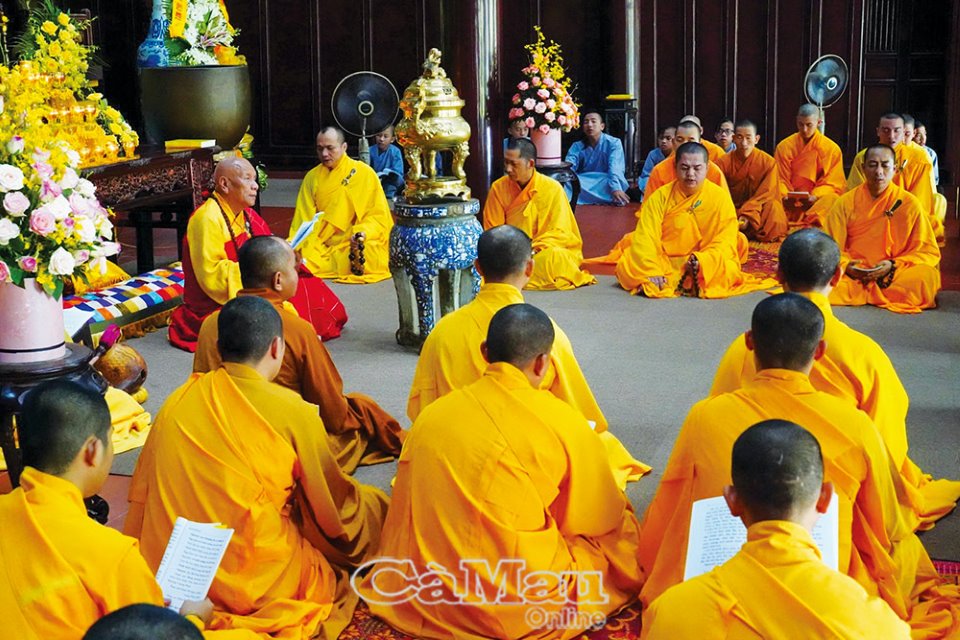
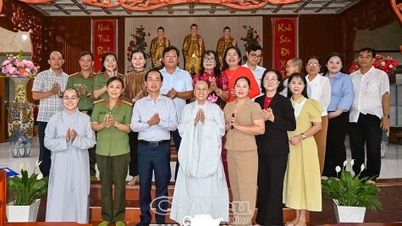
Images of the monks of Linh Mu Pagoda during their daily Buddhist activities.




![[Photo] Ba Lang An Lighthouse - the "eye of the sea" amidst the "rock museum" of Quang Ngai province.](https://vphoto.vietnam.vn/thumb/1200x675/vietnam/resource/IMAGE/2026/05/29/1780038698840_anh-man-hinh-2026-05-29-luc-14-10-42.png)

![[Image] Pleasant weather helps students enter the 10th grade entrance exam with confidence.](https://vphoto.vietnam.vn/thumb/1200x675/vietnam/resource/IMAGE/2026/05/29/1780034401612_ngay-1-thi-lop-10-minh-duy-8-5009-jpg.webp)
















































































Comment (0)