

Exports of agricultural, forestry, and aquatic products have always been a bright spot in Vietnam's economic picture. In the first nine months of 2024, the total export value of these items reached US$46.28 billion, an increase of 21%; the trade surplus reached US$13.86 billion, an increase of 71.2% compared to the same period in 2023.
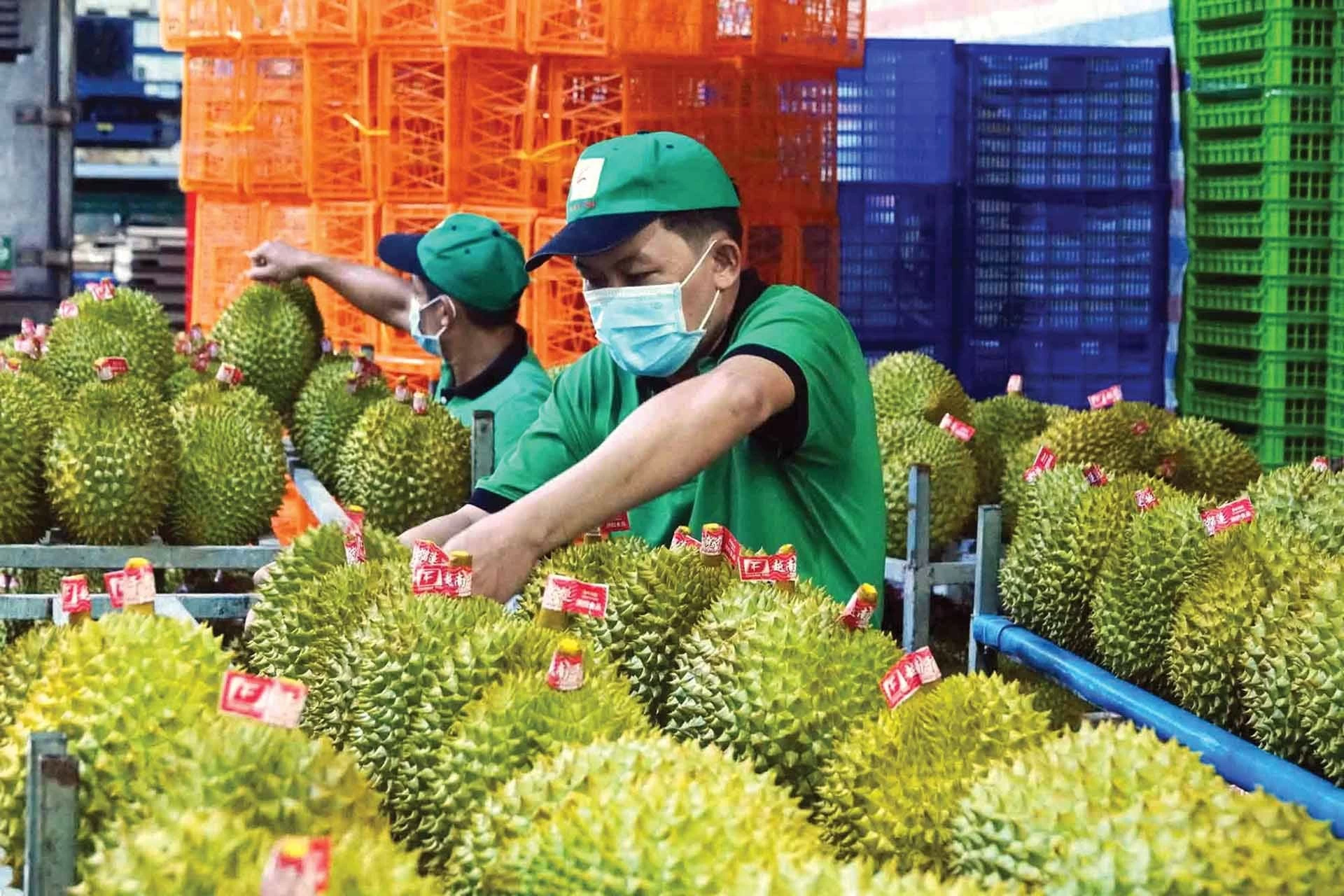 |
| Durian is one of Vietnam's key agricultural exports. (Photo: Dao Ngoc Thach) |
As a pillar of the economy, agricultural exports bring Vietnam more than 50 billion USD annually. This year, with exports of key products higher than last year, the entire sector has strong momentum to soon achieve the assigned target of 54-55 billion USD.
Impressive numbers
According to data from the Ministry of Agriculture and Rural Development (MARD), in the first nine months of 2024, agricultural exports continued to recover and grow impressively, making a positive contribution to the trade surplus. Total export turnover of agricultural, forestry and fisheries products reached US$46.28 billion, an increase of 21%; imports totaled US$32.42 billion, an increase of 7.5%. The trade surplus in agricultural, forestry and fisheries products reached US$13.86 billion, an increase of 71.2%.
Export turnover of key commodities was higher than the same period last year, including: wood and wood products at US$11.66 billion, up 21.3%; coffee at US$4.37 billion, up 39.6%; rice at US$4.37 billion, up 23.5%; cashew nuts at US$3.17 billion, up 22.5%; fruits and vegetables at US$5.87 billion, up 39.4%; shrimp at US$2.79 billion, up 10.5%; pangasius at US$1.36 billion, up 7.8%; pepper at US$1 billion, up 46.9%...
In particular, the average export price of coffee increased the most, by 56% to reach US$3,897/ton; followed by pepper with a 49.2% increase to US$4,941/ton; then rubber with a 19% increase, and rice with a 13.1% increase… Even more impressive is that in September 2024, fruit and vegetable exports reached US$1.2 billion, a sharp increase of 72.5% compared to the same period last year. This is the first time the fruit and vegetable sector has recorded a monthly export value exceeding US$1 billion, bringing the export value of fruits and vegetables in the first nine months of this year to equal the export value for the whole year of 2023.
Moreover, the value of agricultural exports to various markets has grown significantly: Asia increased by 17.4%; the Americas by 26.1%; Europe by 34.6%; and Oceania by 16.1%. Markets such as China, the US, the Philippines, Japan, and South Korea have all increased their purchases of Vietnamese agricultural products.
Multiple export drivers
According to experts and industry associations, these results were achieved thanks to a series of effective solutions that created momentum to boost exports.
Firstly, Vietnam implements 16 free trade agreements (FTAs), creating huge opportunities for the export of goods in general and agricultural products in particular. Especially, thanks to taking advantage of the opportunities and tariff benefits from the Comprehensive and Progressive Trans-Pacific Partnership (CPTPP) and the Vietnam-EU FTA (EVFTA), our country's agricultural exports have grown strongly.
Secondly, as of September 2024, localities have established and issued 7,639 planting area codes in 56 localities and 1,557 packaging facility codes authorized for export to China, the US, Australia, New Zealand, South Korea, Japan, the European Union (EU), etc., contributing to orienting production according to market demand and enhancing the reputation of Vietnamese agricultural products.
Thirdly, the approval and implementation of the plan to promote the export of agricultural, forestry, and aquatic products to major markets such as the US, China, Japan, and the EU... from the end of 2023, combined with the implementation of solutions to open markets and seek new orders in 2024, has been effective.
Fourth, during the State visit of General Secretary and President To Lam to China (August 2024), the Ministry of Agriculture and Rural Development and the General Administration of Customs of China signed three protocols: plant quarantine and food safety inspection for exported frozen durian; plant quarantine requirements for exported fresh coconuts; and quarantine and health requirements for farmed crocodiles... This is expected to further facilitate Vietnamese agricultural products' access to the market of the world's second largest economy.
Secondly, also in August 2024, Vietnam reached an agreement for passion fruit imports into the United States. The two countries initiated a review process for new Vietnamese products, including seedless lemons, guavas, jackfruit, tangerines, plums, yellow lemons, pomegranates, and several other products for use as plant varieties by the US side. The US Department of Agriculture stated that it has not had such close cooperation with any other partner in the region.
Aiming for a new record
As a tropical monsoon country, Vietnam harvests agricultural products year-round. However, according to experts, exporting these goods currently faces many challenges such as: increasingly stringent quality and origin requirements from importing markets; negative impacts of epidemics, trade conflicts, geopolitical conflicts, and protectionist trends…
Deputy Minister of Agriculture and Rural Development Phung Duc Tien noted that in recent times, storms and natural disasters have caused significant damage to the agricultural sector, leading to a decrease in raw material supplies while sea freight costs continue to rise. He predicted that climate change will not only cause extreme weather events such as hailstorms, droughts, and floods, but will also severely impact agriculture, reducing arable land, decreasing quality and yield, and potentially even causing crop failures.
On the other hand, in the context of sustainable development, major export markets such as the US, Japan, and the EU require exported agricultural products to meet standards for reducing carbon emissions and protecting the environment.
All of the above factors highlight the need to find solutions to ensure Vietnam's agricultural exports maintain growth while continuing to set record figures.
In an interview with the World and Vietnam Newspaper, economist Dr. Nguyen Minh Phong stated that Vietnam currently exports raw agricultural products with low processing levels, accounting for approximately 70-80% of total export value, thus lacking significant value and competitiveness. Therefore, to attract more foreign currency, the agricultural sector urgently needs to shift from exporting raw products to increasing the proportion of processed products.
To achieve this, according to Dr. Nguyen Minh Phong, the State needs to continue implementing current policies to support businesses in applying science and technology in agriculture, attract investment to develop the food processing industry; and encourage businesses to invest in deep processing to enhance value and quality. In addition, businesses need to invest in improving and upgrading existing processing plants, upgrading technology to ensure food quality and safety; and building storage systems that meet the requirements of the supply chain, ensuring the maintenance of product quality…
Meanwhile, Deputy Minister Phung Duc Tien recommended that businesses with advanced processing capabilities should focus on building brands so that Vietnamese agricultural products truly have value in the international market; promote trade and introduce advantageous agricultural products; and continue to promote the restructuring of the agricultural sector according to the set strategy.
To access and maintain access to demanding markets, exported goods, especially agricultural products, must meet standards regarding origin and quality. Therefore, Dr. Nguyen Minh Phong emphasized the importance of meeting food safety and hygiene requirements and overcoming technical barriers. “Proactively meeting the requirements of all markets is crucial. In the context of a volatile global economy, relying on a few specific markets is very risky. Therefore, Vietnamese agricultural products need to improve their quality so that if one market fluctuates or other markets emerge, we can adapt to sell our products and achieve sustainable growth,” said Dr. Phong.
Only by improving quality can agricultural products "open the door" to new, potentially lucrative markets such as the Middle East, Africa, Islamic countries, and Halal markets.
Ultimately, developing green agriculture is an inevitable trend and a mandatory requirement in the current context of international integration. Experts affirm that, from now on, people and businesses need to continue shifting from developing agricultural supply chains to developing value chains for agricultural products and developing green agriculture in order to keep pace with the consumption trends of the global market.
Source: https://baoquocte.vn/con-duong-mo-ra-canh-cua-moi-cho-nong-san-289682.html



![[Image] Hanoi's urban life under the challenge of a "scorching hot" environment](https://vphoto.vietnam.vn/thumb/1200x675/vietnam/resource/IMAGE/2026/05/25/1779706979265_nang-nong-t5-2026-minh-duy-7-4636-jpg.webp)
![[Image] Close-up view of the interchange connecting the two expressways and Long Thanh Airport.](https://vphoto.vietnam.vn/thumb/1200x675/vietnam/resource/IMAGE/2026/05/25/1779703378210_ndo_br_z7863716673926-224453a31600126cce10622af6290afd-4549-jpg.webp)




















































































Comment (0)