

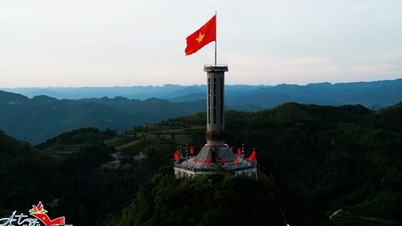
The Lung Cu Flagpole is located at an altitude of nearly 1,500m above sea level, about 3.3km as the crow flies from the northernmost point of Vietnam, and 24km from Dong Van town. (Photo: Thanh Dat/VNA)
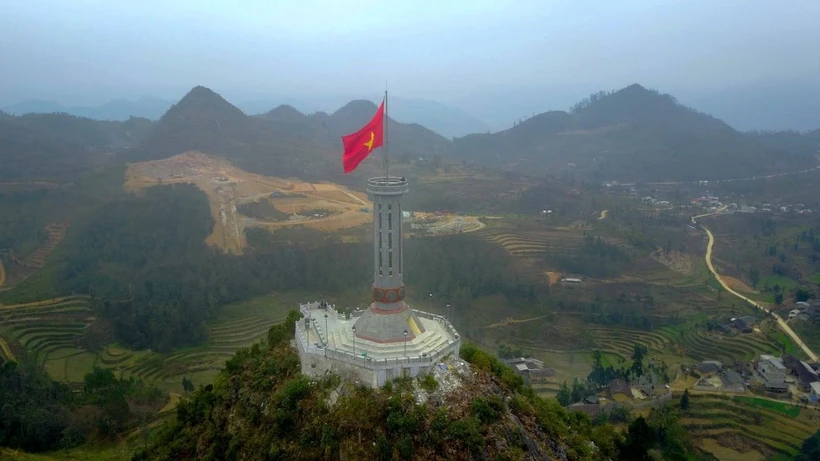
Standing majestically atop Dragon Mountain, amidst the vast, jagged limestone mountains of the Dong Van Plateau ( Ha Giang ), the Lung Cu National Flagpole is not only the sacred northernmost point of the Fatherland, but also a heroic symbol of national sovereignty.
Here, the red flag with a yellow star flutters proudly in the mountain breeze, marking the countless generations of Vietnamese people who have shed sweat and blood to preserve every inch of land left behind by their ancestors.
Flagpole - A symbol affirming sovereignty
Lung Cu – a name deeply etched in the hearts of every Vietnamese person – carries within it many poetic legends.
There is a theory that "Lung Cu" is a corrupted form of "Long Cu," meaning "the place where the Dragon resides." The highest peak in this area is called Dragon Mountain, evoking a sacred image between heaven and earth.
Another interpretation, according to the Hmong language, is that "Lung Cu" means "Corn Valley," because this place was once a lush, fertile cornfield.
There is also a legend that says Lung Cu is the name of a Lo Lo leader who played a key role in reclaiming and protecting this borderland for generations.
Locals pass down a touching story about the "Dragon's Eyes." Before ascending to heaven, the celestial dragon, moved by the villagers' lack of water, left behind its eyes, which transformed into two freshwater lakes on the mountainside – one in the Then Pa village of the Hmong people, and the other in the Lo Lo village. No matter how harsh the dry season, these two lakes never dry up, becoming a source of life for generations of highland inhabitants.
According to historical records, the Lung Cu Flagpole is believed to date back to the Ly Dynasty, when Grand Marshal Ly Thuong Kiet led his troops to defend the border and planted a flag to assert sovereignty on the summit of Dragon Mountain.
During the Tay Son dynasty, King Quang Trung ordered the construction of guard posts and the beating of bronze drums at each watch to affirm that the land and sky were being guarded.
In 1887, the French colonialists and the Qing dynasty attempted to seize Lung Cu, but thanks to the unwavering resistance of the people, that sacred land proudly remained part of Vietnam.
In 1978, the Lung Cu People's Armed Police Station (now the Lung Cu Border Guard Station) erected its first flagpole, made of cypress wood, 12 meters high, and hoisted a 1.2 square meter flag.
By 2000, the Ha Giang provincial government built a sturdy concrete flagpole, and in 2010, the structure was fully restored to a total height of 34.85m, modeled after the Hanoi Flagpole.
Lieutenant Colonel Kim Xuan Giang, Commander of the Lung Cu Border Guard Station, shared that every officer and soldier here understands that maintaining border sovereignty is not just about weapons and bullets, but also about their hearts and love for the country. The flag atop Lung Cu is a source of pride and a constant reminder to every border guard officer and soldier of their sacred responsibility to every inch of their homeland.
The flagpole's shaft is octagonal, adorned with eight bronze drum faces and eight blue stone reliefs depicting periods of national history and the unique cultural life of the ethnic groups in Ha Giang. To reach the flagpole, visitors must climb 839 steps divided into three stages.
At the summit, a 54-square-meter red flag with a yellow star, symbolizing the 54 ethnic groups of Vietnam, flies proudly against the deep blue sky, a powerful declaration of an independent, unified, and enduring Vietnam.
During a visit to his roots and the reception of the national flag hoisted at the Lung Cu National Flagpole for display in the school's traditional hall, Professor, Dr. Tran Thanh Hai, Rector of Hanoi University of Mining and Geology, could not hide his emotion upon witnessing the red flag with a yellow star fluttering in the borderland amidst the stirring national anthem.
“The moment the flag was raised, I felt an overwhelming sense of sacredness. In this sacred space at the northernmost point of the country, all everyday worries seemed to vanish, leaving only pride and profound love for our beloved Vietnam,” said Professor, Dr. Tran Thanh Hai.
Cherry blossom trees are in full bloom at the foot of the Lung Cu flagpole, Ha Giang. (Photo: Khanh Hoa/TTXVN)
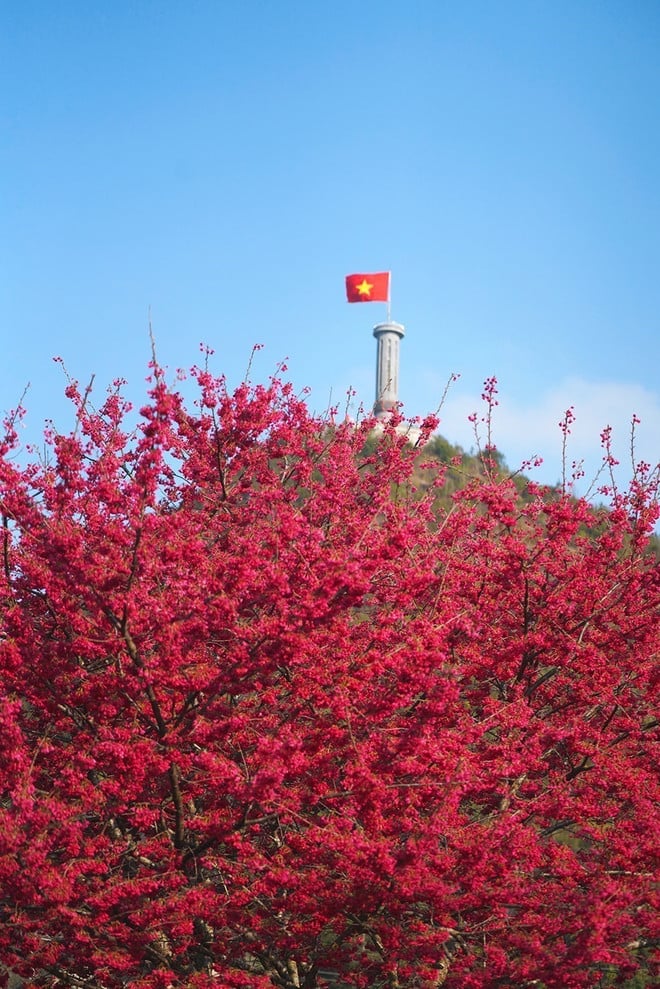
For travelers from afar, the journey to Lung Cu is not just a trip, but also a journey to discover their national identity.
Ms. Nguyen Thi Mai Huong, a tourist from Ca Mau province, shared: "I traveled nearly 2,500km to stand here – the northernmost point of the country. When I looked up and saw the red flag with a yellow star flying atop the mountain, I truly felt a sense of calm. It's so far away, yet so strangely close."
One destination - One source of pride
The Lung Cu flagpole is not only a tourist attraction but also a sacred place that many Vietnamese people long to visit at least once. At the foot of the flagpole is the Memorial House, which preserves traditional artifacts of the local people. Not far away is the Lung Cu Border Guard Station, the "gatekeeper" of the nation's frontier, guarding the border day and night.
The flag atop the flagpole is replaced every 7 to 10 days to ensure it's always fresh, as the winds in the Arctic are very strong. For each border guard officer and soldier, it's not simply a duty, but a solemn ceremony, embodying patriotism, faith, and the aspiration to protect the nation.
On November 18, 2009, the Lung Cu Flagpole was classified by the Ministry of Culture, Sports and Tourism as a national historical and scenic site – a testament to the enduring historical, cultural, and spiritual value of this sacred symbol at the northernmost point of the country.
With its strong appeal stemming from its majestic beauty and profound historical value, the number of tourists visiting Ha Giang has been increasing rapidly year after year.
At the Lung Cu National Flagpole alone, hundreds of domestic and international tourists visit every day. The elderly, children, students, veterans, and international friends all come here to listen to the heartbeat of the sacred land, to better understand the meaning of the word "Homeland" amidst the vast, windswept landscape.
Source: https://baobinhphuoc.com.vn/news/20/171763/cot-co-quoc-gia-lung-cu-noi-non-song-gui-tron-hon-thieng-dan-toc


































































Comment (0)