

This is the first time I've heard of Hai Phong's famous rice porridge.
We arrived in Hai Phong as dusk was falling, and asked the driver to find a Hai Phong crab noodle soup restaurant to enjoy. He said crab noodle soup is delicious at lunchtime, but since it had just rained and stormed, it was late afternoon, so enjoying Hai Phong's "chao khoai" (a type of Vietnamese porridge) would be more appropriate; it was... delightful...
The whole group was excited about this unusual dish, having never heard of "cháo khoái" before. The car turned into a market called Lạc Viên. Stepping out, they were greeted by the fragrant aroma of fried onions. Looking around, they saw an elderly woman with silver hair stirring a pot of bubbling porridge with a wooden ladle. Interestingly, the porridge was a beautiful emerald green color. Nearby, parents dropping off their children at school and young men and women were slurping up bowls of hot porridge.
Spider Lily – its feng shui meaning and the story between life and death . READ NOW
Seeing our group enter, the old woman greeted us warmly, but her hands were still nimbly stirring and scooping porridge into bowls, sprinkling a few mung bean balls, adding a layer of golden fried onions... the aroma wafted up, captivating the senses, a delicious and warm feeling from the tip of the tongue to the stomach and spreading throughout the body, without needing meat or fish.
People in Hai Phong are proud of their signature, rustic "cháo khoái" (a type of porridge). Hai Phong's delicious "cháo khoái" embodies purity, refinement, and the heartfelt dedication of the cook. Originally a simple afternoon snack, this porridge has become a symbol of tranquility and simple joy in the culinary traditions of the port city, a cherished memory for Hai Phong residents living far from home.
It is known that one bowl of Hai Phong-style rice porridge (about 350ml) provides approximately 320–350 kcal, is rich in protein, fiber, B vitamins, calcium, zinc, and iron – very good for digestion, easy on the stomach yet still provides enough energy – truly deserving of the saying "eating this bowl of porridge will make you feel instantly delighted".
The woman selling the porridge also chimed in, saying that besides the traditional way of cooking Hai Phong's "khoai" porridge, there's now a "modern version" – so that anyone far from home can cook it and enjoy it from the very first spoonful.
Hai Phong's "Cháo Khoái" (a type of Vietnamese porridge) bears a simple yet evocative name, deeply connected to the port city for generations. The smooth, green porridge, combined with bone broth, mung beans, and fried onions, is simple yet refined and pure; once you've tasted it, you'll remember it forever.
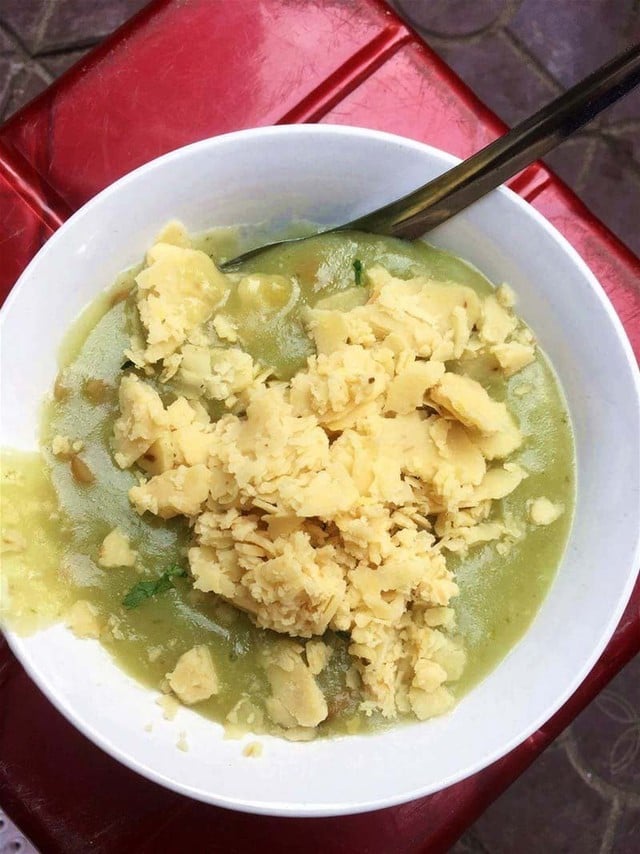
Hai Phong's "Khoai" porridge has a distinctive green color compared to other types of porridge. (Image from the internet)
Distinguishing between "cháo khoái" and other types of porridge
Unlike regular porridge made with whole grains of rice, "cháo khoái" uses finely ground rice flour (usually a mixture of white rice and glutinous rice). The broth is made from simmered bones and green vegetable broth (made from water spinach, pandan leaves, or spinach) to give the porridge a light jade green color, a thick and smooth consistency, and no lumps of rice grains.
On top of the porridge, they sprinkle "mung bean balls"—made from steamed mung beans, mashed, molded, and thinly sliced—along with crispy fried onions. That's all, but when a spoonful of porridge touches your lips, the delicate sweetness of the bone broth, the nutty flavor of the mung beans, the aroma of the fried onions, and the coolness of the greens blend together, creating a smooth, pleasant, and... delightful sensation, just like its name suggests.
Compared to other types of porridge, "cháo khoái" has some notable differences, such as the following:
| Criteria | Porridge | Regular porridge |
|---|---|---|
| Main ingredients | Finely ground rice flour (can be a mixture of glutinous rice and regular rice) | Whole grain rice (white rice or glutinous rice, depending on the type of porridge) |
| Cooking method | Mix the flour with the bone broth, stirring well to prevent lumps. | Rice and water, boil until the rice is soft and tender. |
| Smooth and creamy consistency | Thick, smooth, grain-free, and with a "seamless" texture. | The rice grains are cooked until soft, but the grains are still visible. |
| Color | The light green color (from spinach or pandan leaves) is obtained when vegetable juice is added to the porridge just before it's cooked. | White or off-white in color, depending on the type of rice and broth. |
| Taste & Aroma | The delicate sweetness from the bone broth, the nutty flavor of mung beans, the aroma of fried onions, and a hint of fresh greens. | The dominant flavor is sweet or savory, depending on the type of porridge (chicken porridge, fish porridge, etc.). |
| Garnish & Serve | It contains sliced mung beans and fried onions. | Meat, fish, herbs, onions, pepper, etc., are usually added, but the characteristic "mung bean paste" of Chao Khoai is absent. |
Because it uses flour and vegetable juice to create the color, the "cháo khoái" (a type of Vietnamese porridge) has an unusual light green hue, and because there are no coarse rice grains, you can clearly feel its smooth, seamless consistency when eating it. The characteristic flavor of "cháo khoái" is subtly sweet, nutty, and fragrant with the aroma of onions; a spoonful glides smoothly down the esophagus, leaving a pleasant, light, and refreshing aftertaste.
How to cook Hai Phong-style rice porridge
"Cháo khoái" – eating it is a joy, it's about living and enjoying every moment. Cháo khoái is also a culinary cultural feature of Hai Phong people: pure yet rich, simple yet sophisticated, from ingredients to presentation.
Ingredients for making authentic Hai Phong-style rice porridge.
(Serves 4–5 people)
Pork bones or ribs: 800g

A dark spot, shortness of breath... these can all signal where toxins are accumulating in the body, and how to detoxify through diet. READ NOW
Debunking the 'flirtatious' stereotype of jasmine and revealing its special spiritual and feng shui significance . READ NOW
White rice: 100g
Glutinous rice: 150g
Hulled mung beans: 250g
Sweet potato leaves (or fresh pandan leaves): 150g
5 dried shallots, salt, seasoning powder, fish sauce, pepper, cooking oil, green onions.
How to cook rice porridge
Step 1 – Boil the bone broth
Blanch the bones briefly, then simmer for 45 minutes with 1.5 liters of water. Skim off the foam while simmering to obtain a clear broth.
Step 2 – Make the green vegetable juice
Blend spinach (or other vegetables) with water, strain to obtain 150ml of dark green juice - set aside to add to the porridge when it's almost cooked.
Step 3 – Prepare the mung beans
Soak for 2 hours, steam until cooked, mash thoroughly, form into a ball, then slice thinly.
Step 4 – Mix the rice flour for making porridge.
Grind glutinous rice and regular rice together with 700ml of water, let it settle for 30 minutes, then strain to obtain the thick paste.
Step 5 – Cook the porridge
Bring the bone broth to a boil, stirring constantly as you add the flour. Simmer over low heat for about 20 minutes until thickened. Add the vegetable broth, season with salt, seasoning powder, and fish sauce. Stir gently for 5 minutes, then turn off the heat.
Step 6 – Flight
Thinly sliced dried onions are fried until golden brown in cooking oil.
Ladle the porridge into a bowl, sprinkle with mung beans, fried onions, pepper, and scallions. Serve hot; the porridge is smooth like velvet, with a delicate aroma.
Hai Phong's simple yet heartwarming "khoai" porridge is truly comforting – each drop embodies the warmth of the Hai Phong people, their refined taste, skillful cooking, and simple joys of life. The name "khoai" (meaning "joyful" or "happy") serves as a reminder: live happily, eat healthily, and find joy in the little things in life.
Tips
Using freshly ground flour makes the porridge smoother and naturally sweeter.
Don't add water to vegetables too early to preserve their vibrant color.
You can add minced shrimp, lean meat, or pork ribs for extra flavor.
Source: https://giadinh.suckhoedoisong.vn/dac-san-chao-khoai-hai-phong-and-the-differences-with-common-porridge-172251019161806438.htm
![[Photo] Closing Ceremony of the 10th Session of the 15th National Assembly](/_next/image?url=https%3A%2F%2Fvphoto.vietnam.vn%2Fthumb%2F1200x675%2Fvietnam%2Fresource%2FIMAGE%2F2025%2F12%2F11%2F1765448959967_image-1437-jpg.webp&w=3840&q=75)
![[Photo] Prime Minister Pham Minh Chinh holds a phone call with the CEO of Russia's Rosatom Corporation.](/_next/image?url=https%3A%2F%2Fvphoto.vietnam.vn%2Fthumb%2F1200x675%2Fvietnam%2Fresource%2FIMAGE%2F2025%2F12%2F11%2F1765464552365_dsc-5295-jpg.webp&w=3840&q=75)































![[OFFICIAL] MISA GROUP ANNOUNCES ITS PIONEERING BRAND POSITIONING IN BUILDING AGENTIC AI FOR BUSINESSES, HOUSEHOLDS, AND THE GOVERNMENT](https://vphoto.vietnam.vn/thumb/402x226/vietnam/resource/IMAGE/2025/12/11/1765444754256_agentic-ai_postfb-scaled.png)


















































Comment (0)