

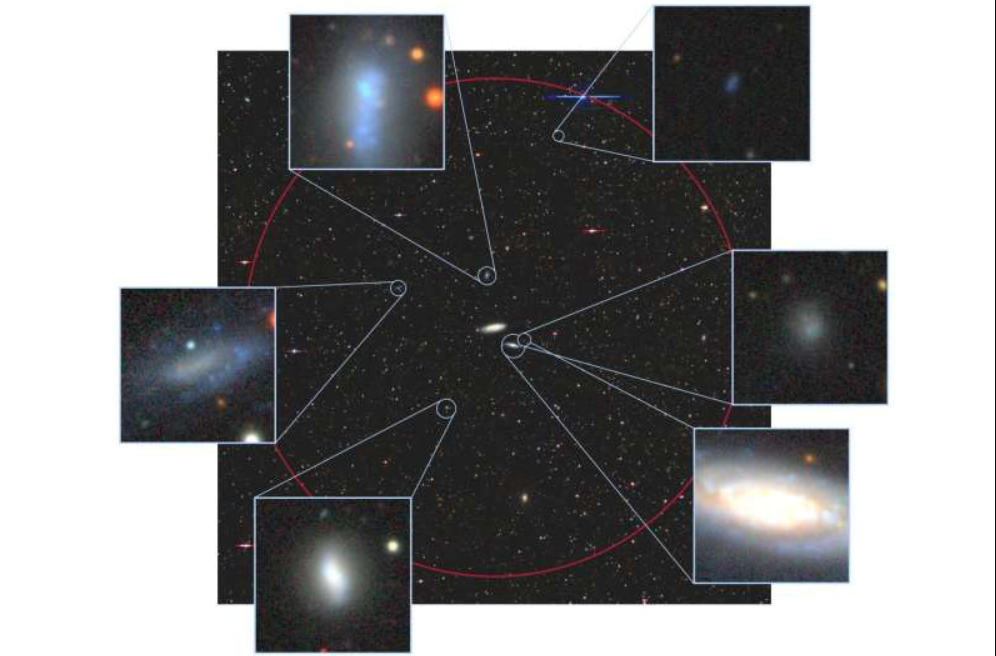
An image of a galaxy such as the Milky Way and its satellites.
To achieve this, experts launched research projects called Surveys of Satellites Around Similar Galaxies (SAGA). Over the past period, the research team has conducted a review of 101 satellite galaxy systems similar to that of the Milky Way.
Now, they have published three reports on the arXiv portal, providing new insights into the uniqueness of the Milky Way.
Satellite galaxies are smaller galaxies in terms of mass and size, while orbiting a larger galaxy, often referred to as the host galaxy. Like satellites in Earth's orbit, these satellite galaxies are influenced by the gravitational pull and dark matter coming from the host galaxy.
The Milky Way itself is the host galaxy with several satellite galaxies. The two largest members of these are the Small Magellanic Cloud (SMC) and the Large Magellanic Cloud (LMC).
The goal of the SAGA Survey is to identify the characteristics of satellites orbiting host galaxies that have the same stellar mass as the Milky Way.
The co-authors of the report are Yao-Yuan Mao of the University of Utah, Marla Geha of Yale University, and Risa Wechsler of Stanford University (all American universities).
In particular, expert Mao is the main author of the first of three reports prepared for publication in the Astrophysical Journal.
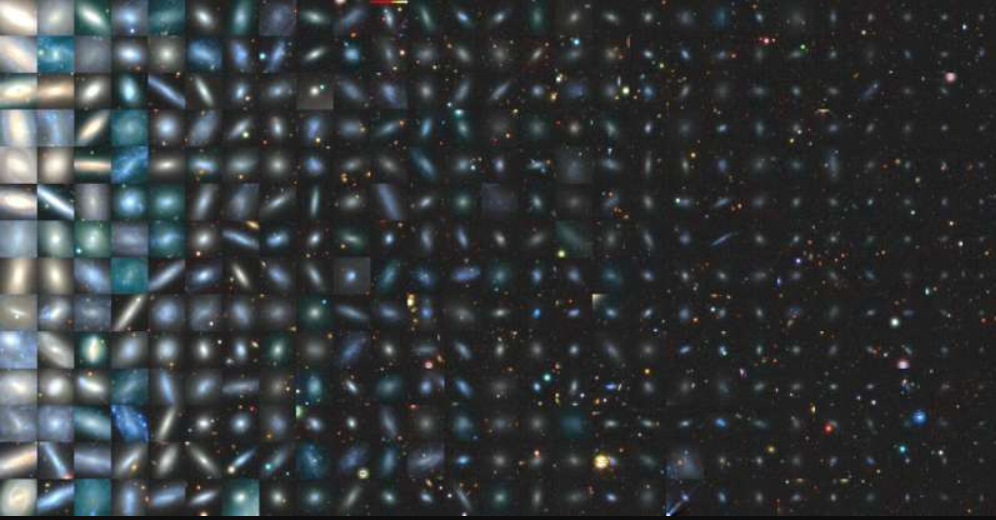
Composite image of 378 galaxies similar to the Milky Way.
An exceptional galaxy?
In the first report, led by expert Mao, the researchers focused on 378 satellite galaxies identified across 101 galactic systems with masses similar to the Milky Way.
The number of confirmed satellites ranges from 0 to 13, compared to 4 satellites in the Milky Way.
"The Milky Way appears to have fewer satellite galaxies," according to expert Mao. The SAGA survey found that galactic systems with giant satellites like the LMC tend to have a higher total number of satellites, while the Milky Way is a complete exception.
The explanation for this difference between the Milky Way and the SAGA systems is that the Milky Way "acquired" the LMC and SMC more recently, compared to the age of the universe.
The portrait of the "gentle giant" black hole in the Milky Way galaxy has been revealed.
Why did the galaxy stop making stars?
The second report, led by expert Geha, aims to investigate whether satellite galaxies still possess the capacity to create stars. Understanding the mechanisms that prevent star formation in satellites will be a crucial question in the field of galactic evolution.
For example, researchers have found that satellite galaxies located near their host galaxy are more likely to have their star-generating capacity suppressed.
The third report was led by Dr. Yunchong (Richie) Wang. This report uses results from the SAGA Survey to improve existing theoretical models of galaxy formation.
Source: https://thanhnien.vn/dai-ngan-ha-dac-biet-den-muc-nao-185240926094201245.htm





































































































Comment (0)