


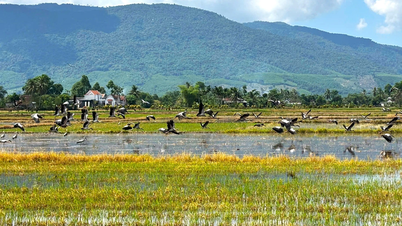
Farmers in Vinh Dieu commune are planting rice using machines.
During a business trip on the last afternoon of 2025, we had the opportunity to return to the Long Xuyen Quadrangle. Standing on the T5 canal bridge, looking ahead, we could see the T5 canal – commonly known as the Vo Van Kiet canal. Houses lined both banks, and further in the distance stretched endless rice paddies. It's hard to believe that the Long Xuyen Quadrangle, once considered one of the harshest regions in the Mekong Delta, has now taken on such a prosperous appearance.
In the memories of those who lived here, the Long Xuyen Quadrangle was once a desolate, low-lying, acidic wasteland where no crops could survive. “The soil was so acidic that the water in the canals was crystal clear, you could see all the way to the bottom. It was a barren area, the land was contaminated with saline acid, and people couldn't grow anything except mangrove trees. Many families couldn't survive and had to leave,” said Mr. Nguyen Van Cong, a resident of Giong Ke hamlet, Binh Giang commune.

Farmers visit the high-quality, low-emission rice production model of Tan Thuan Agricultural Cooperative, My Thuan commune.
According to Nguyen Huynh Trung, Head of the Provincial Irrigation Department, to develop the Long Xuyen Quadrangle region, the late Prime Minister Vo Van Kiet decided to excavate a flood drainage system to the Western Sea. The main channel, the T5 canal, brought floodwaters carrying silt deep into the Long Xuyen Quadrangle. The province also invested in the construction of branch canals and inland canals, which have proven effective in removing acidity and alkalinity from the soil, and transporting silt throughout the region, making the land fertile. People can now cultivate crops intensively, increasing the number of harvests, transitioning from one rice crop per year to two and then three crops per year. Agricultural production in the Long Xuyen Quadrangle has seen remarkable development and growth, and the rural landscape in the region is increasingly improving.
According to the Department of Agriculture and Environment, after the merger of the former Kien Giang and An Giang provinces into the new An Giang province, the Long Xuyen Quadrangle region, comprising An Giang province and part of Can Tho city, covers a total area of approximately 490,000 hectares. Thanks to the efforts of our ancestors in reclaiming and restoring the land, the Long Xuyen Quadrangle has become a region with rich potential for agricultural production, becoming a key rice-producing area in the Mekong Delta and the whole country. In recent years, farmers in the region have been gradually changing their mindset, shifting from a purely agricultural production mindset to an agricultural economic mindset, increasing the value of rice products through production chain models oriented towards clean agriculture, high-tech agriculture, and reducing greenhouse gas emissions.

Farmers in My Thuan commune are harvesting rice.
We visited Tan Thuan Agricultural Cooperative in My Thuan commune just as the cooperative was holding a field workshop on implementing a high-quality, low-emission rice cultivation model as part of the sustainable development project of 1 million hectares of high-quality, low-emission rice cultivation, linked with green growth in the Mekong Delta. Farmers from neighboring communes participated, visited the fields, and exchanged production experiences. Nguyen Thanh Tuan, Director of Tan Thuan Agricultural Cooperative, said: “In the past, the soil here was heavily acidic, resulting in low yields; one hectare wouldn't even yield ten bags of rice. Now, this land is very productive for rice cultivation, with yields of 1-1.3 tons per hectare in the winter-spring season and about 900kg-1 ton per hectare in the summer-autumn season. The cooperative is currently cooperating with businesses to sell carbon credits from rice cultivation that reduces emissions.”
According to Deputy Director of the Department of Agriculture and Environment Tran Thanh Hiep, implementing the project of 1 million hectares of high-quality, low-emission rice cultivation, by 2025 the province will implement over 150,000 hectares, mainly concentrated in key rice-producing areas of the province, including communes in the Long Xuyen Quadrangle region. This is because this area has concentrated rice cultivation areas, a complete irrigation system, and people with rich experience in applying scientific and technical advancements such as the "1 must, 5 reductions" method, alternating wet and dry irrigation, and mechanization in sowing. In recent years, An Giang has consistently led the country in rice production area with over 1.3 million hectares and rice output of over 8.79 million tons/year, with the Long Xuyen Quadrangle region contributing the most to the province's total rice production.

Farmers in Vinh Dieu commune are preparing to plant rice.
The Long Xuyen Quadrangle region not only has advantages in rice production but also possesses significant potential for developing diverse high-value economic production models such as intensive and semi-intensive brackish water shrimp farming, and shrimp-rice farming in coastal areas. The region also has advantages in developing freshwater aquaculture and cultivating various fruit trees. Walking along wide concrete roads or through vast fields of golden, ripe rice, we see farmers diligently working everywhere. The Long Xuyen Quadrangle is changing and developing day by day, becoming one of the most prosperous regions in the Mekong Delta.
THUY TRANG
Source: https://baoangiang.com.vn/danh-thuc-tu-giac-long-xuyen-a476788.html





















































Comment (0)