

 |
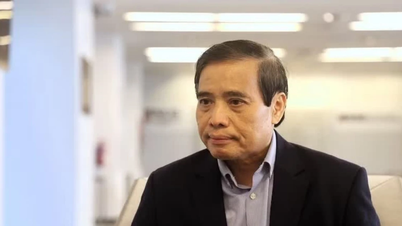
| Professor Nguyen Tai Can (on the right) and the author at the Le Van family church. |
This is the oldest Han Nom text in Hue , in its original form, written on thin Do paper. The text is wide (42cm x 26.5cm), with a thicker layer of Do paper glued to the back. The fold in the middle of the text is torn, losing some strokes and characters, so later generations rewrote it on the reinforced paper. The entire text has 21 lines and 576 characters. The right margin has four additional characters: "Kham Cap Ma Ne". This text is currently preserved at the Le Van family ancestral temple, My Xuyen village, Phong Dinh ward, Hue city.
Translation:
"In Thuan Hoa district, Hoa province, Tan Tri, the chief official of the Inspectorate, inspected and allocated abandoned and illegally occupied land."
In the 7th year of Dai Hoa (1449), on the 5th day of the 12th lunar month, based on the fact that Le Canh, the village head of Da Cam commune, Tra Ke district, Chau Hoa, Thuan Hoa province, together with Doan Tuy, Le Can, Vo That, Le Luc, Nguyen Van Lo, Doan Luyen, Doan Cu, Bui Thi, Doan Van Qui, Doan Van Trien (?) along with Doan Van Ky, Nguyen Cu Long, Phung Van Hy, Le Bai, Ho Doi, Doan Van Thi and Tran Tu Ky (?), Le Hien, Le Van Quoc, Phan Cho Con.
Because the village land was small and the population was large with little arable land, and knowing that there were some barren, uncultivated wastelands in the district that had been turned into rice paddies but were not being cultivated, Le Canh, Doan Tuy (?), Le Van Que, and Phan Cho Con submitted an urgent petition to cultivate the land and pay taxes. The district official approved their request to cultivate the land in the Ma Ne field area, totaling over one hundred acres in all directions: Approving Le Canh, Doan Tuy, Le Van Que, and Phan Cho Con to cultivate the land and pay taxes as prescribed.
On August 10th, the 9th year of Dai Hoa (1451), Le Canh, Doan Tuy, Le Can, Vo Thai, Le Truc, Nguyen Van Lo, Doan Luyen, along with Doan Cu, Bui Thi, Doan Van Qui, Doan Van Trien, Doan Van Ky, Nguyen Y, Le Van Doc, Ho Duc Tuyen, Nguyen Cu Long, along with Phung Van Hy, Le Bai, Ho Doi, Doan Van Thi, Tran Tu Ky (?), Le Hien, Le Van Que, and Phan Cho Con submitted a petition to the District Magistrate and the district official to personally inspect and measure the land in all four directions, as Le Canh, Doan Tuy, Le Van Que, and Phan Cho Con had reported. After the work was completed, the current situation was approved, a document was drawn up for the land, and boundary markers were established and demarcated.
The land was granted to Le Canh, Doan Tuy, Le Van Que, Phan Cho Con (along with those who participated) the right to cultivate over one hundred acres of rice fields in the Ma Ne area. (This land) was registered in the commune's land registry. They had the right to leave it to their descendants to cultivate and pay taxes as prescribed. Therefore, this certificate was issued as proof...
The documents not only tell us about the land reclamation efforts of the people of Thuan Hoa in the 15th century, but also contain valuable information about the dates and place names of some administrative units during the early Le Dynasty.
(1428 - 1527).
Regarding the reign of King Lê Nhân Tông, Trần Trọng Kim's book "A Brief History of Vietnam," Volume I, records: "Lê Nhân Tông (1443 - 1459) Reign Titles: Đại Hòa (1443 - 1453), Diên Ninh (1454 - 1459)". Other historical documents record the reign title of King Lê Nhân Tông as 太和 (Thái Hòa), but the "Má Nê Examination" document writes it as 大和 (Đại Hòa). The reign title 大和 (Đại Hòa) is written three times: The first time, when the people submitted their petition to reclaim land: "Đại Hòa seventh year, twelfth month, fifth day..." (the 5th day of the 12th month, the 7th year of Đại Hòa (1449)...). The second time, a report was submitted to the higher authorities regarding the completion of land reclamation in the Ma Ne rice field area: "On the 10th day of the 8th month of the 9th year of Dai Hoa (1451)..." [On the 10th day of the 8th month of the 9th year of Dai Hoa (1451)...]. The third time, the date of granting the certificate of ownership for land reclamation in the Ma Ne rice field area to the group of residents of Da Cam commune: "On the 8th day of the 12th month of the 9th year of Dai Hoa (1451)..." [On the 8th day of the 12th month of the 9th year of Dai Hoa (1451)].
To learn more about the reign name of King Le Nhan Tong, I went directly to the North to examine the inscription on the rock stele at Bat Nha stream, Tam Dao, Phu Tho, erected by Le Khac Phuc, which reads: “Dai Hoa eighth year, Canh Ngo, fifth month, tenth day” [the 10th day, fifth month, Canh Ngo, Dai Hoa eighth year (1451)], the stele clearly inscribed the two characters 大和 Dai Hoa. In Chinese characters, the characters 大 (Dai) and 太 (Tai) differ only by a dot (.), and 大 (Dai) can be read as Thai. But here, it is the reign name of a king, and I think it cannot be written and read arbitrarily.
Regarding the place name Thuan Hoa, in the book "Vietnam Through the Ages," under the section: Dai Viet during the Tran and Ho Dynasties, when writing about Thuan Hoa, scholar Dao Duy Anh had not yet determined the exact name of the administrative unit of this land at that time, so he wrote: "Thuan Hoa Province (or District?)." "Kham Cap Ma Ne" is the oldest administrative document that clearly records Thuan Hoa Province...
To date, the Sino-Vietnamese text "Khám cấp Ma Nê," preserved at the Lê Văn family ancestral temple in Mỹ Xuyên village, Phong Dinh ward, Huế city, is considered the oldest "Land Use Right Certificate" in Vietnam. This is a valuable Sino-Vietnamese document that has been preserved by the local people for nearly 600 years. It is suggested that the cultural sector and local authorities should develop a plan to create a documentary heritage dossier, and provide guidance and professional support to the people in preserving this valuable document in situ.
Source: https://huengaynay.vn/van-hoa-nghe-thuat/dia-ba-co-nhat-viet-nam-dang-duoc-luu-giu-tai-hue-165419.html

![[Image] Hanoi Police officially crowned champions of V-League 2025/2026](https://vphoto.vietnam.vn/thumb/1200x675/vietnam/resource/IMAGE/2026/05/31/1780244769054_ndo_br_039d561b692be875b13a-jpg.webp)
![[Photo] The General Secretary, President and his wife begin their state visit to the Philippines.](https://vphoto.vietnam.vn/thumb/1200x675/vietnam/resource/IMAGE/2026/05/31/1780230559452_anh-man-hinh-2026-05-31-luc-19-28-11.png)
![[Photo] Admire the coral "masterpiece" amidst the million-year-old heritage of Dak Lak province.](https://vphoto.vietnam.vn/thumb/1200x675/vietnam/resource/IMAGE/2026/05/31/1780221235105_anh-man-hinh-2026-05-31-luc-16-53-27.png)
![[Photo] Solemn bathing ceremony and Buddha procession in Hue](https://vphoto.vietnam.vn/thumb/1200x675/vietnam/resource/IMAGE/2026/05/31/1780228263543_1-jpg.webp)

















![[Video] Sunset at Lap An Lagoon – Where the sun sets over the fishing nets](https://vphoto.vietnam.vn/thumb/340x192/vietnam/resource/IMAGE/2026/05/31/1780192137701_beach-landscape-sea-water-nature-grass-745871-pxhere-com.jpeg)





















































Comment (0)