

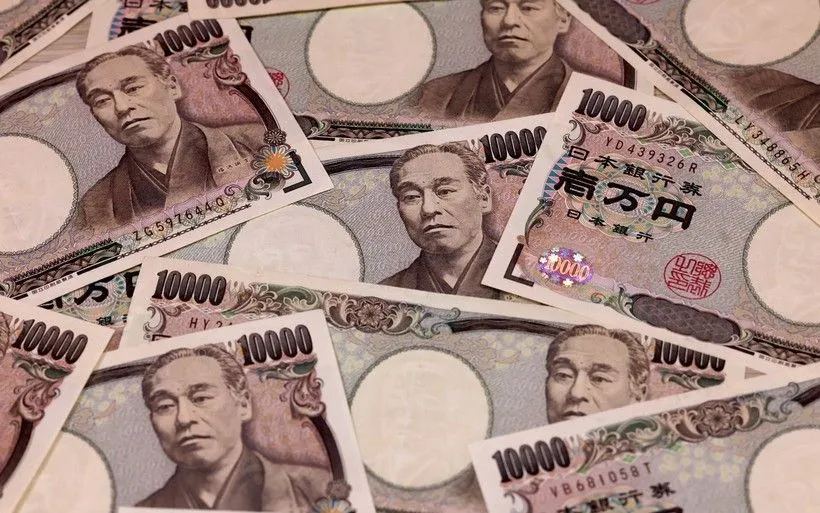
A 10,000 yen banknote from Japan. (Photo: AFP)
Following the announcement by Bank of Japan (BoJ) Governor Ueda Kazuo, the yen fell to 159 yen per US dollar, but rebounded within about 10 minutes. This sudden fluctuation led to speculation that the Japanese government and the BoJ may have intervened in foreign exchange to curb the yen's depreciation.
At the press conference following the Bank of Japan's monetary policy meeting, Governor Ueda did not express a positive stance on further interest rate hikes. Due to expectations that the interest rate differential between Japan and the US would not narrow as much as anticipated, selling of the yen intensified. By approximately 4:30 PM local time on January 23rd, after the press conference concluded, the yen-USD exchange rate had fallen from around 158.6 yen per USD at the start of the press conference to 159 yen per USD.
However, the market atmosphere suddenly changed after 4:40 PM on January 23rd when the yen-USD exchange rate surged to 157 yen per USD, an increase of nearly 2 yen in 10 minutes. Even more surprisingly, the buying momentum did not last, and by around 5:00 PM on January 23rd, the yen-USD exchange rate had fallen back to 158 yen per USD.
Regarding the appreciation of the yen in the foreign exchange market, Finance Minister Katayama Satsuki, on January 23rd, when asked whether the Japanese government and the Bank of Japan would intervene in the exchange rate, avoided giving a direct answer and stated that they always monitor the market with great caution.
Iguchi Keiichi, senior strategist at Resona Holdings, believes that given the price fluctuations, the possibility of exchange rate intervention cannot be ruled out. Meanwhile, according to Okada Yusuke, senior researcher at the Capital and Foreign Exchange Division of Mitsubishi UFJ Bank, the feeling that the yen buying activity has been quite continuous leads to the inference of a "rate check," a move considered "pre-intervention."
However, some argue against the intervention of the authorities, because in previous interventions, the price fluctuations usually exceeded 5 yen. Kariya Shogo, a strategist at Minato Bank, suggests that it is possible that foreign investors took profits on a significant scale when trading began in Europe.
It has also been suggested that, amidst increasing market caution, the emergence of large-scale USD sell-yen buy orders triggered automated trading via computer programs, drawing in many other transactions and further exacerbating price volatility. Some investors who accepted losses to buy yen and sell USD were also drawn into this cycle, further widening the price fluctuations.
Source: https://vtv.vn/dong-yen-bien-dong-manh-100260123195700128.htm
![[Photo] General Secretary and President To Lam presides over a working session with the Central Policy and Strategy Committee on the development of the materials industry.](https://vphoto.vietnam.vn/thumb/1200x675/vietnam/resource/IMAGE/2026/05/21/1779359935432_a3-bnd-3129-1412-jpg.webp)


![[Photo] National Assembly Chairman Tran Thanh Man working with the Standing Committee of the Law and Justice Committee](https://vphoto.vietnam.vn/thumb/1200x675/vietnam/resource/IMAGE/2026/05/21/1779378929214_ndo_br_1-4610-jpg.webp)




























































































Comment (0)