

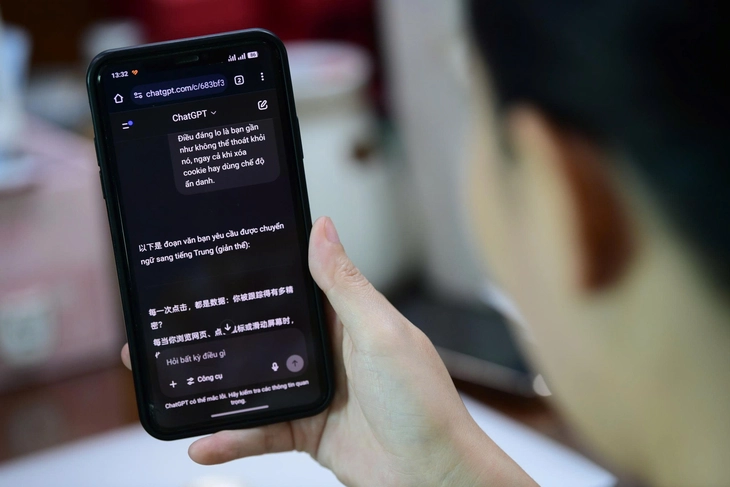
More and more users and businesses are applying AI tools in translation and localization - Photo: QUANG DINH
Many companies are considering reducing the recruitment of interpreters or lowering foreign language requirements. Instead of hiring interpreters or finding the company's best English speaker for meetings with foreign partners, AI assistants are now readily available, completely free of charge.
It's easy to speak in multiple languages.
As a startup providing digital transformation services, Tanca.io frequently has to meet with foreign partners. Mr. Tran Viet Quan, founder and chairman of Tanca.io, recounts: "Before each meeting with foreign partners, we often struggled because only a few people could communicate well in English. In those situations, the speaker also acted as the interpreter, which was time-consuming and affected the quality of the meeting."
For many important meetings or when partners don't speak English well, we have to hire interpreters. This is a significant cost for a start-up, especially with frequent meetings and the dependence on the interpreter's schedule."
Mr. Quan has now introduced AI applications to assist in translation. Online meeting platforms like Zoom and Microsoft Teams integrate real-time AI translation. For offline (in-person) meetings, devices like AI headphones (Google Pixel Buds) also allow for live translation, supporting basic communication so that interpreters are not needed.
"In fact, we speak Vietnamese and our customers still understand us, which makes accessing foreign markets much easier than before," Mr. Quan said.
The CEO of another tech company also said that he recently had to meet with many investors and partners from Japan, South Korea, and Hong Kong. Although his English is excellent, he still had to use AI translation because many partners used local languages. "I found it very interesting because the AI assistant translated very well," the CEO shared.
According to Tuoi Tre 's research , while previously popular tools like Google only supported text translation, now AI tools and integrated AI features support conversational translation.
Recently, at the Google I/O 2025 event, Google introduced a real-time voice translation feature, using a large-scale audio language model from Google DeepMind to preserve the original speech, allowing users to speak naturally in their native language while their interlocutors hear it as their own language but with the speaker's accent...
Many individuals and businesses in Vietnam have stated that they have been experimenting with AI translation assistants and plan to use them extensively to increase convenience and reduce costs.
AI provides assistance, but learning is still necessary.
Speaking to Tuổi Trẻ newspaper , Mr. Ton Quang Thanh, director of Quang Thanh Foreign Language Center ( Ba Ria - Vung Tau ), shared that he had recently tried using AI technologies and said he was "truly amazed by its capabilities." While primarily teaching foreign languages, Mr. Thanh also uses AI to develop lesson plans, conduct one-on-one conversations, and personalize learning for students.
According to Mr. Thanh, AI cannot yet replace teachers or interpreters. "Learning a foreign language is not just about simple communication, but also about learning the culture, learning how to become confident, and mastering the language. As AI develops, foreign language learners will have more opportunities to practice at a lower cost," Mr. Thanh stated.
Others argue that AI will advance very rapidly, so translation will become increasingly smooth, even on difficult topics.
According to Ms. Hoang Huong, CEO of Unikon Technology Company, advances in AI - especially large language models (LLM), speech recognition technology (ASR), and speech synthesis (TTS) - have enabled machines to understand, translate, and respond to natural language with great accuracy.
This has created significant challenges for jobs such as translators and language teachers. But this is not the end of learning foreign languages; rather, it's a reminder that the education sector needs to adapt.
According to Ms. Huong, in the future, learning a foreign language will no longer be just about basic communication because machines and technology can provide excellent support. Instead, language learning needs to be elevated to help students gain a deeper understanding of culture, linguistic thinking, and intercultural communication skills – things that machines can hardly replace.
Similarly, Mr. Tran Viet Quan also argued that although AI has made many miraculous advances, it still faces difficulties in grasping cultural nuances or complex contexts, such as business negotiations or political speeches.
"Although AI is replacing humans in repetitive tasks, the role of translators and interpreters remains important in fields requiring cultural sensitivity and creativity, such as literary translation or diplomacy," Mr. Quan commented.
Adapt to change
Speaking to Tuoi Tre newspaper , Ms. Hoang Huong suggested that to ensure employment, those with foreign language skills and the education and training system need to shift in three main directions.
Firstly, focus on the cultural depth and linguistic thinking: learning a foreign language is not just about speaking, but about understanding how native speakers think, feel, and express themselves.
Secondly, when integrating AI, it should be viewed as a supporting tool rather than an adversary. For example, classrooms could use AI to practice pronunciation, simulate communication situations, or perform more advanced translation exercises.
Thirdly, there is a need for thorough training in language technology skills. Translators and students need to be equipped with the skills to use translation tools, research, and communicate multilingually using technology.
"We need to change and adapt in a way that fosters deep connections that only humans can achieve," Ms. Huong stated.

























































































Comment (0)