

Vietnam has preserved its existence not only through the blood and sacrifices of its ancestors in war, but also through a strong sense of community, love for its land and people, from the fiery pages of its history to the silent contributions in peacetime.
But in this new era, where information travels faster than thought, where a person can connect with the world more easily than they can chat with their neighbor, patriotic education cannot continue to follow the same old path. It demands a different mindset: sharper, more open, more action-oriented, and closer to real life.
Today, the majority of the younger generation were born in peacetime, grew up in an integrated environment, had early access to technology, spoke English better than Vietnamese, and sometimes understood more about world wars than the historical battles of their ancestors. This is not a loss of roots, as some nostalgic people often warn.
That is the inevitable consequence of the times. And it is in this context that patriotic education needs to be renewed so that it does not slip away from the minds of young people amidst the noise of social media, diverse personal choices, and the habits of digital living.
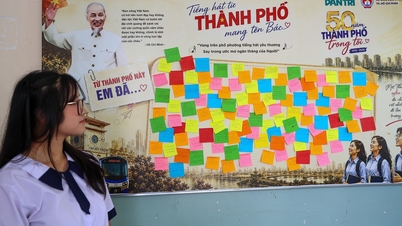
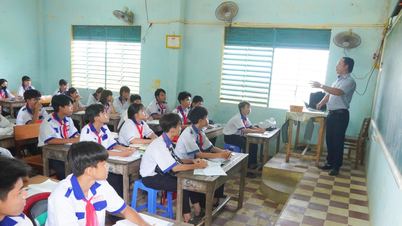
One limitation that needs to be acknowledged with an open mind is that current patriotic education activities in schools still lean heavily towards symbolic forms such as flag-raising ceremonies, creating wall newspapers during holidays, and historical painting competitions, but rarely create opportunities for students to truly "touch" and experience citizenship. These activities are not wrong; on the contrary, they are necessary.
However, if education stops there, it easily loses its depth. We cannot expect students to fully understand the value of national independence through a written exam about September 2nd if they have never had the opportunity to speak up to defend their community, confront real social conflicts, or develop critical thinking skills in the face of diverse viewpoints. Therefore, patriotic education should no longer be designed as a process of "information transmission," but rather as a process of "building civic competence."
Patriotism in the 21st century cannot be separated from three elements: critical thinking, responsible behavior, and the ability to integrate. A patriotic young person is not just someone who knows how to sing the national anthem, but also someone who knows how to refuse academic cheating, behaves civilly online, refrains from sharing fake news, and is conscious of preserving the nation's image when abroad. Patriotism is no longer just an emotion, but needs to be nurtured as a skill to thrive in a world full of temptations, competition, and conflicting values.
A civics lesson on patriotism might not begin with ideals, but with a scenario: If you were a student who made thoughtless statements on social media that distorted Vietnam's image, what would you do? A class that goes beyond simply answering right and wrong questions invites students to dialogue about the boundaries between freedom of speech and responsible expression, between individual ego and community identity. This is how patriotism is brought under scrutiny to be understood correctly and lived authentically.
Furthermore, Singapore's modern civic education model is a valuable case study. The National Education program exposes students from primary school to university to topics such as history, security, and public policy through practical activities: simulated elections, community consultations, and smart city development.
Each activity is both rooted in its own identity and oriented towards the world. Vietnam can certainly learn from this, but the important thing is to adapt it to its own cultural context – where the tradition of "drinking water, remembering the source" and the spirit of community are still deeply ingrained in every family and village.
However, it would be a shortcoming if patriotic education were confined to schools. In reality, love of country doesn't necessarily need to be expressed through grand pronouncements or lofty ideals. It's present in small but enduring choices in everyday life. A bus driver persistently returning change, an administrative staff member refusing to compromise with wrongdoing, a mother teaching her child not to litter – all are silent expressions of patriotism.
In modern society, where people are easily swept up in the fast pace of life, it is precisely these seemingly ordinary behaviors that form the foundation for building a livable nation – where discipline, order, and morality become national identity, not just slogans.
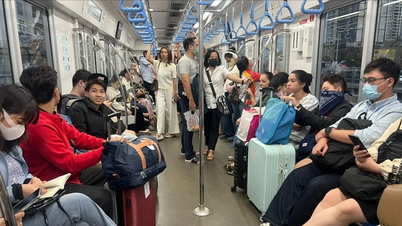
Patriotism is also reflected in civilized behavior in public: knowing how to queue, maintaining order in movie theaters, apologizing after a collision… A patriot doesn't necessarily have to put a flag on their avatar, but rather understands that they represent the community in every action. An artist who responds respectfully when Vietnamese culture is distorted, a student studying abroad who lives a virtuous life in their dormitory, a scientist who chooses to conduct research to solve problems for their own country – all are citizens who love their country in a profound and enduring way.
In an age where AI can write a patriotic essay fluently, what truly makes a difference is whether learners dare to act on that love. Therefore, patriotic education in the new era needs to create real-life situations where learners have the opportunity to live as real citizens: to offer constructive criticism, to make mistakes and receive correction, to be listened to, and to be given responsibility.
Patriotism, if properly nurtured, will not only create a generation that loves its country, but also loves truth, morality, and humanity, because these values are not contradictory. A young person who loves their country will not cling to the past, but will know how to build the future. A nation does not grow only through victories, but also matures through the kindness of its people, who silently and persistently do the right thing in countless moments that go unnoticed.
And so, ultimately, patriotism lies in how a person lives each day amidst choices that could harm the community, yet still chooses to live with integrity. That is the simplest, yet most enduring, form of patriotism.
Source: https://giaoducthoidai.vn/giao-duc-long-yeu-nuoc-trong-ky-nguyen-moi-post746665.html
![[Photo] General Secretary and President To Lam presides over a meeting on the implementation of Directive No. 34-CT/TW of the Party Central Committee.](https://vphoto.vietnam.vn/thumb/1200x675/vietnam/resource/IMAGE/2026/05/19/1779187768672_a1-bnd-2350-631-jpg.webp)
![[Photo] National Assembly Chairman Tran Thanh Man attends the groundbreaking ceremony for the National Highway 1A spatial axis project.](https://vphoto.vietnam.vn/thumb/1200x675/vietnam/resource/IMAGE/2026/05/19/1779161360398_ndo_br_bnd-1412-jpg.webp)
![[Photo] Capturing the moment the tide recedes at Yen Binh Son rapids - a million-year-old scenic spot in Quang Ngai.](https://vphoto.vietnam.vn/thumb/1200x675/vietnam/resource/IMAGE/2026/05/19/1779175463885_yen9-1199-jpg.webp)



































![[Photo] General Secretary and President To Lam receives Indian Defense Minister Rajnath Singh](https://vphoto.vietnam.vn/thumb/402x226/vietnam/resource/IMAGE/2026/05/19/1779184046302_anh-man-hinh-2026-05-19-luc-16-46-58.png)






















Comment (0)