

Expanding the barriers disrupts traffic flow.
On the 29th day of the Lunar New Year (February 8th), the entire Nguyen Van Linh - Nguyen Huu Tho intersection was barricaded for the construction of the tunnel section. The Department of Transport prohibited all vehicles from crossing Nguyen Van Linh road from Nguyen Huu Tho road at the Nguyen Van Linh - Nguyen Huu Tho intersection. Instead, trucks traveling from District 7 to Nha Be District along Nguyen Huu Tho road will turn right onto Nguyen Van Linh road (2 lanes for cars), make a U-turn before Tu Dinh bridge or before the toll booth to rejoin Nguyen Van Linh road, and then turn right onto Nguyen Huu Tho road. Motorcycles and passenger cars will follow the route: Nguyen Huu Tho road - turn right onto Nguyen Van Linh road (2 mixed lanes) - make a U-turn on the service road under Ong Lon bridge - Nguyen Van Linh road - turn right onto Nguyen Huu Tho road.
The news of the intersection closure caused great anxiety among many residents in District 7 and Nha Be District before their return to Ho Chi Minh City after the Tet holiday, as this area is already prone to traffic congestion. A 24/7 closure and gridlock were the concerns of most drivers who frequently travel through this area. However, the reality over the past two weeks shows that traffic at the Nguyen Van Linh - Nguyen Huu Tho intersection has been relatively stable.
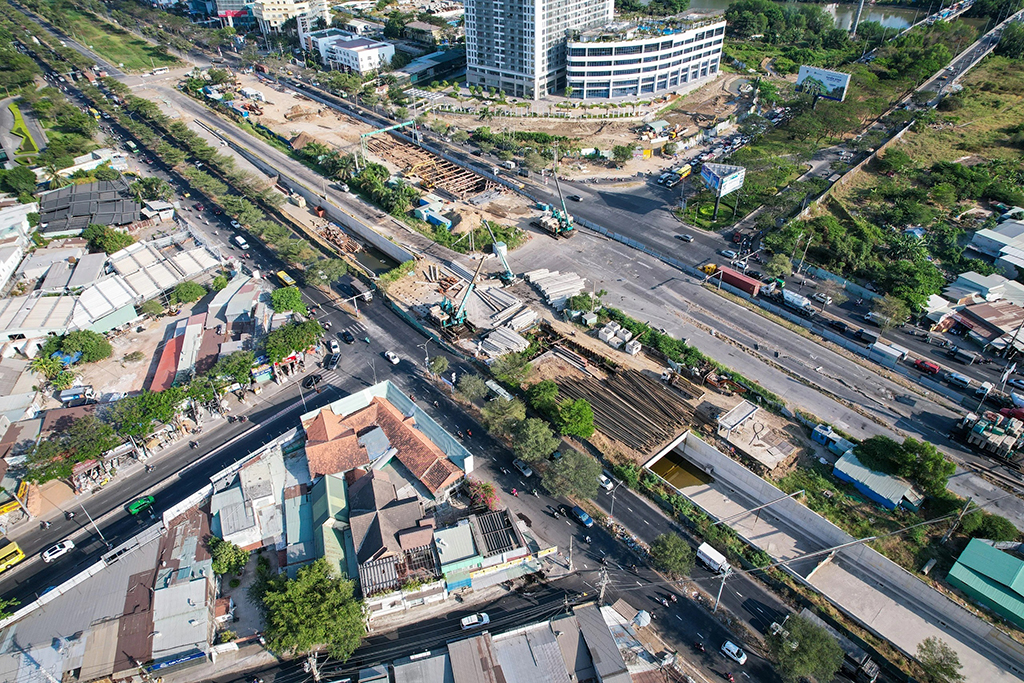
Closing the Nguyen Van Linh - Nguyen Huu Tho intersection is the most difficult "problem" for traffic management in Ho Chi Minh City today.
The traffic jams that used to occur from the intersection with the East-West road (Phuoc Kien commune, Nha Be district) across Rach Dia 2 bridge to the intersection area have significantly decreased compared to before. On the 8th of February 17th, traveling from Tan Son Nhat airport to Phuoc Kien at 7 PM, Ms. Mai Duong was worried about traffic congestion. However, upon reaching the Lotte supermarket on Nguyen Huu Tho road, the taxi driver unexpectedly turned right onto the Him Lam urban area road, then followed D4 road, then D1 road along the riverbank, and finally the service road under Ong Lon bridge. The entire stretch of road was clear, and cars sped along.
"Let's take this road to avoid traffic jams. Going straight to Nguyen Van Linh and then circling around might lead to congestion with the container trucks. Besides, I'm sure not everyone has arrived yet; they'll probably only fully get there next week," the driver said slowly.
With the same thought in mind, on her first day back at work on Monday morning (February 19th), Ms. Mai Duong left home at 7:30 AM, knowing it was rush hour and therefore leaving 30 minutes earlier than usual. However, the entire journey was very smooth. At each intersection, there were police officers guiding and directing traffic.
On the return journey home during the evening rush hour, the area around the extended Kênh Tẻ bridge connecting to Nguyễn Hữu Thọ street still had heavy traffic, but it wasn't congested. Ms. Dương chose to drive straight to D6 road near Tôn Đức Thắng University before merging onto D1 road. Near the toll booth, traffic slowed down but there was still no congestion. The total return time was nearly 15 minutes longer than before, if she traveled during rush hour. "These past few days, I've had to travel at different times, but I haven't seen the congestion I expected, although I'll have to arrange to leave earlier because the distance is longer," Ms. Mai Dương said.
Motorcycles and passenger cars can navigate the traffic more easily, but container trucks frequently face long queues, especially along the 3-kilometer stretch of Nguyen Van Linh road from the toll booth. "The traffic jams from Binh Chanh to District 7 are constant every day. During rush hour, we sometimes wait in line for nearly two hours just to move 2 kilometers to the Pham Hung intersection. This area was already congested, and now it's even worse. We just hope that once the intersection is closed, the authorities will expedite construction so that an underpass and alternative routes can be built to improve traffic flow," shared Phan Van Trong, a container truck driver who frequently travels this route.
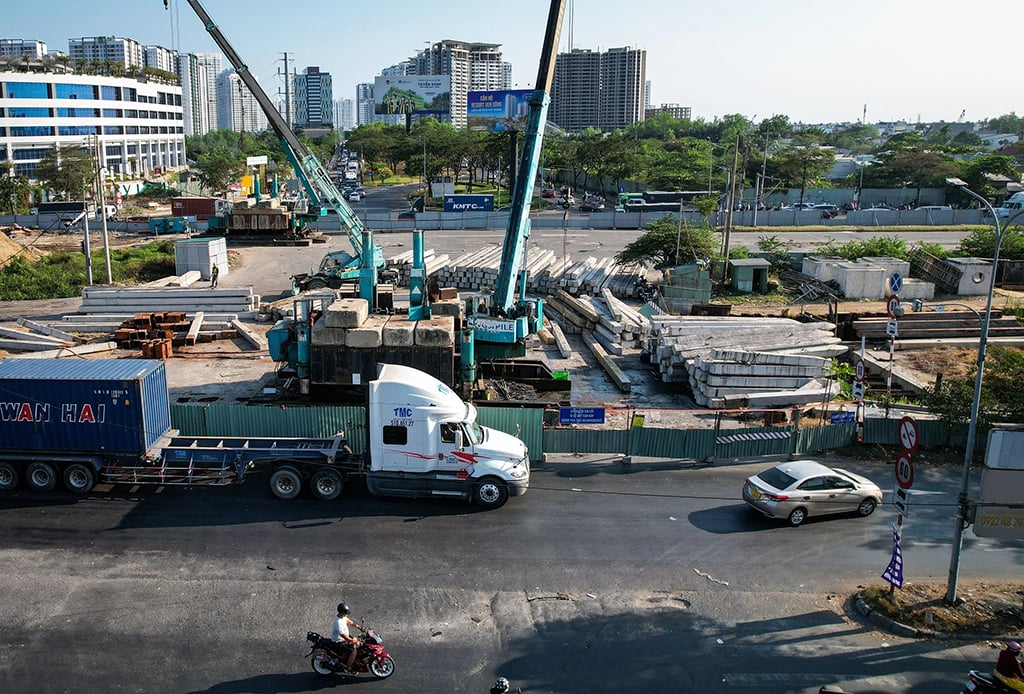
Closing the Nguyen Van Linh - Nguyen Huu Tho intersection is the most difficult "problem" for traffic management in Ho Chi Minh City today.
Facing similar congestion due to construction barriers, the increased traffic volume leading up to the Lunar New Year of 2024 has caused frequent traffic jams at the gateway to Tan Son Nhat Airport. The roads surrounding the airport, such as Cong Hoa, Truong Chinh, Hoang Van Thu, and Pham Van Bach (Tan Binh District), which were already overloaded, are now even more congested because the intersection of Tran Quoc Hoan and Phan Thuc Duyet (Ward 2, Tan Binh District) is the starting point of the Tran Quoc Hoan - Cong Hoa connecting road, currently under construction as part of package 9 of the project. The barriers occupying more than half of the road make traffic movement even more difficult and congested.
Starting February 24th, the construction contractor is expected to expand the existing barricades on Phan Thuc Duyet Street (on the Thang Long Street side) by an additional 13.5 meters into Tran Quoc Hoan Street to construct an underpass. This initial expansion will reduce the existing 5-lane Tran Quoc Hoan Street to 3 lanes, potentially increasing traffic congestion.
The impact on the people will be minimized.
Representatives from the Ho Chi Minh City Traffic Construction Project Management Board (Traffic Board) stated that when expanding the construction barriers for the Tran Quoc Hoan - Phan Thuc Duyet underpass, the contractors will install a temporary 5-lane overpass to alleviate traffic pressure from the Tan Son Nhat airport area. The plan is that from February 25th to April 25th, contractors will build a temporary bridge on the Thang Long road side, 66 meters long, 14 meters wide, and with 3 lanes. Following that, from April 25th to June 25th, a second temporary bridge will be constructed, with 2 lanes, 100 meters long, and 9 meters wide, towards Hoang Van Thu Park for vehicles to pass through. From June 25th to December 31st, the investor will complete the construction of the entire enclosed tunnel, which will be 79 meters long and 5-9 meters wide.
Speaking to Thanh Nien newspaper , Mr. Nguyen Kien Giang , Deputy Head of the Road Infrastructure Management Department under the Ho Chi Minh City Department of Transport, said: The construction unit will not immediately expand the barrier by 13.5 meters, but will divide it into three phases: from February 25th, the barrier will be opened, occupying about 5 meters of the road width; once people get used to it, another 5 meters will be added on February 28th, and then on March 1st, the barrier will be fully closed to occupy the required 13.5 meters of road width. This will allow people time to adjust and change traffic routes, avoiding sudden disruption. At the same time, while the barrier is closed, the road expansion construction is being carried out in stages, so when the project occupies 13.5 meters of road width, it will still accommodate 3-4 lanes of traffic, not to mention the addition of an overpass.
According to Mr. Nguyen Kien Giang, the number of construction barriers in Ho Chi Minh City this year is lower than last year. However, these are all key projects, and accelerating construction requires a large land area to be occupied. Furthermore, these projects are mainly concentrated at gateways and "bottleneck" areas, thus putting significant pressure on traffic management.
Therefore, the Ho Chi Minh City Department of Transport, in coordination with the Traffic Management Board, the traffic police, and relevant units, is closely monitoring the situation and establishing rapid response teams in each area to promptly adjust and address even the smallest inadequacies, from the length of median strips to the duration of traffic lights and the allocation of vehicles making U-turns. Simultaneously, they are developing priority plans based on the network. For example, they are accelerating the Tran Quoc Hoan - Cong Hoa route because the presence of an underpass will alleviate traffic pressure during the Truong Chinh road expansion project when barriers are in place.
During this period, key infrastructure projects expanding and connecting the city's gateways are accelerating, inevitably impacting the lives of residents. The transportation sector will minimize traffic congestion at affected areas. We hope residents will understand, cooperate, and create favorable conditions for the projects to be completed and become effective as soon as possible.
Mr. Nguyen Kien Giang , Deputy Head of the Road Infrastructure Management and Exploitation Department, Ho Chi Minh City Department of Transport.
Source link

![[Image] Central Party Office summarizes work in 2025](/_next/image?url=https%3A%2F%2Fvphoto.vietnam.vn%2Fthumb%2F1200x675%2Fvietnam%2Fresource%2FIMAGE%2F2025%2F12%2F18%2F1766065572073_vptw-hoi-nghi-tong-ket-89-1204-jpg.webp&w=3840&q=75)




























































































Comment (0)