


His works primarily feature bamboo, as a way of expressing his feelings about his homeland, nature, the environment, and his desire to preserve the bamboo groves of his village, which are becoming increasingly scarce in today's urban life.
The frequent flooding in Hue due to heavy rains was perhaps just one of the many reasons why Tuan moved to Minh Mang Street, located in the southwestern hills of the city, to live and create. This place is truly peaceful, perfectly suited to someone who lives a slow, emotional life like him, not to mention the refreshing green surroundings of trees, especially bamboo. For him, moving to Hue was the right decision, partly because he is from central Vietnam, and partly because he loves nature. And the nature here is both beautiful and harsh, providing the perfect catalyst for his creative inspiration on themes of landscapes, trees, and animals.
The young man from Ha Tinh said that, having studied Painting at the University of Arts, Hue University, he immediately focused on professional watercolor painting from 2014. During his five years of university, Tuan studied every medium imaginable. Although his graduation project was oil painting, he realized that watercolor offered a more subtle depth and smooth tonal range. Therefore, he chose watercolor, a clear indication of his professional artistic path and his unwavering determination to master the techniques of painting with this medium. While his recurring themes are his homeland, nature, and the environment, the image of bamboo in his paintings remains particularly special and impressive. This explains why he is also known in the art world as "Tuan the Bamboo Painter."
Tuan shared: Growing up in Huong Son, the image of bamboo has been ingrained in his childhood and subconscious. Later, during the process of building new rural areas, as his hometown developed, the village road once shaded by bamboo trees where he was born disappeared. Therefore, witnessing the gradual disappearance of bamboo trees during his visits to Huong Son inspired him to incorporate bamboo into his artwork. He wants to paint bamboo to slow down, reminisce about his village, not only for himself but also for many Vietnamese living abroad who miss their homeland.
However, Tuan found it difficult to exploit the familiar image of bamboo in Vietnamese life, even when he considered using it as a metaphor for various issues. His paintings lean towards realism, but also contain surreal elements. In his paintings, he uses blank spaces, as if to symbolize the present and development. Significantly, in his works about bamboo, there are always dynamic elements such as birds, buffaloes, and storks interwoven, as if he wanted to say that there is movement within stillness.
A readily recognizable characteristic in Tuan's paintings is his focus on space. He uses space as a way to open up voids, thereby evoking emotions in the viewer. For example, in the painting "Sunset Shadow," the bamboo tree is not depicted alone but placed in a wide space where a bittern bird flies forward – or rather, returns to its nest – suggesting the tranquil feeling of the end of the day.
In another painting of bamboo, Tuan incorporates the image of a bird with the intention that, normally, bamboo groves are where birds build their nests, but when the bamboo is gone, where will the birds migrate to? He often asks himself such questions. Therefore, the image of the bird in Tuan's paintings always conveys a sense of sadness, evoking a feeling of unease when their habitat is gone. Through this, the artist wants viewers to slow down, look back at the past, and have a moment of quiet reflection.
And even though at times he focuses on the decay of bamboo, with bamboo stumps cut close to the ground and left bare, the image of young bamboo shoots still remains in the paintings. This detail symbolizes tradition, inheritance, and continuity between generations of Vietnamese people.
Tuan explained that, according to Eastern philosophy, bamboo is a plant that is strong yet resilient, hollow but not empty, bending but not breaking, and growing straight and strong – symbolizing an upright and noble gentleman. This also explains why he is drawn to the ruggedness of bamboo, and in his paintings, that very ruggedness contains the graceful rustling of leaves, a simple and romantic beauty very close to the feelings and soul of the Vietnamese people.
Tuan explained that, according to Eastern philosophy, bamboo is a plant that is strong yet resilient, hollow but not empty, bending but not breaking, and growing straight and strong – symbolizing an upright and noble gentleman. This also explains why he is drawn to the ruggedness of bamboo, and in his paintings, that very ruggedness contains the graceful rustling of leaves, a simple and romantic beauty very close to the feelings and soul of the Vietnamese people.
For Tuan, bamboo is not only a memory of his village, but also a reflection of the character of people in central Vietnam, and more broadly, Vietnamese people in general, in their relationship with harsh nature. Before storms and floods, bamboo, though thorny, is resilient and tenacious, standing in clumps to shield and protect each other. When old bamboo falls, new shoots sprout, one generation following the next. In Tuan's paintings, this image not only evokes the enduring life of nature, but also symbolizes the spirit of unity, resilience, and continuity of generations of Vietnamese people in the face of life's vicissitudes.
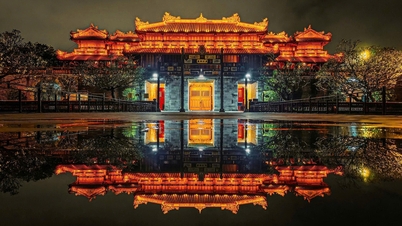
The slow, peaceful pace of life in Hue gave Tuan time to contemplate, reflect, and gain a deeper understanding of issues. His paintings therefore contain many moments of quiet contemplation, nostalgia, and gentleness, not only in his works about his homeland, nature, and bamboo, but also in many of his paintings of Hue.
To date, Tuan has painted about 40-50 paintings of bamboo, the largest of which, measuring 6 meters, is displayed in the lobby of a resort. Tuan shared that, to reinvent himself and prepare for a future solo exhibition, he plans to explore the image of bamboo in a different way and from a different perspective. He wants to bring viewers a world of bamboo, with a consistent theme. Instead of viewing the image of bamboo as repetition, he sees it as a way to delve deeper into his inner self and the cultural values that have nurtured him.
Amidst the slow pace of life in Hue, his bamboo paintings seem to be finding a lasting place in the urban space, where poet Vo Que once expressed his wish that one day Hue would become an art city, with paintings displayed in headquarters, offices, parks, and public spaces alongside installations and sculptures.
And Tuan chose to stay in Hue, painting bamboo trees, as a way of adding a somber tone to his dream of a city living with art, not ostentatiously, but quietly and persistently, like the very image of village bamboo in the memories of Vietnamese people.
Source: https://nhandan.vn/giu-bong-tre-trong-hoi-hoa-post942171.html



























































Comment (0)