On March 5th, in an interview with a reporter from HanoiMoi newspaper, Mr. Nguyen Dinh Dang, Head of the Hanoi Department of Livestock, Fisheries and Veterinary Medicine, emphasized that despite a high vaccination rate, even a small "gap" in livestock management can lead to disease outbreaks.

Mr. Nguyen Dinh Dang, Head of the Hanoi Department of Livestock, Fisheries and Veterinary Medicine. Photo: Tung Dinh
"Gaps" in the pandemic response
- The discovery of two rabies outbreaks in dogs in Hoa Lac and Ha Bang communes is causing concern among many residents. Could you please tell us whether the Department of Livestock, Fisheries and Veterinary Medicine has identified the initial cause? Did this lead to the emergence of these outbreaks?
- Currently, we have instructed local authorities to conduct a review, inspection, and verification of the origin of the infected animals. However, at this time, the specific source of infection has not yet been determined. Through reviewing livestock farms and gathering information locally, it has not yet been determined which household the infected animals originated from.
Currently, measures to control the outbreak have been implemented in accordance with veterinary regulations. The city has also provided vaccines from its reserve to Hoa Lac and Ha Bang communes to organize emergency vaccination for dogs and cats in the area. This large-scale vaccination aims to promptly control the risk of spread and limit the emergence of new outbreaks.

Hanoi has a vaccination rate against rabies for dogs and cats exceeding 90%. Photo: Nguyen Minh
- Although Hanoi has maintained a relatively high rabies vaccination rate for dogs and cats for many years, outbreaks still occur. What is the reason for this, sir?
According to professional regulations, a vaccination rate of over 80% for dogs and cats is considered sufficient for disease prevention. In Hanoi, the annual vaccination rate is usually over 90%, which is quite high. However, the risk of disease outbreaks still exists because there are still cases of unvaccinated dogs or dogs purchased from other localities. When these animals are not fully vaccinated and carry the disease, they can still cause outbreaks. Therefore, despite the city's high vaccination rate, there are still cases of dogs biting people and testing positive for rabies every year.
- In that context and given the recent developments, how does the veterinary sector assess the risk of rabies spread in the two communes where outbreaks have occurred, as well as the current risk of rabies in Hanoi, and what further measures are needed to control it, sir?
- As I mentioned, immediately after the outbreak was detected in the two aforementioned communes, all prescribed measures were strictly implemented. We widely publicized the information so that people could monitor their dogs and cats, keep them leashed and fully vaccinated. The city also promptly provided vaccines from its reserve to organize emergency vaccination for dogs and cats in the area. At the same time, the vaccination schedule for the two communes will be moved up this year. Local authorities and villages are strengthening monitoring of dog populations to promptly detect any unusual cases.
It can be said that the risk of rabies always exists. Although Hanoi maintains a high rate of rabies vaccination for dogs and cats, the trade and transportation of animals between localities is very large. According to statistics from the Ministry of Agriculture and Environment , at times, the average rabies vaccination rate for dogs and cats nationwide is only about 50%, not reaching the safe threshold, so the risk of the disease entering localities is always present. In places where full vaccination is implemented, the risk is lower. However, because livestock and pet-keeping activities are constantly changing, and new dog and cat populations are frequently emerging, the risk remains if vaccination efforts are not continuously maintained.
- In the current efforts to prevent and control rabies in dogs and cats, what difficulties, in your opinion, is the veterinary sector facing?
- The biggest challenge remains the awareness of some people. There are cases where people buy dogs from other places but don't proactively vaccinate them immediately, or even don't vaccinate them at all. The city usually organizes vaccination campaigns for dogs and cats around April each year. However, after this time, many households buy dogs from other places to keep as pets. If they don't proactively take their pets for supplementary vaccinations, it will create a "gap" in disease prevention.
In some cases, pets may be purchased from areas with a high risk of rabies. When an animal carries the disease and has not been vaccinated, the risk of an outbreak is entirely possible.
The awareness of the farmers is what matters.
- In your opinion, what is the most important "key" to preventing rabies in the community today?
- It can be said that the risk of rabies always exists. Therefore, the most effective measure remains annual rabies vaccination for dogs and cats. A vaccination rate of over 80% of the total population is required for effective disease prevention. However, vaccination is only one measure. Pet owners must also manage their animals, not letting them roam freely, and muzzling their dogs when taking them outside to ensure community safety.
In reality, pet management in households within Hanoi's inner city is relatively well-managed. However, in suburban and rural areas, due to large gardens, many households still have the habit of letting their dogs roam freely in the yard or run outside. Therefore, public awareness campaigns by media outlets and local authorities play a crucial role in raising people's awareness.

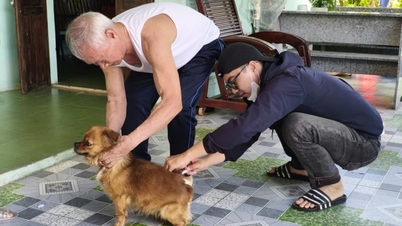
Vaccinating dogs and cats against rabies is a crucial measure to combat the disease. Photo: Nguyen Minh
- What are the current penalties for letting dogs roam freely or for not vaccinating them against rabies, sir?
- The regulations on penalties have been clearly stipulated in government decrees. Cases of failing to vaccinate dogs and cats, allowing dogs to roam freely, or allowing dogs to bite people can all be subject to administrative penalties. Furthermore, if a free-roaming dog bites someone and causes serious consequences, the owner may face three levels of serious liability: administrative liability, civil liability, and criminal liability.
- Given the continued risk of rabies, what advice do you have for people to proactively vaccinate their dogs and cats to protect public health?
- Given the existing threat of rabies, the most important thing is not only government support programs but also the proactive awareness of each citizen in preventing the disease early on. Currently, the city is providing rabies vaccination support for dogs and cats in suburban areas, creating favorable conditions for people to access and protect their pets.
In reality, the cost of a rabies vaccine for dogs and cats is not high, only a few tens of thousands of Vietnamese dong, but its effectiveness in preventing the disease is enormous. Meanwhile, rabies is one of the infectious diseases with a nearly 100% mortality rate once the disease develops, so proactive prevention from an early age is especially important.
Therefore, people need to proactively take their pets for full and timely vaccinations, considering this a regular and necessary practice, just like taking care of the health of their own family members. Besides vaccination, pet owners also need to manage their dogs and cats closely, not letting them roam freely, and when taking dogs to public places, they must be on a leash and muzzle as required. This is not only a responsibility towards their own pets but also a responsibility towards the safety of the community.
When each citizen raises their awareness, proactively vaccinates their pets, and properly manages them, we can completely minimize the risk of rabies, and move towards controlling and eradicating this dangerous disease in the community.
Thank you very much, sir!
Source: https://hanoimoi.vn/ha-noi-phat-hien-2-o-dich-cho-dai-tang-cuong-tiem-vac-xin-phong-dai-va-quan-ly-vat-nuoi-736333.html



![[Photo] General Secretary and President To Lam presides over a meeting with the Central Organizing Committee.](https://vphoto.vietnam.vn/thumb/1200x675/vietnam/resource/IMAGE/2026/06/03/1780482764658_a1-bnd-4741-3342-jpg.webp)
![[Photo] First session of the 14th Congress of the Vietnam Trade Union](https://vphoto.vietnam.vn/thumb/1200x675/vietnam/resource/IMAGE/2026/06/03/1780465947883_ndo_br_img-3852-jpg.webp)

![[Photo] Secretary of the National Assembly Party Committee, Chairman of the National Assembly presides over the meeting of the Standing Committee and Executive Committee of the National Assembly Party Committee.](https://vphoto.vietnam.vn/thumb/1200x675/vietnam/resource/IMAGE/2026/06/03/1780480353201_ndo_br_bnd-2585-jpg.webp)



















































![[Video] Sunset at Lap An Lagoon – Where the sun sets over the fishing nets](https://vphoto.vietnam.vn/thumb/1200x675/vietnam/resource/IMAGE/2026/05/31/1780192137701_beach-landscape-sea-water-nature-grass-745871-pxhere-com.jpeg)



































Comment (0)