

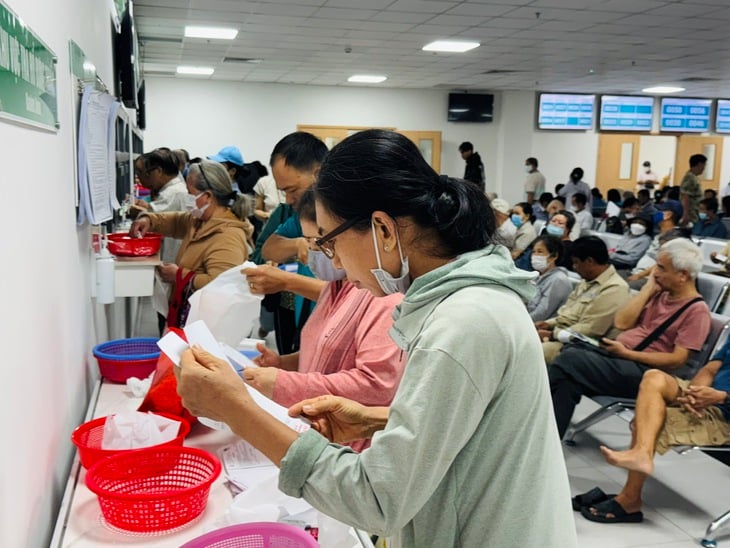
Patients are being examined at a hospital in Ho Chi Minh City - Photo: THU HIEN
On June 30th, Associate Professor Dr. Tang Chi Thuong - Director of the Ho Chi Minh City Department of Health - announced that from July 1st, the city's health sector will have 2 sub-departments and 124 public service units, including 32 general hospitals, 28 specialized hospitals, 11 non-hospital centers, 15 social welfare centers, and 38 regional health centers.
Regarding health stations, after the merger, the entire city has 443 existing ward and commune health stations. These stations will continue to perform their current tasks and functions to avoid disrupting primary healthcare services for the people.
Within 60 days (according to the plan approved by the People's Committee of Ho Chi Minh City), the Department of Health will convert 168 ward and commune health stations corresponding to the new wards and communes, and 296 health points.
At the same time, based on the guidelines of the Ministry of Health , the functions, tasks, and powers of the new ward/commune health stations and health points will be developed.
The Department of Health has instructed regional health centers to prioritize supplementing human resources so that health stations and health points that meet the criteria can sign contracts for health insurance-covered medical examination and treatment (for health stations and health points that have not yet implemented health insurance-covered medical examination and treatment).
Regarding medical centers, 38 district-level medical centers (17 with inpatient beds, 21 without inpatient beds) will be converted into 38 regional medical centers, responsible for 168 commune/ward health stations.
Specifically, the four inpatient centers of the former Ho Chi Minh City (including districts 3, 5, 10, and Can Gio) will be converted into non-hospital regional health centers. The Department of Health has instructed the directors of these health centers to prioritize strengthening medical personnel, especially doctors, at the newly established ward and commune health stations and other health points.
Next, existing inpatient facilities will be converted to more suitable types to meet the healthcare needs of the city's residents.
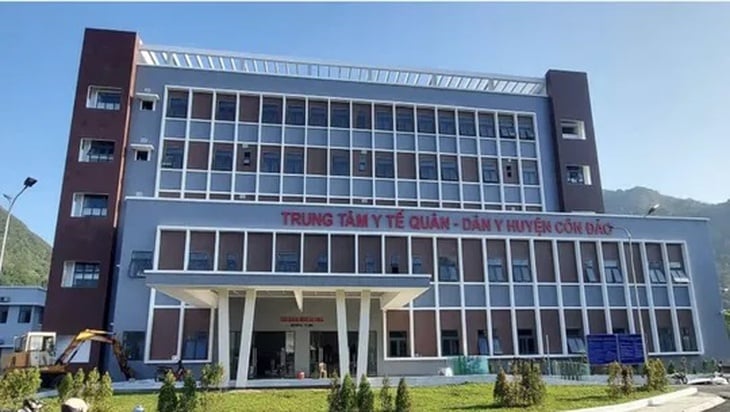
The Con Dao Military-Civilian Medical Center, under the Ho Chi Minh City Department of Health, will soon receive support in the form of specialized medical personnel from general and specialized hospitals in Ho Chi Minh City starting from July 1st. - Photo: Provided by the Department of Health
The new healthcare system in Ho Chi Minh City will include 162 hospitals, comprising 12 hospitals under ministries and sectors, 32 general hospitals, 28 specialized hospitals, and 90 private hospitals.
In addition, the number of private clinics has also increased significantly. Specifically, there are approximately 9,886 specialized clinics, 351 general clinics, and 15,611 pharmacies and drugstores.
According to Associate Professor Tang Chi Thuong, with the new healthcare system, diverse in types and increasing in number of facilities, along with the expanding geographical area, many challenges arise in the management of the city's health sector, requiring a unified, flexible, and modern management mechanism.
"The Ho Chi Minh City Department of Health will promote the application of information technology and digital transformation in management and operation, ensuring rational resource allocation and strengthening connections between different levels and medical facilities."
"At the same time, we need to build a workforce with sufficient capacity to adapt to the new organizational model, in order to better meet the increasingly high and diverse healthcare needs of the city's people in the new phase," he said.
Expand the coverage of the 115 emergency network throughout the entire area.
Regarding the 115 Emergency system, Ho Chi Minh City currently has 1 115 Emergency Center and 45 satellite emergency stations, mainly located in existing areas.
In the coming period, the city's health sector will continue to expand the network of satellite emergency stations to ensure full coverage of the new city area.
The Department of Health is advising the People's Committee of Ho Chi Minh City on a plan to merge non-hospital centers with the same name (City Center for Disease Control, Medical Examination Center, Forensic Examination Center) with the goal of streamlining, efficiency, effectiveness, and effectiveness in accordance with the directives of the city's leadership.
Also, as of July 1st, the city has 110 social welfare centers, including 15 public centers and 95 private centers.
Source: https://tuoitre.vn/he-thong-y-te-tp-hcm-hoat-dong-ra-sao-tu-ngay-1-7-20250630184253815.htm




































































Comment (0)