

The U.S. reached an agreement to strengthen its nuclear umbrella with South Korea, but this move is unlikely to be sustainable and could further provoke North Korea.
In a White House press conference on April 26, US President Joe Biden made his strongest commitment yet to ally South Korea, warning that North Korea would face "the end" if it launched any nuclear attack against Washington or Seoul.
Biden's comments came as the two leaders released the Washington Declaration, in which the U.S. offered South Korea a robust "nuclear umbrella" with a commitment to deploy nuclear submarines carrying ballistic missiles to the country to bolster its nuclear deterrence capabilities against North Korea.
In return, South Korea affirmed that it would abandon its intention to develop a domestic nuclear weapons program, which was part of its obligations after signing the Nuclear Non-Proliferation Treaty.
Biden also said the U.S. would establish a "Nuclear Consultative Group (NCG)" to assist South Korea in planning for contingencies and scenarios involving the use of nuclear weapons.
The Washington statement was issued during South Korean President Yoon Suk-yeol's six-day state visit to the United States, as the two countries celebrated the 70th anniversary of the establishment of diplomatic relations. During the visit, strengthening the U.S. "nuclear umbrella" for South Korea against the growing threat from North Korea was a central issue discussed by the two leaders.
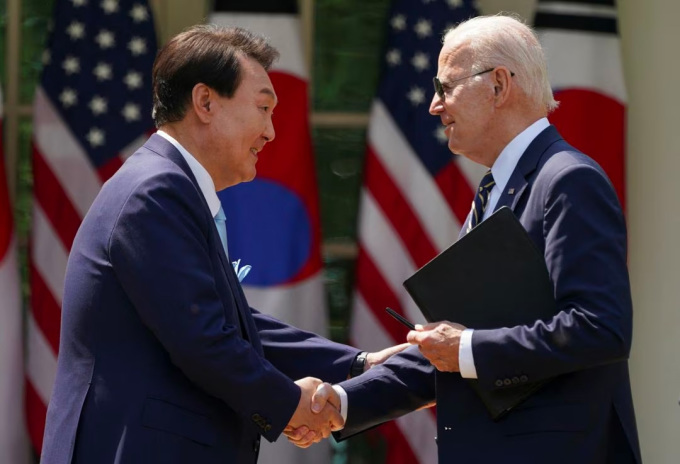
US President Joe Biden (right) and South Korean President Yoon Suk-yeol at the White House in Washington, D.C., on April 26. Photo: Reuters
Last year, Pyongyang conducted an unprecedented number of missile tests. Earlier this month, North Korea launched its first solid-fuel intercontinental ballistic missile, a major step forward in Pyongyang's nuclear capabilities. U.S. and South Korean officials believe North Korea is preparing to conduct its first nuclear test since 2017.
Concerns about North Korea's weapons program have led South Korean politicians and the public to repeatedly call for the government to develop its own nuclear weapons program, rather than relying on U.S. security guarantees. Over the past decade, polls have shown that around 70% of South Koreans support the country possessing nuclear weapons.
However, South Korea's possession of nuclear weapons would likely spark a large-scale arms race in Northeast Asia, further increasing the threat from nuclear weapons. Therefore, the Washington Declaration is considered the most logical solution to address this concern.
However, Frank Aum and Adam Gallagher, two analysts at the U.S. Institute of Peace, do not believe this agreement will actually deter North Korea, nor alleviate South Korean public concerns about not having its own nuclear weapons.
Research and history show that increased deterrence measures by the U.S. and South Korea often fail to prevent aggressive actions by North Korea, and tend to exacerbate the situation.
A 2000 study by Jordan Bernhardt and Lauren Sukin showed that North Korea often responds to joint US-South Korean military exercises with a series of missile launches. The intensity of these missile tests depends on the scale of the US-South Korean exercises.
From 2013 to 2017, as the alliance intensified joint exercises in response to North Korea's third nuclear test in February 2013, Pyongyang responded with significant advances in its nuclear weapons program, conducting three more nuclear tests and over 90 ballistic missile tests.
Last year, Pyongyang conducted a record number of missile tests and unveiled a range of new weapons, including hypersonic glide vehicles and unmanned submersibles. These moves were made both in response to US-South Korea joint military exercises and to project a show of force after four years of de-escalation in an unsuccessful attempt to pursue nuclear negotiations with Washington.
"If the larger goal of the U.S. and South Korea is to prevent conflict on the Korean Peninsula, the question is whether this enhanced deterrence through the nuclear umbrella is necessary and wise," Frank Aum and Adam Gallagher questioned.
The nuclear and military capabilities of the US-South Korea alliance over the past 70 years have been substantial enough to deter any military action by North Korea. However, the vicious cycle of both sides strengthening their military capabilities under the guise of deterrence has repeatedly escalated tensions and fueled an arms race on the peninsula and in the region.
Observers believe that the Washington Declaration and the nuclear umbrella offered by the U.S. to South Korea cannot completely end the anxiety and debate in South Korean public opinion regarding nuclear weapons. According to experts, South Korean support for possessing its own nuclear capabilities is not entirely due to the threat from North Korea or a lack of confidence in the U.S. commitment to deterrence.
Karl Friedhoff, an expert at the Chicago Council on Global Affairs, argues that the biggest problem with the Washington Declaration is that it is not a treaty, meaning the commitments within it could become completely worthless if the US political landscape changes after the 2024 presidential election.
One prominent candidate in this election is Donald Trump, who significantly reduced joint military exercises with South Korea during his time in office, and even controversially demanded that Seoul contribute more to the cost of US forces stationed in the country. The scenario of Trump returning to the White House is likely to spark "very serious discussions" in Seoul, according to Friedhoff.
Therefore, this expert believes that the biggest challenge to the US-South Korea nuclear umbrella is something that neither country can control: the internal political situation in the United States.
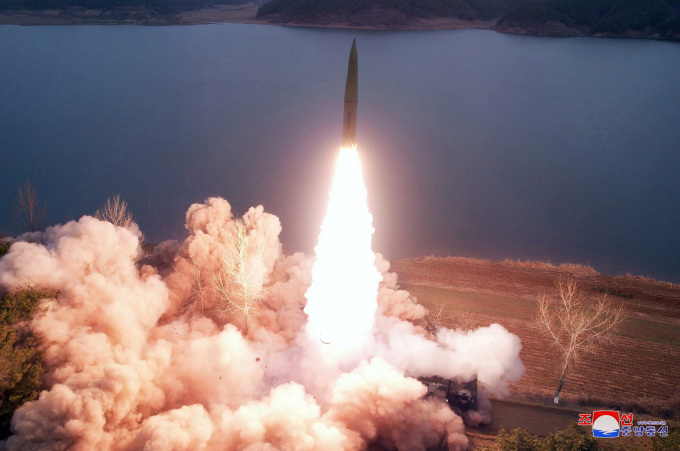
North Korea launched a ballistic missile from South Hwanghae province toward the Sea of Japan on March 14. Photo: KCNA
Analysts at the U.S. Institute of Peace suggest that another approach to de-escalating North Korean aggression and appeasing South Korean public opinion is for Biden and Yoon to find ways to strengthen their engagement with Pyongyang.
Studies indicate that North Korea significantly reduced its military activities and weapons testing during the nuclear negotiations with the United States. Between 1994 and 2002, while the U.S. and North Korea adhered to the Framework Agreement and engaged in nuclear talks, Pyongyang conducted only one ballistic missile test and did not reprocess plutonium.
During the 2018 US-North Korea talks, Pyongyang did not conduct any nuclear or missile tests, and South Korean public support for developing its own nuclear weapons also dropped from 70% to 50%.
"However, the Washington Declaration only mentions dialogue and diplomacy with North Korea in the last sentence," Frank Aum and Adam Gallagher stated.
Nevertheless, the Washington Declaration achieved at least two things: a commitment from South Korea not to pursue nuclear weapons in the future, and a strong message to Pyongyang that if nuclear missiles were fired, "it would all be over," according to Chun In-bum, a retired South Korean army general.
"North Korea will understand this message and be more cautious in its actions," said Yang Moo-jin, an expert at the University of North Korean Studies in Seoul. "But they are unlikely to be subdued and give up their nuclear arsenal."
Thanh Tam (Based on USIP, Al Jazeera, AP )
Source link
![[Image] Close-up view of the interchange connecting the two expressways and Long Thanh Airport.](https://vphoto.vietnam.vn/thumb/1200x675/vietnam/resource/IMAGE/2026/05/25/1779703378210_ndo_br_z7863716673926-224453a31600126cce10622af6290afd-4549-jpg.webp)


![[Image] Hanoi's urban life under the challenge of a "scorching hot" environment](https://vphoto.vietnam.vn/thumb/1200x675/vietnam/resource/IMAGE/2026/05/25/1779706979265_nang-nong-t5-2026-minh-duy-7-4636-jpg.webp)

































































































Comment (0)