

"Every tree has roots, every river has a source."
Thanh Mien District has more than 40 historical and cultural relics classified by the State, including 6 relics dedicated to figures from the Hung King era. During the annual Hung King Commemoration Day, many schools in the district organize practical activities to help students connect with their national heritage.
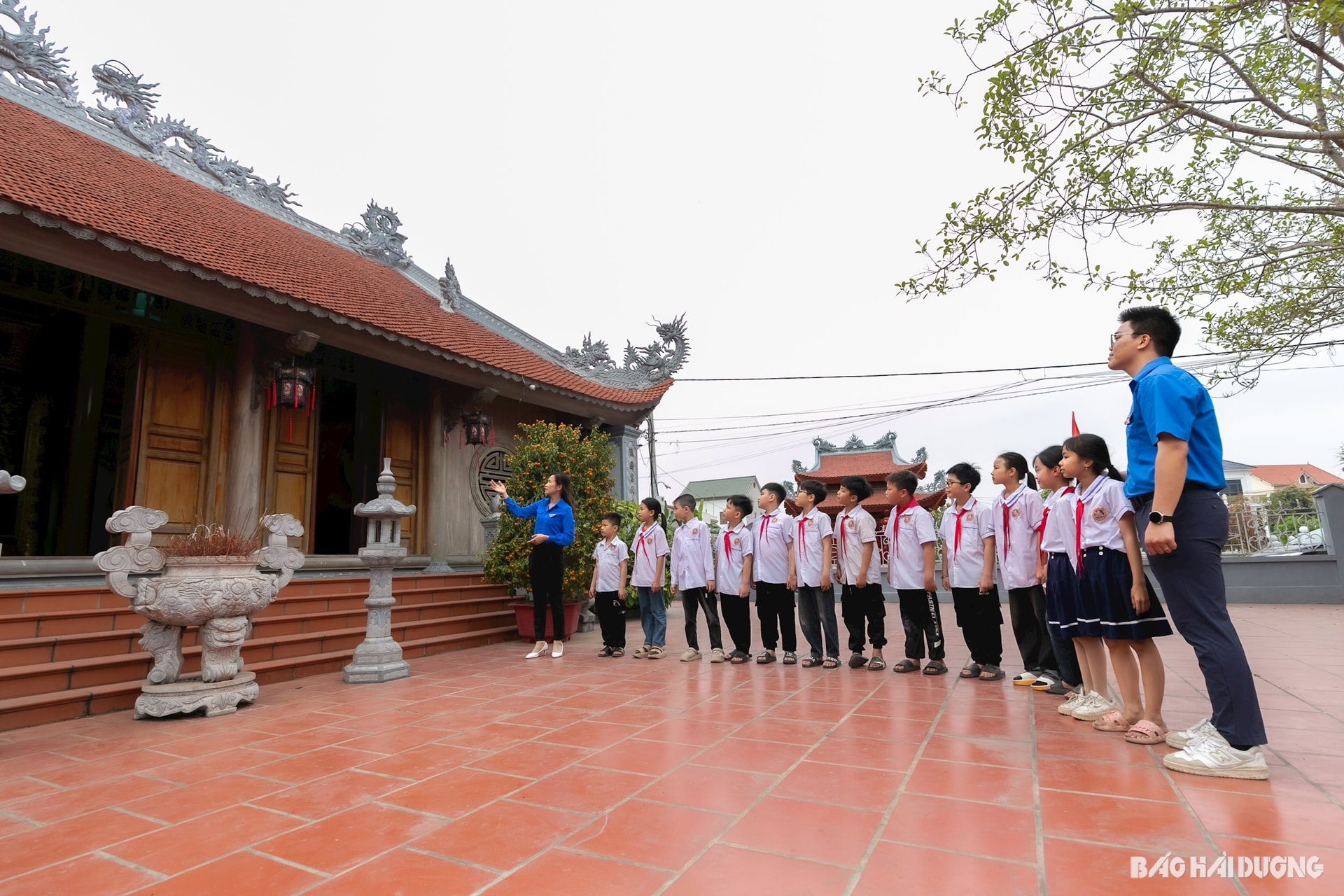
This year, Tu Cuong Primary School organized a "back to the roots" activity for its students. The location chosen by the school for the visit and experience was An Khoai communal house - one of the few places in the province that worships King Hung.
Under the shade of ancient banyan trees, teacher Vu Thi Hoa from Tu Cuong Primary School and her students explored the history and culture of An Khoai communal house and the immense contributions of the Hung Kings to the nation-building and defense efforts. According to Ms. Hoa, this historical site dates back to the early 20th century and was built in the shape of the Vietnamese character "Đinh," consisting of five main halls and three rear halls. Besides worshipping the Hung Kings, An Khoai communal house also venerates three village guardian deities: Dao Dai Hung, Vo Cong Truc, and Bui Khan, all of whom contributed to the Later Le Dynasty. The site still preserves several valuable ceremonial artifacts, notably a gilded wooden scroll dating back 116 years. In 2007, An Khoai communal house was classified as a national historical and cultural relic.
Nguyen Thi Thao My, a 5th-grade student at Tu Cuong Primary School, said: "An Khoai Temple and several other historical sites in the commune are always important landmarks for us. Every year, the school regularly organizes extracurricular activities at these sites to help students better understand the origins and history of our nation. This is also an opportunity for us to learn and improve our knowledge through researching historical sites and the revolutionary traditions of our homeland."
As a tour guide, teacher Vu Thi My from Chi Lang Bac Primary School thoroughly researched Tao Khe communal house. Thanks to this, the extracurricular lesson held at this historical site provided the 5th-grade students with a wealth of useful information. Some students were surprised to learn that the communal house worships four village guardian deities, all descendants of King Lac Long Quan, and that the communal house played a role in the Trung Sisters' rebellion against the Eastern Han invaders.
"Some students live near historical sites but don't know who is worshipped there or what the contributions of these figures were. Organizing extracurricular activities is necessary to help students become more aware of national and local history," teacher My shared.
Diverse methods
The Thu Phap communal house in Doan Ket commune is a clear historical testament to the Hung King era. It houses a historical record written in Chinese characters about the fascinating and mysterious legend of Tan Vien Son Thanh (commonly known as Son Tinh). Every year during the Hung King's Commemoration Day, this national historical site welcomes many groups of students for visits.
Doan Ket Secondary School has carried out many practical activities at the Thu Phap communal house historical site. Here, students learn about the customs, beliefs, and traditional festivals of their homeland. They also learn about the historical site and act as tour guides to promote local culture and history. Every year during the festival season, the school organizes activities for students such as cleaning up the environment, performing arts, and participating in the procession of the sacred palanquin.
According to Mr. Le Anh Tuan, Head of the Education and Training Department of Thanh Mien District, historical relics are of great importance in traditional education, expressing the deep gratitude of today's generation for the sacrifices of previous generations. Organizing practical lessons associated with local historical relics is an effective form of education that helps students raise their awareness of preserving the traditional cultural values of their homeland. Activities such as "Paying gratitude" and "Remembering the source of the water" are also good ways that have a positive impact on the formation of character, cultivating life ideals, willpower, and resilience for generations of students.
DQSource: https://baohaiduong.vn/hoc-sinh-thanh-mien-huong-ve-nguon-coi-408352.html


![[Image] Nearly 125,000 Hanoi students completed the Literature exam for the 10th grade entrance exam.](https://vphoto.vietnam.vn/thumb/1200x675/vietnam/resource/IMAGE/2026/05/30/1780117233041_ndo_br_thiet-ke-chua-co-ten-2-png.webp)















![[Photo] Admire the coral "masterpiece" amidst the million-year-old heritage of Dak Lak province.](https://vphoto.vietnam.vn/thumb/1200x675/vietnam/resource/IMAGE/2026/05/30/1780107638639_y25-jpg.webp)



















































Comment (0)