

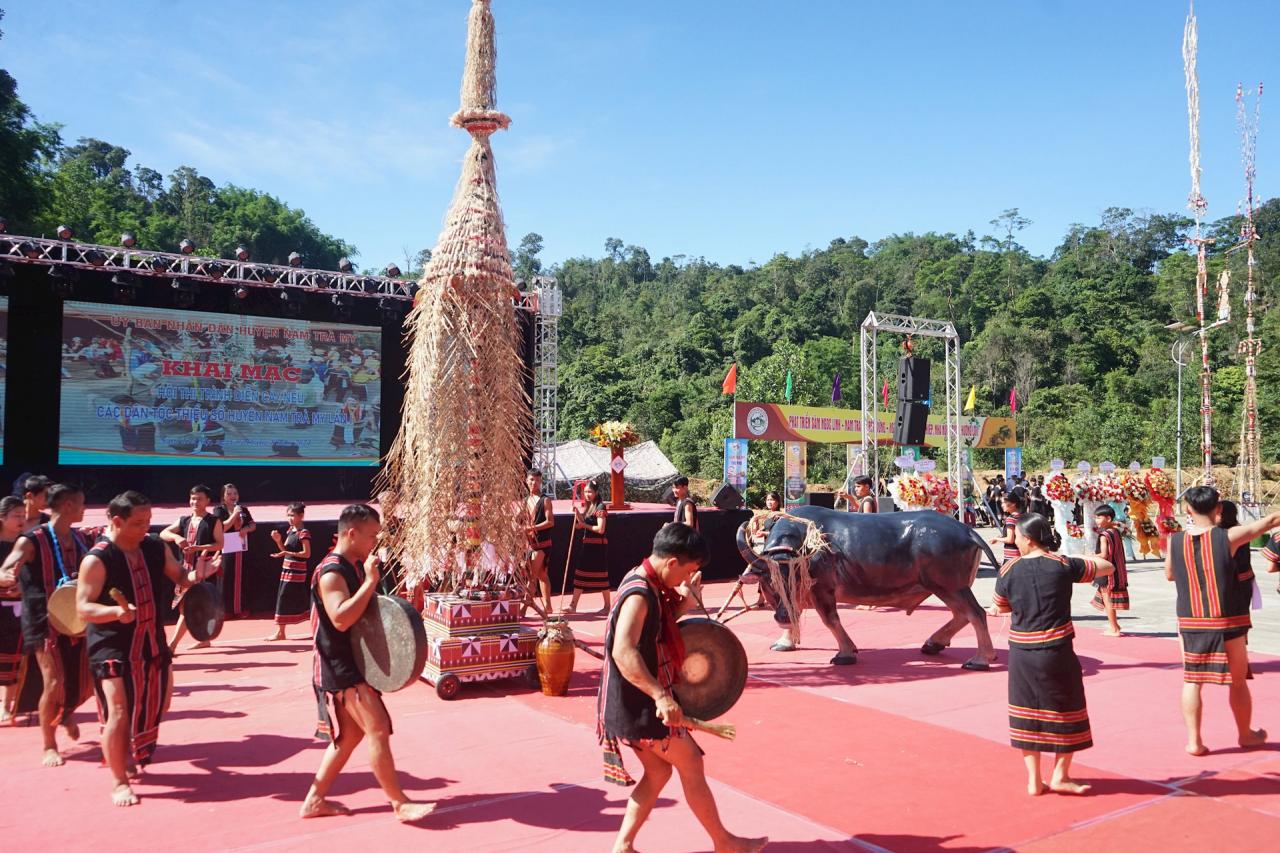
The ceremonial pole is closely associated with the Tet Waterfall Festival, the New Rice Offering Ceremony, the buffalo sacrifice, and weddings of the Ca Dong, Xo Dang, and Mo Nong ethnic groups. Witnessing the actual erection of the pole to worship the gods is not easy, as most ceremonies are held within small villages, without the participation of outsiders.
At this competition, the Mơ Nông people in Trà Leng commune brought a vibrant "Rang" ceremonial pole and reenacted the buffalo sacrifice ritual. The pole was made from natural materials such as bamboo, reeds, tung wood, and rattan vines. Near the base of the pole, the artisans arranged rattan vines in an arc shape to tie the buffalo's neck.
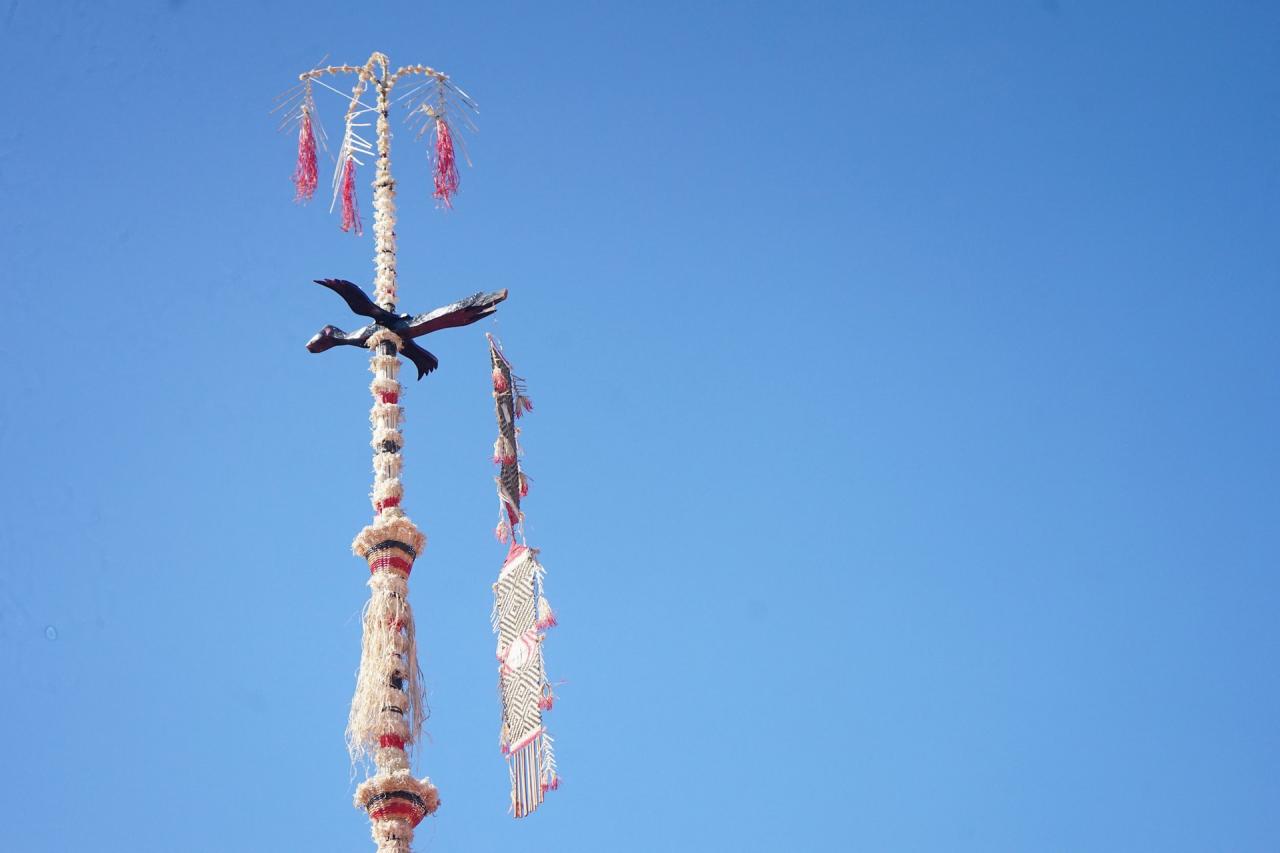
The "Rang" pole is decorated with many motifs, colors, and patterns made from woven rattan in a herringbone pattern, and white silk threads from crushed tung tree bark… symbolizing the strength of the extended family and the village.
The pole also features a decorative vase, symbolizing wealth and prosperity; a swallow perched in the center, a kite, and three jars for collecting fortune. The top of the pole is divided into three branches: the central, tallest branch represents the husband, while the two smaller branches represent the wife and children.
The motifs on the New Year's pole vividly reflect the daily life and work of the Mơ Nông people; at the same time, they express the people's aspirations for a prosperous and abundant life, bountiful harvests, and flourishing nature.
[ VIDEO ] - Performance of the ceremonial pole in the reenactment of the buffalo sacrifice ritual of the people of Nam Tra My:
Meanwhile, the Xơ Đăng people in Trà Nam and Trà Linh communes brought a ceremonial pole decorated with motifs in predominantly black and white colors. The lines and patterns on the pole's body feature a full range of square, round, and rectangular shapes...
The Xơ Đăng people decorate the ceremonial pole in vibrant colors, hoping that the mountain and water spirits will see the sincerity of the villagers, grant the village a bountiful harvest, allow trees to sprout and flourish, and bestow health and happiness upon each villager.
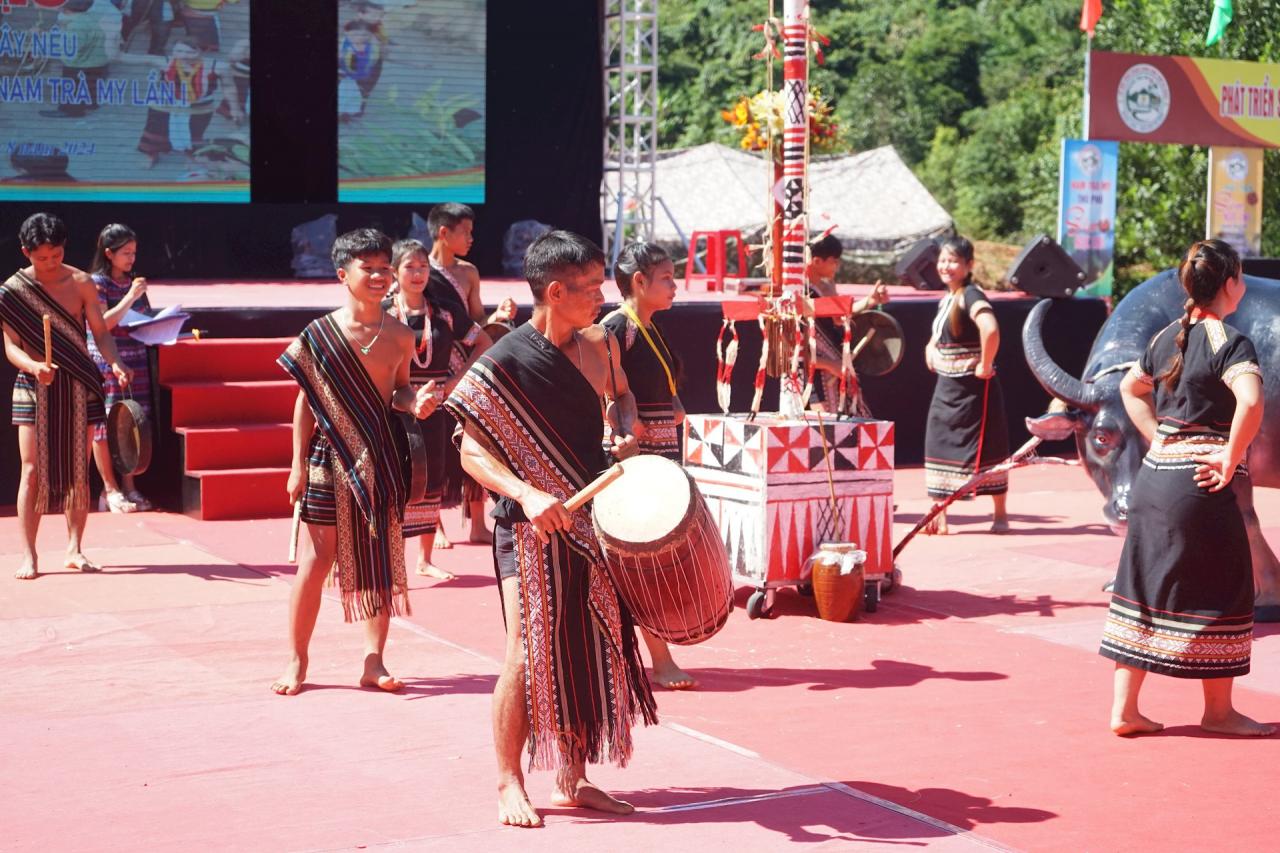
The Ca Dong people of Tra Tap, Tra Mai, Tra Don communes, etc., believe that the ceremonial pole (cay neu) is a bridge connecting the human world and the spirit world. It is a place where villagers offer sacrifices to thank heaven and earth, guiding their ancestors and the deceased to the eternal realm; at the same time, it connects people with people, one house with another, one village with another, creating a community that lives together in unity and prosperity.
Typically, the Ca Dong people's ceremonial pole is made from bamboo, reeds, or chò wood, symbolizing strength and resilience. The pole is usually about 13-15 meters high, connected by forest vines, and decorated with skillfully crafted bamboo flowers.
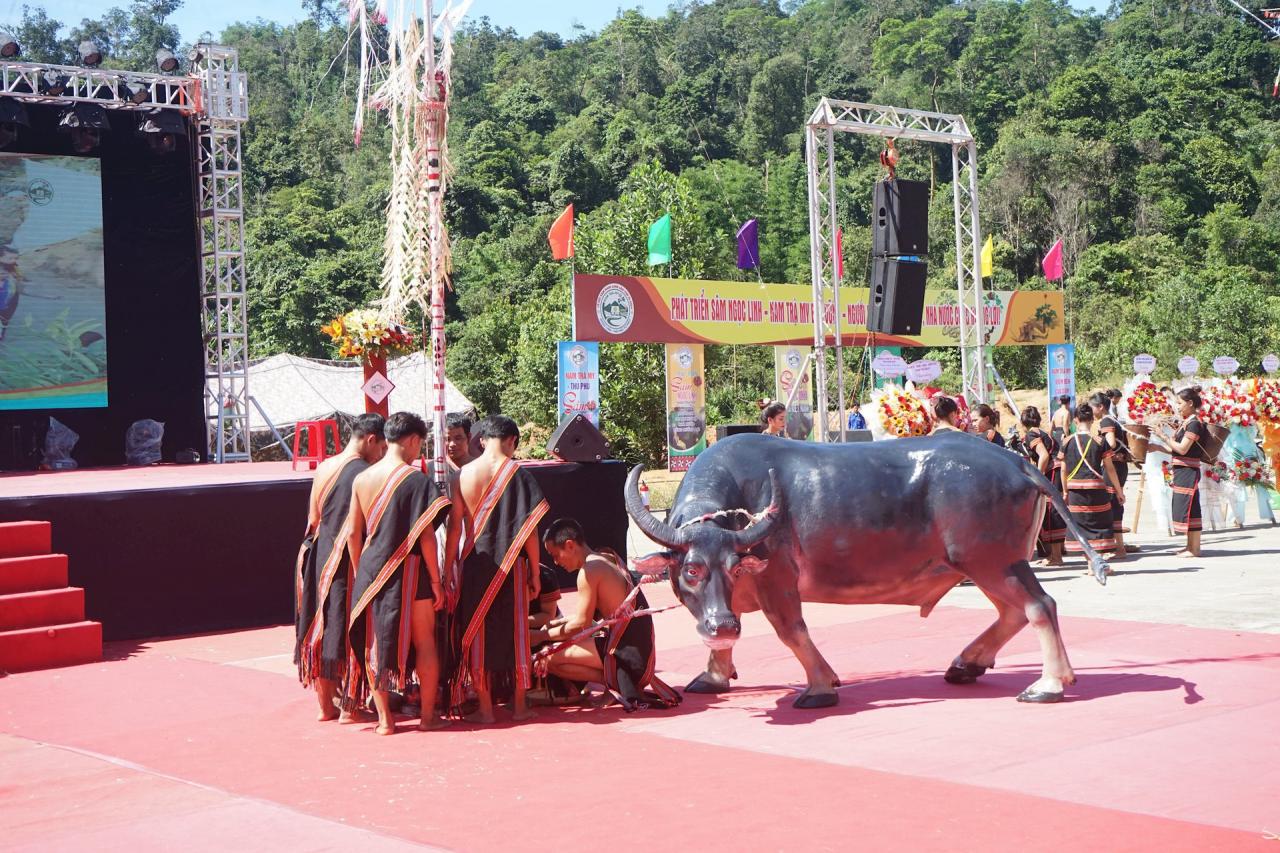
The ceremonial pole is adorned with impressive decorative motifs in five colors (five-colored), which are made from ground bark from forest trees or betel nut residue mixed with soot and lime. Each pattern tells a story. The Ca Dong people believe that the more colorful, tall, beautiful, and unique the ceremonial pole is, the more it demonstrates the skillful craftsmanship of the village artisans.
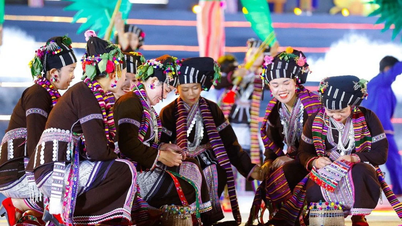
In the festival space, 10 communes in Nam Tra My district brought ceremonial poles according to the standards of the organizing committee. The poles stood out against the blue sky, beneath which young men and women danced to the chanting of the village elders, reenacting the ritual of sacrificing a flower buffalo.
Source: https://baoquangnam.vn/hoi-thi-trinh-dien-cay-neu-cua-dong-bao-vung-cao-nam-tra-my-3138934.html


![[Photo] Prime Minister Pham Minh Chinh attends the Conference on the Implementation of Tasks for 2026 of the Industry and Trade Sector](/_next/image?url=https%3A%2F%2Fvphoto.vietnam.vn%2Fthumb%2F1200x675%2Fvietnam%2Fresource%2FIMAGE%2F2025%2F12%2F19%2F1766159500458_ndo_br_shared31-jpg.webp&w=3840&q=75)






























































Comment (0)