

Foreign tourists "fall in love" with Xam singing.
During a street interview with international tourists in the Hoan Kiem Lake pedestrian area ( Hanoi ), when introduced to and played a sample of traditional Xam folk singing, many tourists expressed surprise.
Initially, it was curiosity about a completely unfamiliar form of music , but after just a few minutes, many tourists were captivated by melodies deeply rooted in traditional Vietnamese culture.

Dan and Elle, two tourists from Europe, said they had never heard of Xam singing before arriving in Hanoi. However, their chance encounter with this folk art form left an unforgettable impression on them.
In particular, the artist's voice and performance deeply moved Dan. He shared: "What impressed me most was the artist's voice. It was like listening to a life story told through emotion. Even though I didn't understand Vietnamese, I could still feel the experience, the joys and sorrows, and the thoughts conveyed through each lyric."
Meanwhile, Elle was captivated by the sounds of traditional musical instruments. The sounds of the stringed instruments and percussion created a musical atmosphere very different from anything she had heard in the West.
She expressed: “I feel this music has a very strong guiding quality. It makes listeners want to listen longer to explore . It's not the kind of upbeat music that makes you want to dance immediately, but rather the kind of music that makes you curious about the people and culture behind it.”

Not only on the Ho Guom pedestrian street, but Xam folk songs also attract the attention of many international tourists in the Ho Van area, part of the Van Mieu - Quoc Tu Giam historical complex (Hanoi).
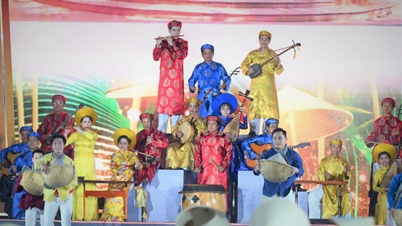
In this ancient setting, steeped in traditional culture, folk art performances, especially Xam singing, often attract large audiences from both within and outside the country. Many tourists arrive early, attentively watching each performance, listening to the simple sounds of the two-stringed fiddle and clappers harmonizing with the narrative-rich songs.

Alicia, a tourist from the United States, paid special attention to the Xam singing performance. She expressed: "I used to think that ancient art forms usually only appeared in museums or shows specifically for tourists."
But here, I see many locals also coming to watch and enjoy it very attentively. This shows that this art form still has a place in contemporary life.”
According to the female tourist, directly experiencing a traditional performance offers a completely different experience compared to learning about it through guidebooks or videos on social media. Through the music, the performance style, and the atmosphere of the show, she gained a deeper understanding of the cultural depth of the destination.

The positive reception from international audiences shows that Xẩm (a traditional Vietnamese folk music genre) still possesses its own unique appeal, transcending language barriers. For many tourists, this is an opportunity to get closer to the history, life, and soul of the Vietnamese people.
The attentive gazes, the applause after each performance, and the prolonged conversations after the show all demonstrate that the value of Xẩm (a traditional Vietnamese folk music genre) is still spreading to new audiences, including international friends.
Young people learn, practice, and spread Xam (a traditional Vietnamese folk music genre).
While Xẩm was previously often mentioned as an art form that needed preservation, today, many young people are choosing to approach this heritage with a different mindset: learning to understand, practicing to preserve, and creating to spread. For them, Xẩm is not just a memory of the past, but also a part of their identity that can accompany contemporary life.
Nguyen Khanh Linh, a young woman from Generation Z who is studying Xam singing, said that the more she learns, the more she realizes that behind the simple lyrics lies a treasure trove of technique and cultural depth.
Khánh Linh shared: "When I started learning Xẩm (a traditional Vietnamese folk singing style), I realized that it's not simply about memorizing lyrics or singing the melody correctly. Every aspect of articulation, breathing technique, and rhythmic control requires perseverance and a keen sense of perception. Some melodies may seem simple, but conveying their essence is a very long process."
According to Linh, the most appealing aspect of Xẩm lies in the life stories embedded in each song. This is what helps young people today find a connection to their national cultural roots amidst countless modern entertainment trends.

Beyond simply learning and performing, many young people are proactively seeking new ways to bring Xẩm closer to the public. One such project is the Sắc Xẩm project , undertaken by a group of students from the Creative Writing and Journalism Department of Hanoi University of Culture.
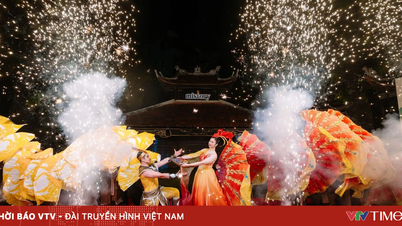
Unlike the familiar image of traditional art performances, Sắc Xẩm is designed as a creative space combining Xẩm singing, fashion shows, and modern stage effects.
Through the interplay between traditional elements and contemporary artistic language, the program aims to convey the message that heritage always has the ability to adapt and continue to "live" in contemporary life if approached appropriately.
Besides the performances, the program also creates a space for dialogue between artists, researchers, and the audience. Through these interactive activities, participants have the opportunity to better understand the history, artistic characteristics, and challenges in preserving and promoting the value of Xam singing in the modern context.
As an artist with many years of experience in Xẩm (a traditional Vietnamese folk music genre), Mai Tuyết Hoa believes that finding new approaches is essential to broaden the audience for this heritage. According to her, experiments combining Xẩm with modern genres like rap or EDM have sparked much debate, but the important thing is to see this as an effort to bring the heritage closer to the younger generation.
"The heritage only truly comes alive when it continues to be practiced and creatively adapted in contemporary life. If young people feel connected to and want to learn about Xam through new approaches, that is also a positive sign for the future of this art form," artist Mai Tuyet Hoa expressed.

From a research and practice perspective , musician Nguyen Quang Long stated: "People often think that preserving heritage means keeping exactly what our ancestors left behind. But with Xam, if we 'freeze' it, we are losing the inherent vitality of this art form. The core essence of Xam is its improvisational nature and relevance to current events."
In the past, our ancestors sang in crowded places, on trams, and about the social life of the time. Today, Xẩm (a traditional Vietnamese folk singing style) must also tell the story of the 21st century.
"When we maintain the artistic essence of Xẩm melodies but expand the scope of content, combining it with trendy music of young people, Xẩm will automatically have new vitality, 'fitting' into any global musical space," the musician emphasized.
Source: https://baovanhoa.vn/nghe-thuat/khi-hat-xam-cham-den-trai-tim-nguoi-tre-va-du-khach-quoc-te-233697.html




![[Photo] General Secretary and President To Lam presides over a meeting on preparations for the review of one year of operation of the three-tiered government system.](https://vphoto.vietnam.vn/thumb/1200x675/vietnam/resource/IMAGE/2026/06/02/1780391821195_a1-bnd-4595-9717-jpg.webp)

















































































Comment (0)