


The transportation market is imbalanced, with road transport still accounting for approximately 75% of the volume of goods transported. Photo: NK
In 2025, Vietnam's import and export turnover is projected to reach nearly US$930 billion; freight transport volume will exceed 3 billion tons, a 14.1% increase compared to the same period. These figures demonstrate that the scale of goods circulation in the economy has entered a completely different phase. However, behind this growth picture remains a bottleneck that has been discussed extensively but has seen little improvement: the majority of goods are still transported by road.
At the conference on promoting multimodal transport development organized by the Ministry of Construction last week, Minister Tran Hong Minh frankly acknowledged that multimodal transport in Vietnam still has many shortcomings. According to the minister, the transport market share is unbalanced, with road transport still accounting for about 75% of the volume of goods transported, while rail transport - a mode capable of transporting large volumes - only accounts for about 0.18%.
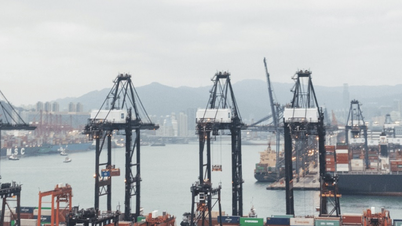
Vietnam's maritime fleet is limited, with most of its transport volume concentrated in foreign shipping companies. Inland waterway transport, despite its cost advantage, has not developed proportionally due to bottlenecks in waterways and bridge clearance. Connections between railways and seaports, inland container depots (ICDs), and major cargo hubs are virtually non-existent.
It's worth noting that this isn't simply a transportation issue. Logistics is essentially an input cost for exports, industrial production, e-commerce, and national competitiveness. When logistics costs are high, export businesses lose their competitive advantage; when the transport chain relies too heavily on road transport, the economy becomes more vulnerable to fluctuations in fuel prices or disruptions in the global supply chain.
According to Mr. Do Cong Thuy, Deputy Director of the Department of Transport and Traffic Safety (Ministry of Construction), multimodal transport allows for the optimal combination of various modes of transport within the same logistics chain instead of operating them separately. This model helps leverage the strengths of each mode, reduce costs, and improve the efficiency of infrastructure utilization.
In many developed economies, multimodal transport has become the dominant model for organizing transportation. Instead of developing each mode separately, these countries organize logistics chains around clusters of seaports, logistics centers, and interregional transport corridors. As a result, logistics costs are typically only 9-11% of GDP. Meanwhile, in Vietnam, the proportion of multimodal transport is still below 10%, and logistics costs remain around 16-17% of GDP.
It is worth noting that Vietnam does not lack the potential to change this situation. Its transportation infrastructure has developed very rapidly in recent years: over 3,300 kilometers of expressways, over 7,000 kilometers of national inland waterways, 34 seaports, 22 airports, and a railway network spanning over 3,100 kilometers. However, despite this growing infrastructure, transportation methods still largely operate on a " каждый за себя" (every man for himself) basis.
According to Mr. Thuy, the core issue for developing multimodal transport "lies not only in building more infrastructure, but also in the capacity to organize, connect, and optimize the existing system."
This is the most pressing issue in logistics today. After years of massive investment in transportation infrastructure, what the economy needs is a reorganized, integrated transportation system, not simply more roads or ports. Without solving the connectivity problem, logistics costs will be very difficult to reduce effectively, even with the addition of thousands of kilometers of highways or the construction of new seaports.
Many opinions at the conference also indicated that the "bottleneck" of multimodal transport today does not lie entirely in hard infrastructure.
According to Mr. Nguyen Quoc Vuong, Deputy General Director of Vietnam Railways Corporation , the North-South transport axis needs to be reorganized so that railways handle long-distance container transport; roads play the role of consolidating and distributing goods at the final stage; and sea transport is responsible for import and export transport, international transshipment, and domestic transport. At the same time, it is necessary to promote the connection of railways with the seaport system, develop international intermodal transport, and promote the socialization of investment in railway infrastructure and logistics services.
Mr. Nguyen Ngoc Anh, Deputy General Director of Vietnam Maritime Corporation, believes that building a national logistics data platform and strengthening connectivity and data sharing between logistics businesses, seaports, shipping lines, customs, and management agencies is a crucial foundation for developing multimodal transport.
Meanwhile, Mr. Khuat Viet Hung, Vice Chairman of the Board of Directors of Vietjet Aviation Joint Stock Company, stated that Vietnam almost lacks large-scale air logistics enterprises; the system of warehouses, parking areas for cargo aircraft, and air logistics infrastructure is still insufficient and not developed synchronously. Therefore, according to Mr. Hung, a separate mechanism is needed to develop large air logistics centers such as Noi Bai, Long Thanh, or Chu Lai; at the same time, administrative procedures need to be reformed, a dedicated cargo aircraft fleet needs to be developed, and appropriate incentive policies need to be built to attract businesses to invest in this field.
According to the head of the Ministry of Construction, developing multimodal transport is not only a matter of connecting transportation infrastructure, but also a matter of national competitiveness, economic security, and the aspiration to make Vietnam a regional and global goods transit hub in the new era.
Minister Tran Hong Minh argued that there needs to be a strong shift from developing individual modes of transport separately to organizing an integrated transport system along interconnected chains; from investing in individual infrastructure to developing synchronized infrastructure along highly connected multimodal transport corridors; and simultaneously moving from a decentralized management model to data-driven and digitally-based transport system governance. He requested relevant units to focus on advising and perfecting mechanisms and policies for the development of multimodal transport; and restructuring transport to attract freight transport by waterway and rail, reducing the burden on road transport.
An import-export economy worth nearly $1 trillion will struggle to go far if its logistics chain continues to operate with the mindset of endless lines of trucks on highways. What Vietnam needs now to contribute to double-digit growth is a reorganized, integrated transportation system where road, rail, waterway, maritime, and air transport operate together in a unified, interconnected chain.
Source: https://money.vtv.vn/khi-logistics-van-ket-บน-duong-bo-109260601172621924.htm

























































































Comment (0)