

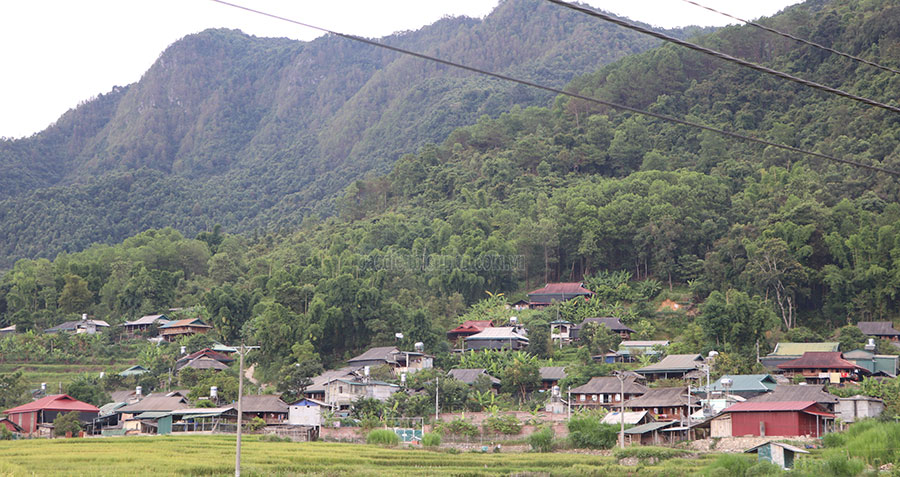
At the beginning of the 2020-2025 term, Tủa Chùa district set a target of having 30% of its villages and hamlets meet the New Rural Area standards by 2025 (equivalent to 31 out of 103 villages and hamlets). However, to date, no villages or hamlets in the entire district have been recognized as meeting the New Rural Area standards. A review of the criteria shows that only 9 villages and hamlets have met 9-10 criteria; 80 villages and hamlets have met 5-8 criteria; and 14 villages and hamlets have met fewer than 5 criteria.
According to Mr. Pham Quoc Dat, Head of the Agriculture and Rural Development Department of Tua Chua District, although the Party committees and authorities at all levels in the district have made efforts to implement the program, they have encountered many difficulties. In particular, some criteria have been pending for many years and are unlikely to improve immediately, such as electricity, multidimensional poverty, income, environment, and food safety… In addition, the program's investment budget is low and does not meet the requirements, mainly relying on integrated funding; some aspects of the program's criteria are difficult to implement; and the mobilization of public participation and non-state resources remains limited.
Similarly, in Dien Bien Dong district, the construction of villages and hamlets meeting the standards of New Rural Areas and model New Rural Areas is also facing many difficulties and obstacles. The entire district registered 5 out of 198 villages and hamlets to meet the standards, but to date, none have been officially recognized as achieving New Rural Area status. Specifically, Trung Tam hamlet (Muong Luan commune) met 10 out of 12 criteria; Muong Luan 1 hamlet met 9 out of 12 criteria; Nam Ngam A and Huoi Tao A hamlets (Pu Nhi commune) both met 7 out of 12 criteria; and Na Phat hamlet (Na Son commune) met 10 out of 12 criteria. The criteria that villages face the most difficulties in implementing are: income, poverty rate, housing, and the percentage of trained workers with degrees and certificates.
Mr. Lo Van Thinh, Chairman of the People's Committee of Pu Nhi commune (Dien Bien Dong district), said: After being recognized as basically meeting the New Rural Area standards in 2020, the commune selected and registered two villages, Nam Ngam A and Huoi Tao A, to build them into New Rural Areas. However, to date, both villages have only achieved 7 out of 12 criteria; the unmet criteria include: income; multidimensional poverty; labor; health ; environment and food safety. In particular, the criterion regarding the percentage of multidimensional poor households in the 2021-2025 period must be below or equal to 13%, which is very difficult to achieve. Meanwhile, the lives of the people in the two villages are still poor, with few effective livelihood models, and people's income mainly depends on agricultural production.
Similar to Tủa Chùa and Điện Biên Đông, the districts of Mường Nhé, Mường Ảng, and Mường Lay town in the province still have no villages or hamlets recognized as meeting the standards of the New Rural Development Program. According to statistics from the Provincial New Rural Development Coordination Office, despite the efforts of localities to implement solutions, only 125 out of 1,445 villages and hamlets in the province have met the standards (including 66 model New Rural Development villages and hamlets). Implementing the criteria according to the set of criteria for New Rural Development villages and hamlets and the set of criteria for model New Rural Development villages and hamlets in the province by 2025 faces many difficulties. Of the total 12 criteria with 29 indicators (New Rural Development villages and hamlets) and 6 criteria with 26 indicators (model New Rural Development villages and hamlets), many criteria and indicators are high and difficult to implement, such as: Income; For villages and hamlets meeting the New Rural Area standards, the percentage of households regularly using electricity from the national grid must reach 95% or higher; there should be no dilapidated houses; the percentage of households sorting waste and having waste collection and treatment pits at home must reach 100%; or the multidimensional poverty rate must be 8% or less for model villages and hamlets...
To accelerate the progress of building villages and hamlets that meet the standards of the New Rural Development Program and model New Rural Development Program, it is necessary to promptly overcome limitations stemming from subjective causes. These include: insufficient and infrequent dissemination of information; some officials and people not fully understanding the role and significance of the New Rural Development Program; and the continued reliance on government support. Simultaneously, it is necessary to strengthen inspection and review to resolve difficulties and obstacles; and effectively integrate various funding sources.
Source


![[Photo] Prime Minister Pham Minh Chinh attends the Conference on the Implementation of Tasks for 2026 of the Industry and Trade Sector](/_next/image?url=https%3A%2F%2Fvphoto.vietnam.vn%2Fthumb%2F1200x675%2Fvietnam%2Fresource%2FIMAGE%2F2025%2F12%2F19%2F1766159500458_ndo_br_shared31-jpg.webp&w=3840&q=75)
























































































Comment (0)