

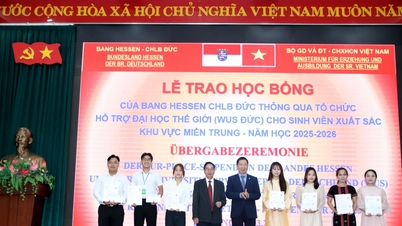
Scholarships are one of the policies used by higher education institutions to attract talented students. Generous scholarship packages not only provide financial support but also offer students numerous opportunities for holistic development and training.
For example, the Vietnam National University, Hanoi's High School Talent Incubation Program (VNU 12+) aims to identify, attract, train, and provide early career guidance for gifted high school students. The program's goal is to create a pool of trained, nurtured, and developed scientists who meet international standards in the future, especially those in the field of basic science.
Not only Hanoi National University, but many higher education institutions have developed scholarship policies to improve the quality of their student intake, aiming to train high-quality human resources to meet the requirements of the country's scientific, technological, and innovative development. One example is the "Nurturing Talents in Mathematics and AI" scholarship fund worth 25 billion VND, extending until 2026, of Ho Chi Minh City National University.
Similarly, the University of Technology - Da Nang University awards scholarships of 50-70 million VND to new students who are directly admitted and achieve high rankings in national and international student competitions. These scholarship policies not only aim to develop the fields of technology, engineering, and artificial intelligence, but also meet the demand for cutting-edge human resources to meet international standards.
On the other hand, some universities are developing scholarship policies to attract students to fields with limited enrollment, aiming to address the imbalance between supply and demand. Training programs in the fields of Natural Sciences, Agriculture, Forestry and Fisheries, Social Services, Life Sciences, Environment and Environmental Protection have all been failing to meet enrollment targets in recent years.
While these are traditional fields with a huge demand for human resources, especially high-quality personnel, Ho Chi Minh City University of Agriculture and Forestry has developed policies to attract students to these hard-to-recruit fields, such as special scholarships and job placement guarantees for graduates.
Each university's scholarship policy reflects its own development strategy. This could prioritize supporting academically gifted students from disadvantaged backgrounds, aiming to improve the quality of education, or focusing on developing human resources for cutting-edge industries to meet the rapid development of the high-tech sector. However, the scholarship packages of higher education institutions generally strike a balance between promoting academic achievement and nurturing talent.
Many underprivileged students, especially first-year students, are able to enroll and cover tuition and living expenses thanks to scholarship programs. Some scholarship funds prioritize first and second-year students, believing that students from their third year onwards can overcome financial difficulties through part-time work opportunities.
Meanwhile, first-year students will feel disoriented as they adapt to a new living environment, making it more difficult to find part-time jobs. The scholarship selection criteria are not only for students with high entrance exam scores, but also support those with special circumstances and clear academic goals.
In the trend of promoting university autonomy, especially financial autonomy, tuition fees are a significant source of revenue not only for private universities but also for the public university system.
Scholarship programs aimed at supporting disadvantaged students and vulnerable groups in society are a way for higher education institutions to fulfill their social responsibility. For students from disadvantaged backgrounds, scholarships help reduce financial barriers, creating equal opportunities in accessing education and enabling them to succeed through their studies and knowledge.
Source: https://giaoducthoidai.vn/khuyen-hoc-va-khuyen-tai-post740913.html

![[Photo] Prime Minister Pham Minh Chinh receives the Chinese Ambassador to Vietnam](https://vphoto.vietnam.vn/thumb/1200x675/vietnam/resource/IMAGE/2026/04/05/1775397481797_ndo_br_dsc-5512-jpg.webp)










































































Comment (0)