Brazil is assuming the G20 presidency for the first time as the country strives to regain its prominent position on the international stage.
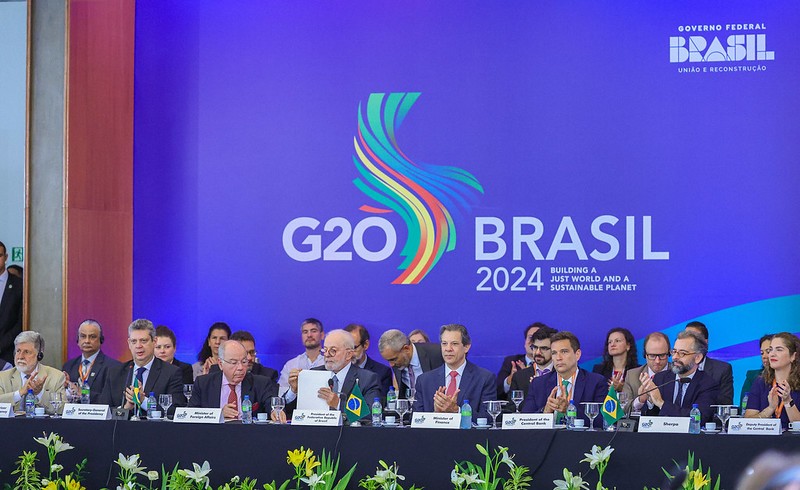 |
| Brazil kicked off its G20 presidency year with the theme "Building a just world and a sustainable planet." (Source: Brazilian Report) |
On December 1st, Brazil officially assumed the chairmanship of the Group of Twenty (G20) leading developed and emerging economies for 2024, with an agenda of over 100 meetings culminating in a summit from November 18-19 in Rio de Janeiro. This is the first year the G20 has expanded to include the African Union (AU) – a bloc with a combined GDP of approximately $3 trillion and a population of over 1.4 billion people.
2024 was also the year Brazil assumed the rotating presidency of the BRICS group of emerging economies; however, as the country's Finance Minister, Fernando Haddad, explained, Brasilia decided to postpone that task to 2025 in order to focus on fulfilling both roles effectively.

As a forum for the world's largest economies, discussions at the G20 primarily focus on global economic cooperation and related issues. Brazilian President Luiz Inacio Lula da Silva is known as an early supporter of the G20, dating back to 2008 when it upgraded from a forum of finance ministers to a forum of heads of state. At that time, he affirmed this as a historic event and expressed great optimism about the G20's future. Brazil's efforts to promote the G20's role are also part of an endeavor to build a better multilateral system in which countries like Brazil play a larger part.
The 2024 agenda focuses on three major themes: combating poverty and inequality; sustainable development with three pillars: economic, social, and environmental; and reforming the global governance system. This shows that host country Brazil places high expectations on its G20 presidency year, aiming to enhance the role of developing countries in the global financial system, especially in increasing concessional loans to poor countries for climate change mitigation projects and restructuring their debts. In addition, this Latin American nation also wants to promote reforms to the global tax system, which have been discussed at the United Nations General Assembly and the Organization for Economic Cooperation and Development (OECD) but have not yet yielded concrete results.
To achieve G20 consensus on these issues, Brasilia needs the support of the Group of Seven (G7), also a member of the G20, as well as China, the world's second-largest economy and the largest creditor of many poor countries at risk of default. In addition, the host country must address the difficult issue of Russia's involvement, given Brazil's membership in the International Criminal Court, an organization that has issued an arrest warrant for President Vladimir Putin. The global situation remains complex and unpredictable, with the lingering negative impacts of the Covid-19 pandemic, geopolitical tensions, armed conflicts in many places, a slowing economic recovery, and concerns about non-traditional security threats such as climate change, environmental pollution, and cybercrime.

These are the challenges Brazil must overcome in 2024 to achieve its expectations during its year as G20 chair, the political and economic forum with the greatest potential to impact and influence international agendas.
Source


![[Photo] General Secretary and President To Lam working with the Technical and Professional Center, Ministry of Public Security](https://vphoto.vietnam.vn/thumb/1200x675/vietnam/resource/IMAGE/2026/07/06/1783318005842_a1-bnd-1129-2263-jpg.webp)