

What solutions can be implemented to reduce the gap in high school exam results between these two regions, especially when assessing students' competencies according to the 2018 General Education Program?
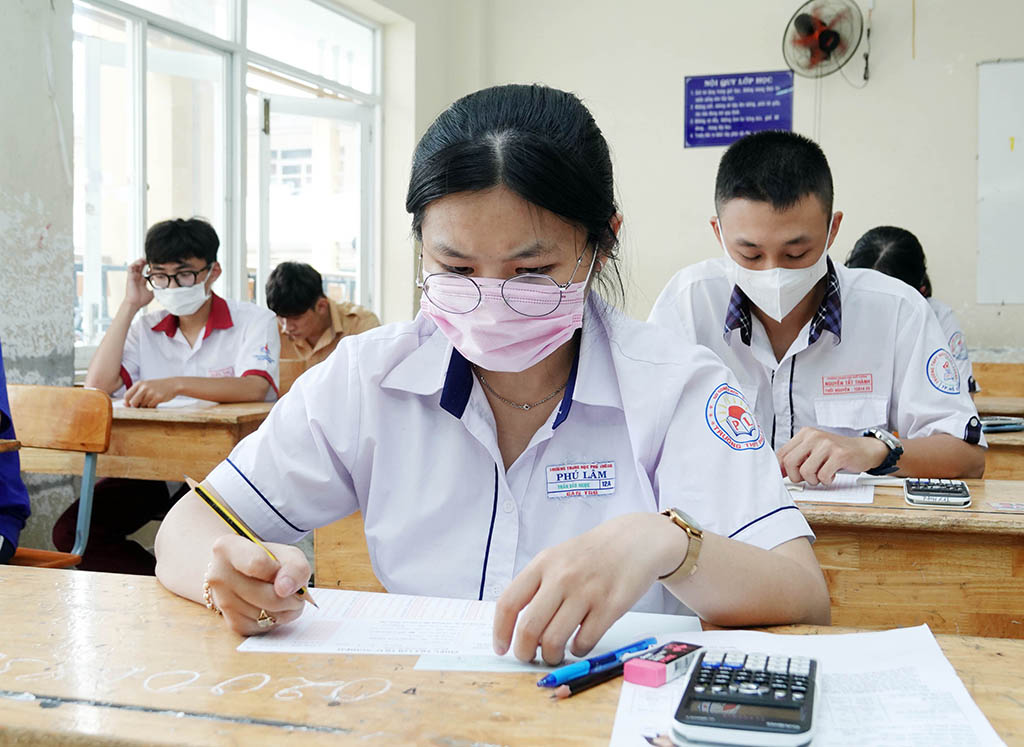
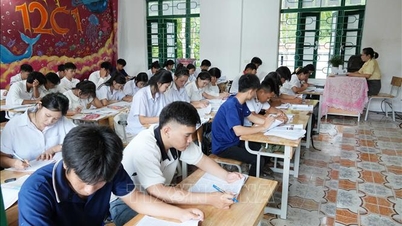
Candidates take the mathematics exam for the 2023 high school graduation exam. This subject shows a significant disparity in scores between regions, which has been increasing over the years.
The regional education gap is shrinking.
Over the past decades, the Government , the education sector, and society have implemented numerous solutions to support education in disadvantaged areas, mountainous regions, rural areas, and areas inhabited by ethnic minorities; as a result, the educational gap between more affluent and disadvantaged regions has narrowed.
This is reflected in the gradual decrease in priority points awarded in university admissions, a practice widely accepted by society. Before 2003, students received a maximum of 3.0 bonus points; from 2004 to 2017, the maximum bonus was 1.5 points; and since 2018, the maximum bonus has been reduced to just 0.75 points.
According to the Ministry of Education and Training, the reason for adding priority points in university admissions is due to disparities in learning conditions across regions. Mountainous, island, and rural areas still face many difficulties regarding schools, teachers, learning environments, and the quality of high school entrance exams. In particular, there is a shortage of teachers during the implementation of the 2018 General Education Program, and the digital transformation in education remains limited in economically and socially disadvantaged areas.
The average scores across the 9 subjects differed by less than 1 point.
Based on the graduation exam results announced by the Ministry of Education and Training, we have compiled and calculated the average scores for 9 subjects across the top 10 and bottom 10 localities for the past three consecutive years. This shows that the difference in scores between these two groups of localities is always less than 1 point.
Specifically, in 2021 (the average score for 9 subjects in the 10 highest-scoring localities was 6.823 points; in the 10 lowest-scoring localities it was 6.003 points; the difference between the two groups of localities was 0.820 points). Similarly, in 2022 (6.859; 5.946; 0.913) and 2023 (6.959; 6.046; 0.913). Thus, if we calculate the average score for 9 subjects, the difference between the 10 highest-scoring localities and the 10 lowest-scoring localities is less than 1.0 point, which is acceptable.
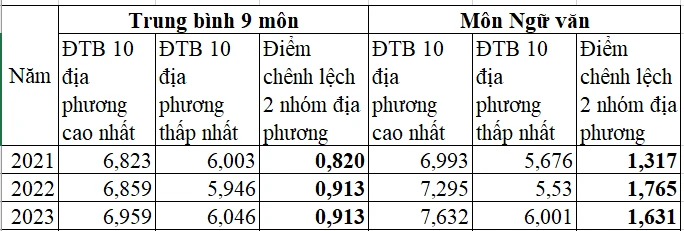
The scores in Literature, Math, and Foreign Language differ by 1.5 to almost 2 points.
However, for the three compulsory subjects—literature, mathematics, and foreign language—the score difference between the top 10 localities and the bottom 10 localities was 1.5 points for literature and nearly 2.0 points for foreign language.
Based on the above calculations, for the Literature subject, the scores in 2021 were (6.993; 5.676; 1.317), in 2022 were (7.295; 5.530; 1.765), and in 2023 were (7.632; 6.001; 1.631). The difference in Literature scores between the two groups of localities was over 1.5 points.
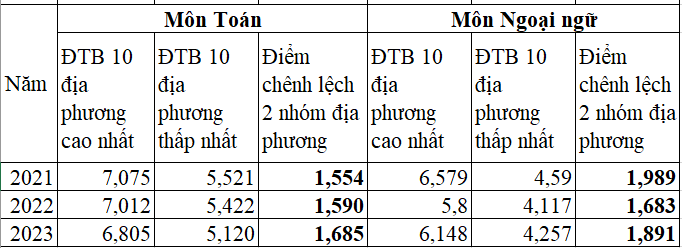
The difference in scores for mathematics is larger and increases over the years. Specifically, in 2021 (7.075; 5.521; 1.554), in 2022 (7.012; 5.422; 1.590), and in 2023 (6.805; 5.120; 1.685). The difference between the top 10 localities and the bottom 10 localities for mathematics is over 1.6 points.
For the foreign language subject, the score difference between the two groups of localities is very large. Specifically, in 2021 (6.579; 4.590; 1.989), in 2022 (5.800; 4.117; 1.683), and in 2023 (6.148; 4.257; 1.891). Thus, the difference in foreign language scores between the two groups of localities is nearly 2.0 points.
The 2018 general education curriculum is oriented towards developing students' competencies and qualities. Graduation exams from after 2025 will assess students based on the competency and quality requirements stipulated in the 2018 general education curriculum. This leads to a high risk of regional disparities if effective solutions are not implemented, as teaching and learning conditions and the quality of student intake in mountainous and disadvantaged areas are consistently lower than in more developed regions.
SOLUTIONS TO REDUCE REGIONAL GAP
The high school graduation exam from 2025 onwards, under the 2+2 model (two compulsory subjects: mathematics and literature, and two elective subjects based on career aspirations), is considered a method that reduces exam pressure and creates a better balance between the proportion of students choosing subjects in social sciences and natural sciences. In particular, making foreign languages an elective subject will reduce pressure on disadvantaged areas.
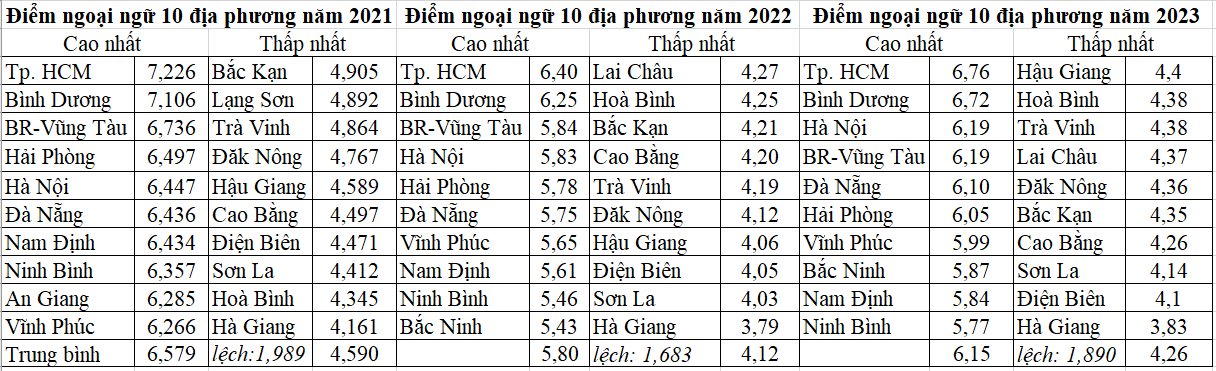
Looking at the statistics of foreign language scores in 2021, 2022, and 2023, it is evident that cities and provinces with high socio-economic development consistently rank at the top; while the northern mountainous provinces, the Central Highlands, and the Mekong Delta – areas with a large number of ethnic minority students – consistently rank at the bottom.
To reduce the regional quality gap through the high school graduation exam, the Ministry of Education and Training first needs to survey, evaluate, and summarize the implementation of the 2018 General Education Program in each region and locality; provide training on exam question design and student assessment methods focused on developing competencies, with a particular emphasis on training and support for teachers in disadvantaged areas. Simultaneously, conduct pilot tests of exam questions across all regions, then compare the results between regions and localities. Exam question design should also ensure fairness across all subjects, avoiding situations where some subjects are too easy and others too difficult.
Next, localities and high schools need to survey students' preferences for graduation exam subjects and strengthen career guidance activities to help students choose subjects that both ensure they pass the graduation exam and align with their own career aspirations.
To ensure the competence of teachers in assessment and exam design, and to enhance their ability to apply knowledge to solve practical problems, teacher training universities in each region need to coordinate with local authorities where the universities are located. Lecturers and high school teachers should collaborate to develop exam questions in the new format, thereby gaining experience to teach teacher training students about testing, assessment, and competency-based assessment methods.
From the students' perspective, parents need to change their viewpoint: learning is about developing abilities and qualities; exams are merely an assessment of one stage of learning, and learning is a lifelong process.
Find the reasons for Vietnam's decline in PISA rankings.
Recently, the 2022 PISA results, which assess the abilities of 15-year-old students in more than 73 countries and territories belonging to the Organization for Economic Cooperation and Development (OECD) and outside the OECD, showed that the results of Vietnamese students have dropped significantly compared to 2018.
In 2018, Vietnam ranked 24th out of 79 countries in mathematics, 13th out of 79 in reading comprehension, and 4th out of 79 in science, above the OECD average. However, in 2022, Vietnam ranked 31st out of 73 in mathematics, 34th out of 73 in reading comprehension, and 34th out of 73 in science, below the OECD average. Particularly noteworthy is the sharp drop in science rankings, from 4th in 2018 to 34th in 2022.
It is very clear that the percentage of students choosing the Social Sciences subject combination in the high school graduation exam is increasing. In 2021, this rate was 64.72%; in 2022, it was 66.96%; and in 2023, it was 67.64%. Especially in mountainous and disadvantaged provinces, this rate is very high, with some provinces exceeding 80%. This trend shows that students choose the Social Sciences subject combination because it is easier to study and graduate, rather than choosing it based on career aspirations.
This trend has led to the majority of Vietnamese students, especially in the provinces, choosing to study social sciences and humanities from grade 10 onwards. Even in Ho Chi Minh City and Hanoi, students in lower-ranked schools tend to choose social science subjects more often. This has resulted in a decline in the overall scientific competence of Vietnamese students compared to many other countries. The increased choice of social science subjects also affects the fact that the percentage of Vietnamese students choosing STEM (science, technology, engineering, and mathematics) fields is much lower than in many other countries in the region and the world. According to data released by the Ministry of Education and Training on December 6, 2023, this percentage in Vietnam in 2021 was 28%, while Singapore was 46%, Malaysia 50%, South Korea 35%, Finland 36%, and Germany 39%.
In Vietnam, students studying STEM fields in the Southeast region account for 58.2% of the total student population in the region, the Red River Delta accounts for 50.2%, the Mekong Delta approximately 15%, the northern mountainous region 10%, and the Central Highlands the lowest at only 2%.
Source link





![[Photo] General Secretary and President To Lam presides over the meeting to approve the draft report on the results of the second inspection by the Politburo of the Standing Committee of the Hanoi City Party Committee.](https://vphoto.vietnam.vn/thumb/1200x675/vietnam/resource/IMAGE/2026/05/26/1779789811432_a2-bnd-4430-9620-jpg.webp)





























































































Comment (0)