

(NLĐO) - Two new satellites, named Sextans II and Virgo III, have unexpectedly appeared in the dark region near the Milky Way galaxy, which contains Earth.
According to Space.com, with their sudden appearance in astronomical data, Sextans II and Virgo III have joined a group of about 60 known dwarf galaxies clustered around the Milky Way, the giant spiral galaxy where Earth resides.
A research team led by Professor Masahi Chiba from Tohoku University (Japan) says these two ghostly objects promise to help us understand more about a mysterious "force" in the universe: dark matter.
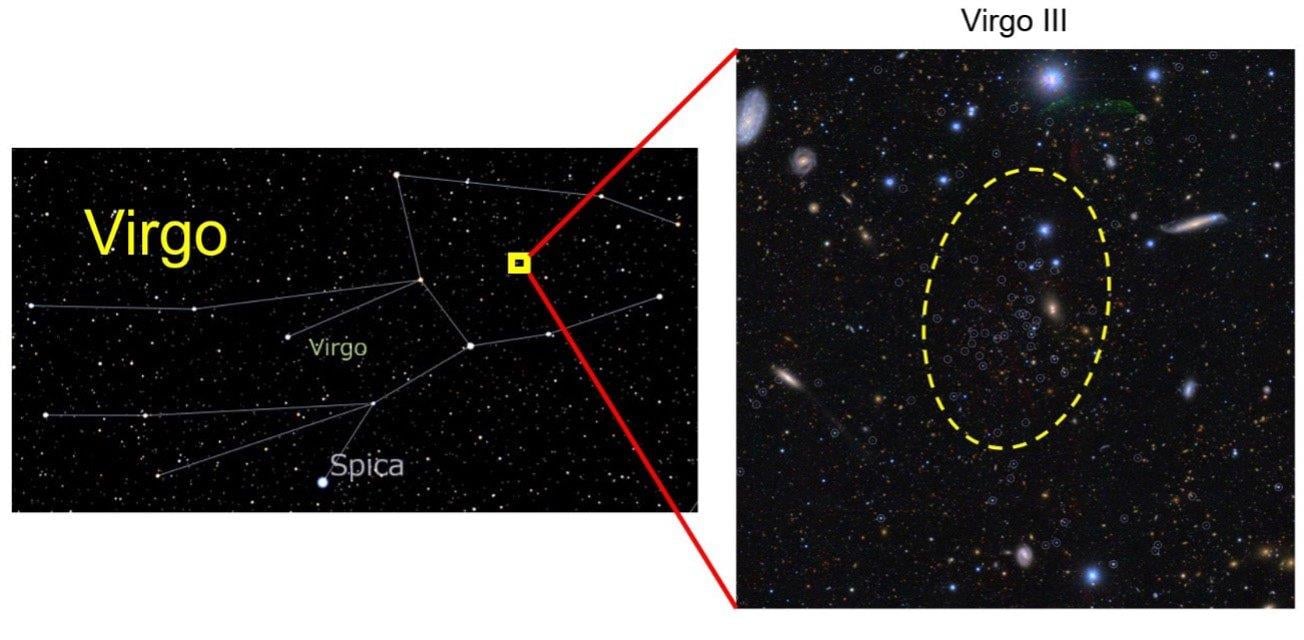
Enlarged image showing the location of the Virgo III galaxy, located in the constellation Virgo, as seen from Earth - Photo: NAOJ/TOHOKU UNIVERSITY
Believing that many more satellites of the Milky Way remain undiscovered due to their great distance and faintness, Professor Chiba and his colleagues embarked on a new hunt using the Subaru telescope located near the summit of Maunakea in Hawaii and found the two aforementioned galaxies.
The existence of the two newly identified dwarf galaxies is strongly linked to dark matter activity.
Dark matter is a persistent cosmic problem because it doesn't interact with light or the ordinary matter that makes up stars, planets, moons, and even ourselves.
However, dark matter makes up 85% of the universe and actually interacts with gravity, potentially affecting the movement and dynamics of light and everyday matter.
This allowed scientists to deduce the presence of dark matter and ultimately determine that large galaxies are surrounded by large halos of this mysterious substance, which plays a crucial role in the galaxy's evolution.
In the early universe, they formed gravitational wells, where gas and dust formed stars within galaxies. Eventually, these halos coalesced, forming large galaxies like the Milky Way.
This model also suggests that if dark matter exists, it would not form a single large galaxy, but rather create hundreds of satellites around it.
For example, the giant galaxy Andromeda, slightly larger than the Milky Way, has as many as 500 moons, while the Milky Way has at least 220.
But we've only seen just over 60 moons of the Milky Way and 39 of Andromeda's.
Therefore, discovering the most elusive satellite galaxies of the Milky Way or Andromeda is also an indirect way to understand how dark matter influences the evolution of cosmic objects.
Most recently, research on Sextans II and Virgo III promises interesting information.
Scientists also noted that even Subaru, a leading figure in the exploration of the Milky Way's satellites, only observed a portion of the sky.
Therefore, there are still many promising pieces to be found as humanity develops more comprehensive and at least as powerful observational telescopes as Subaru.
Source: https://nld.com.vn/lo-dien-2-ke-an-nap-bi-an-ben-thien-ha-chua-trai-dat-196240703102530363.htm


![[Photo] Capturing the moment the tide recedes at Yen Binh Son rapids - a million-year-old scenic spot in Quang Ngai.](https://vphoto.vietnam.vn/thumb/1200x675/vietnam/resource/IMAGE/2026/05/19/1779175463885_yen9-1199-jpg.webp)
![[Photo] General Secretary and President To Lam presides over a meeting on the implementation of Directive No. 34-CT/TW of the Party Central Committee.](https://vphoto.vietnam.vn/thumb/1200x675/vietnam/resource/IMAGE/2026/05/19/1779187768672_a1-bnd-2350-631-jpg.webp)

![[Photo] National Assembly Chairman Tran Thanh Man attends the groundbreaking ceremony for the National Highway 1A spatial axis project.](https://vphoto.vietnam.vn/thumb/1200x675/vietnam/resource/IMAGE/2026/05/19/1779161360398_ndo_br_bnd-1412-jpg.webp)

































































![[Photo] General Secretary and President To Lam receives Indian Defense Minister Rajnath Singh](https://vphoto.vietnam.vn/thumb/402x226/vietnam/resource/IMAGE/2026/05/19/1779184046302_anh-man-hinh-2026-05-19-luc-16-46-58.png)




































Comment (0)