

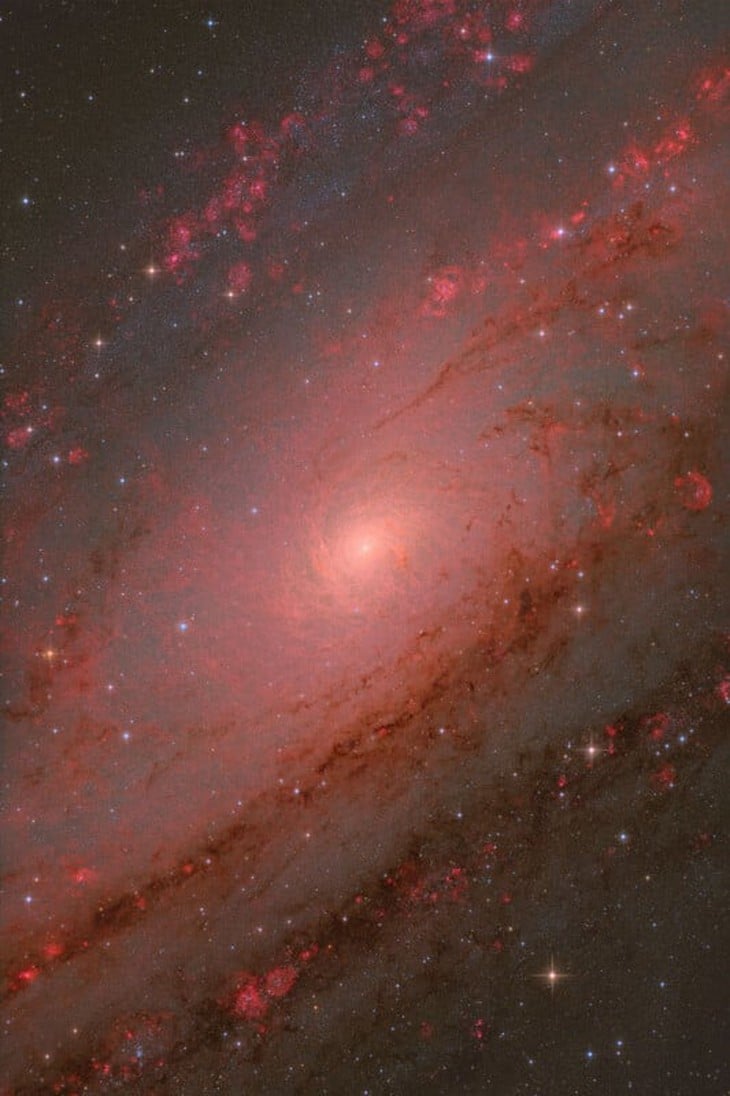
The photograph "Andromeda Spiral Galaxy" by Weitang Liang, Qi Yang, and Chuhong Yu won the top prize in this year's competition.
The winner of this year's Astronomy Photography Contest is the trio of photographers Weitang Liang, Qi Yang, and Chuhong Yu, with their photograph of the spiral galaxy Andromeda . The image, captured over 39 hours of observation, reveals unprecedented detail of the Milky Way's nearest neighboring galaxy.
The ZWO Astronomy Photographer of the Year competition is an annual event organized by the Royal Greenwich Observatory (UK) in collaboration with ZWO Astronomy Equipment, and is considered the "Oscar of the world of astronomical photography".
2025 marks the 17th season, attracting over 5,800 entries from around the world. Entries are divided into diverse categories, including: Auroras, Our Moon, Our Sun, People & Space, Planets, Comets & Asteroids, Skyscapes, Stars & Nebulas, Emerging Talent Award, Young Photographer Award, the Annie Maunder Extended Award, and a Special Award from the Sir Patrick Moore Foundation.
The results of the competition were announced on September 11th in an online ceremony. The winning photos will be exhibited at the National Maritime Museum in the UK from September 12th, 2025.
This is not only a place to celebrate the breathtaking moments of the night sky, but also offers the public the opportunity to admire the magnificence of the universe through the lenses of talented astronomical photographers.
The Young Astronomical Photographer of the Year award goes to Daniele Borsari (Italy) for his work "Orion, the Horsehead and the Flame in H-alpha". Instead of the usual vibrant colors, Borsari used the H-alpha filter to create a unique black-and-white image, emphasizing the shapes and outlines of the nebulae.
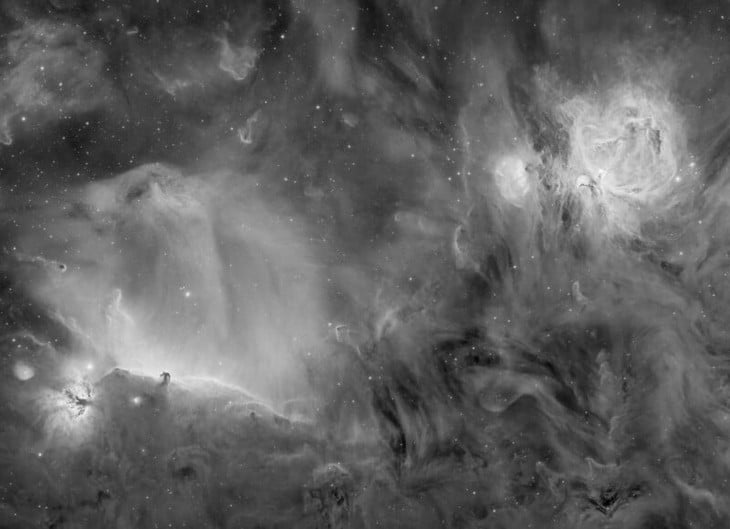
The photograph "Orion, the Horsehead and the Flame in H-alpha" earned Daniele Borsari (Italy) the Young Astronomical Photographer of the Year award.
Astronomer Greg Brown (Royal Greenwich Observatory), a member of the judging panel, commented: "Abandoning color in favor of focusing entirely on structure and detail was a bold decision, and clearly, it yielded fantastic results."
In the frame, swirling clouds of gas and dust intertwine, alternating between contrasting areas of light and shadow, along with scattered stars illuminated against the deep sky. This monochromatic effect highlights the ethereal beauty of the Orion Nebula, Horsehead, and Flame, earning Borsari the ZWO 2025 Young Astronomy Photographer of the Year award.
This year 's Our Moon category is awarded to photographer Marcella Giulia Pace, for her photograph capturing the scattering and refraction of moonlight through the Earth's atmosphere, taken over Sicily (Italy) on April 7, 2024.
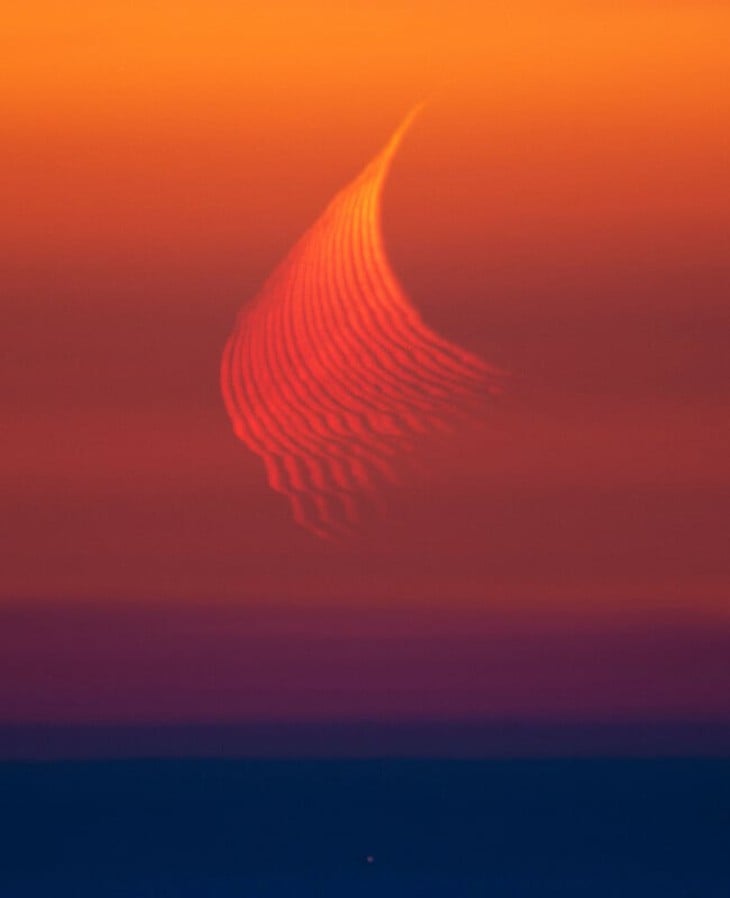
The winning photograph in the "Our Moon" category was taken by photographer Marcella Giulia Pace.
In the image, the halo around the Moon appears with unique bands of color, ranging from red and orange to blue. This phenomenon is the result of Rayleigh scattering, a process in which the Earth's atmosphere deflects shorter wavelengths (blue light), while allowing longer wavelengths (red and orange light) to pass through almost intact.
The photograph not only captures the ethereal beauty of the Moon, but also serves as vivid evidence of the physical laws at work right in our atmosphere.
The Solar category was highlighted by James Sinclair's work, titled "Active Region of the Solar Chromosphere ." The image, taken in September 2024, shows a portion of the Sun's atmosphere with vibrant swirling red and orange rings, centered around a dark region near the center.
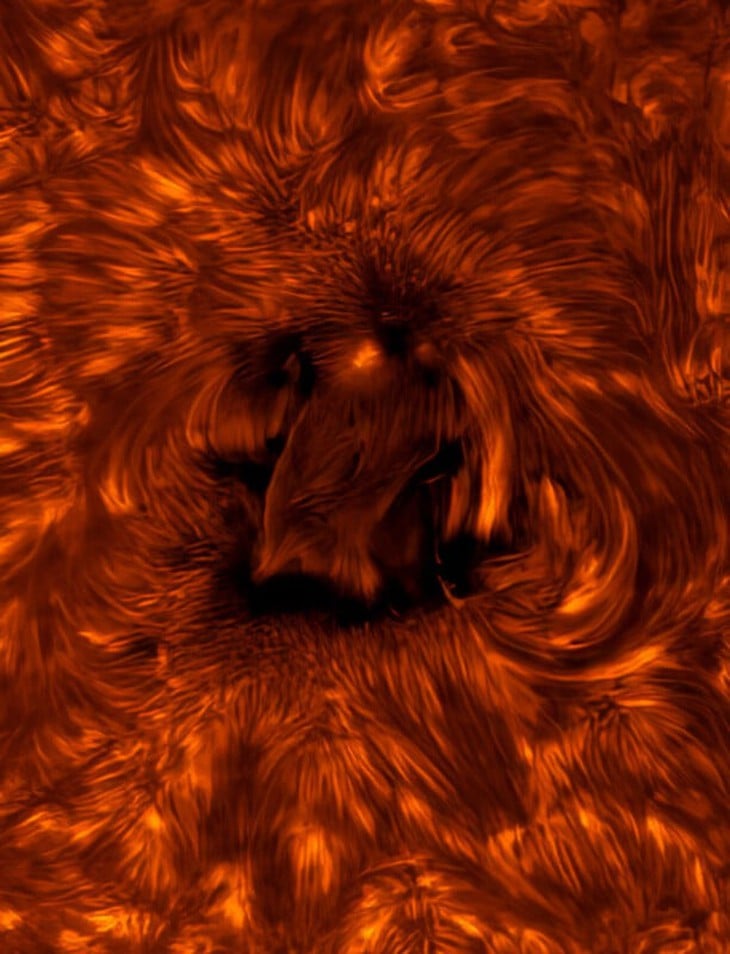
The image shows the active zone of the solar chromosphere - Photo: James Sinclair
This is the chromosphere, the turbulent layer of atmosphere where hydrogen and helium plasma are constantly being molded and reformed by the Sun's ever-changing magnetic field.
This image was created from a single 10-second exposure using the Lunt 130mm telescope in conjunction with the Player One Astronomy camera, providing a detailed and spectacular view of one of the most dynamic phenomena of the central star of our solar system.
Tom Williams' photograph , "ISS's Flight By the Moon," won in the People & Space category. The image shows the International Space Station (ISS) prominently displaying its familiar "H" shape, gliding very close to the cratered surface of the Moon against a deep black sky.
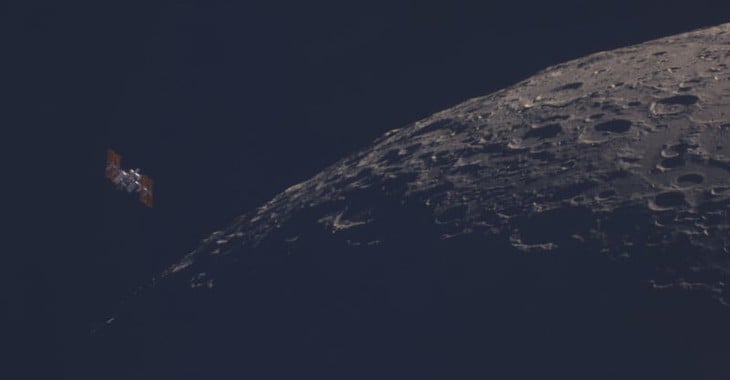
The ISS's flyby of the Moon - Photo: Tom Williams
This extraordinary moment was captured from Wiltshire, United Kingdom, on October 27, 2024. To capture the fleeting, split-second flight path, Williams used the Sky Watcher 400P GoTo Dobsonian telescope and an astronomical camera with an ultra-short exposure time of just 1.5 milliseconds.
The photograph not only showcases the magnificence of the Moon, but also serves as a reminder of humanity's great scientific achievements, with work taking place right here in orbit around Earth.
The Planets, Comets, and Asteroids category features Dan Bartlett's work , "Comet 12P/Pons-Brooks' Last Bow ." The photograph, taken at June Lake, California, on March 31, 2024, captures the moment the comet shone brightly with its long tail illuminating the starry sky.
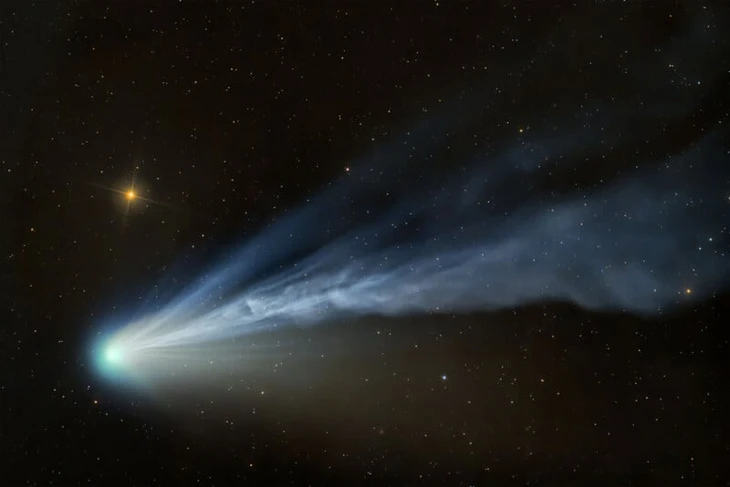
Comet 12P/Pons-Brooks "bows" for the last time - Photo: Dan Bartlett
At that time, the sun was in its most active phase, making the photograph even more special. Bartlett skillfully captured the ethereal beauty of comet 12P/Pons-Brooks, a celestial body that only reappears near Earth after decades, making this moment all the more precious.
The Skyscapes category is marked by Tom Rae's work, The Ridge . This stunning panoramic photograph, taken at Aoraki/Mount Cook National Park (New Zealand) on April 8, 2024, shows the Milky Way curving brilliantly across the night sky, illuminating the glacial streams flowing through the rocky landscape.
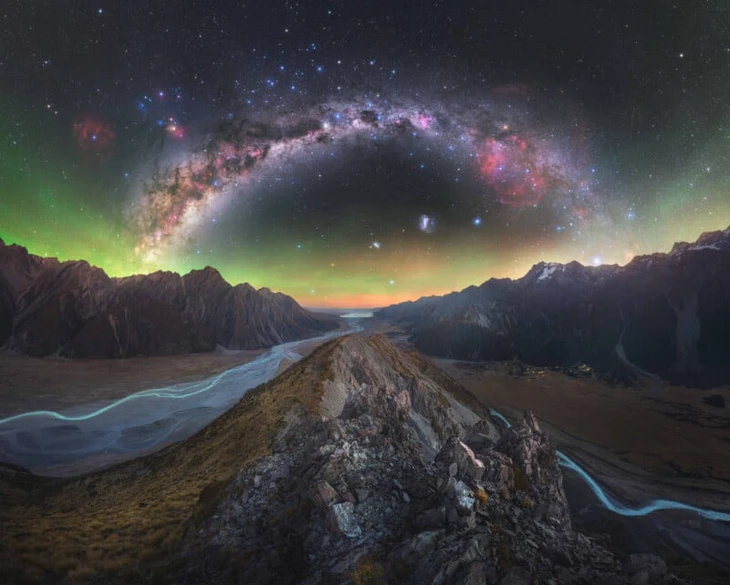
The winning photograph in the Sky category is "The Ridge" - Photo: Tom Rae
To create this work, Tom Rae pieced together 62 individual photographs, totaling over a billion pixels, resulting in a breathtaking scene that is both majestic and poetic.
The Stars and Nebulae category is highlighted by M13: Ultra-deep exposure of the Hercules cluster by the Distant Luminosity team (Julian Zoller, Jan Beckmann, Lukas Eisert, and Wolfgang Hummel). The image captures the magnificent Hercules globular cluster, located approximately 22,200 light-years from Earth in the constellation Hercules.
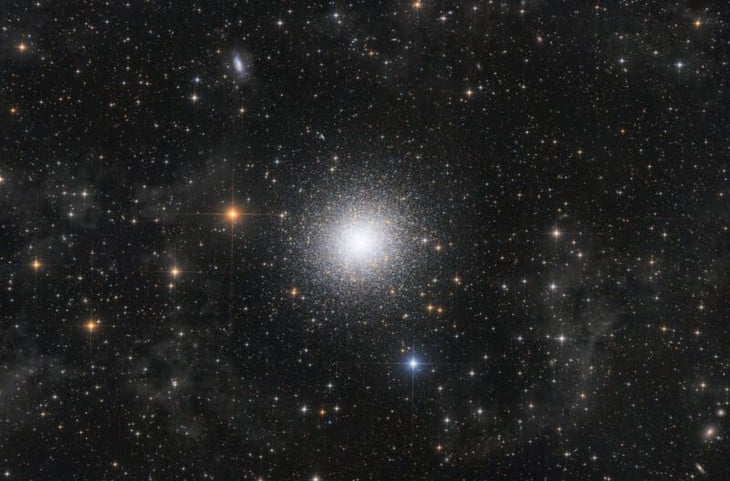
The work "M13" by photographers Julian Zoller, Jan Beckmann, Lukas Eisert, and Wolfgang Hummel.
To create the dazzling scene resembling "a city of stars," the team used a Newtonian 200mm telescope in combination with a ZWO ASI2600MM Pro camera, with a total exposure time of over 29 hours.
The Sir Patrick Moore Award for Best Newcomer went to Yurui Gong and Xizhen Ruan for their photograph "Encounter Across Light Years ." The work captures the unexpected moment when a meteor from the Perseid meteor shower streaked across the sky, precisely where the spiral galaxy Andromeda (M31) is located.
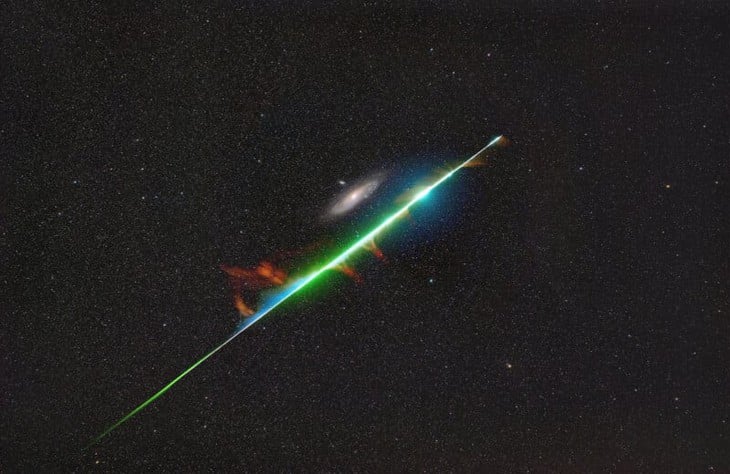
Yurui Gong and Xizhen Ruan won the Sir Patrick Moore Award for their photograph "Encounter Across Light Years."
This photograph was taken on the night of the meteor shower's peak, August 12, 2024, in Zhucheng City (China) using a Nikon Z 30 camera. The combination of the meteor trails and the ethereal beauty of the distant galaxy created a spectacular and emotionally rich scene.
Leonardo Di Maggio's "The Fourth Dimension" won the award in the Extended category. The work presents a bizarre, monochrome landscape, reminiscent of an "alien city".
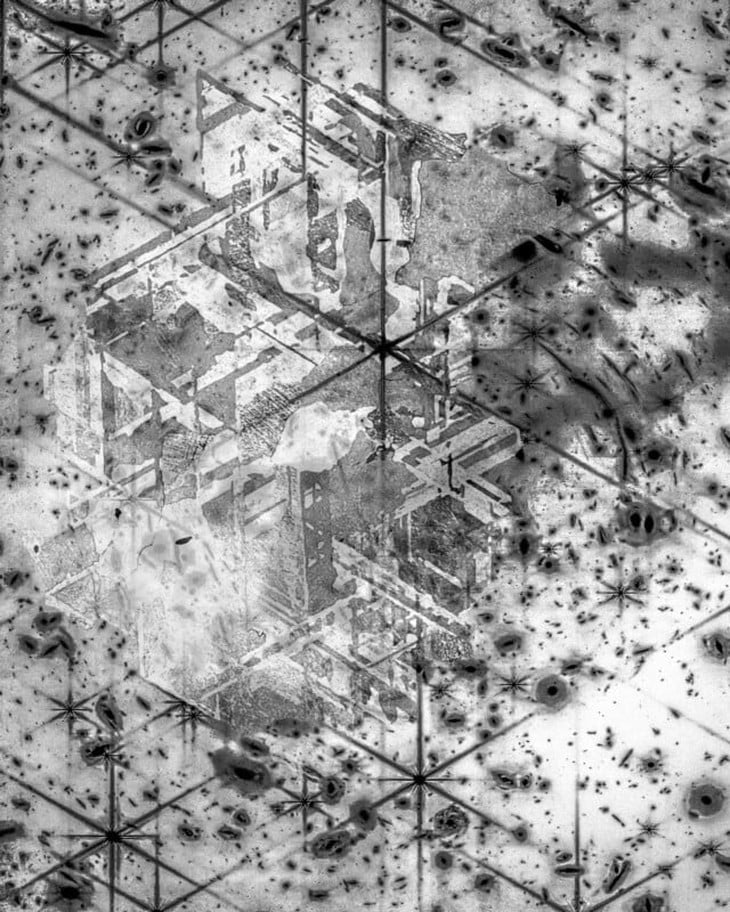
"The Fourth Dimension" - Photo: Leonardo DiMaggio
Leonardo Di Maggio combined the geometric patterns inside a meteorite with fascinating lensing data from the James Webb telescope. This superposition creates a unique visual effect, as if opening up a mysterious and captivating fourth dimension.
Source: https://tuoitre.vn/oscar-cua-nhiep-anh-thien-van-andromeda-va-nhung-tuyet-tac-bau-troi-dem-2025-20250912144007909.htm






































































Comment (0)