

This is not surprising, because without the right conditions, we would not have been able to appear to observe the universe.
However, the Sun is not the most common type of star. In fact, M-dwarf stars make up 60-70% of all stars in the galaxy. This contradiction is central to the "Red Sky Paradox".
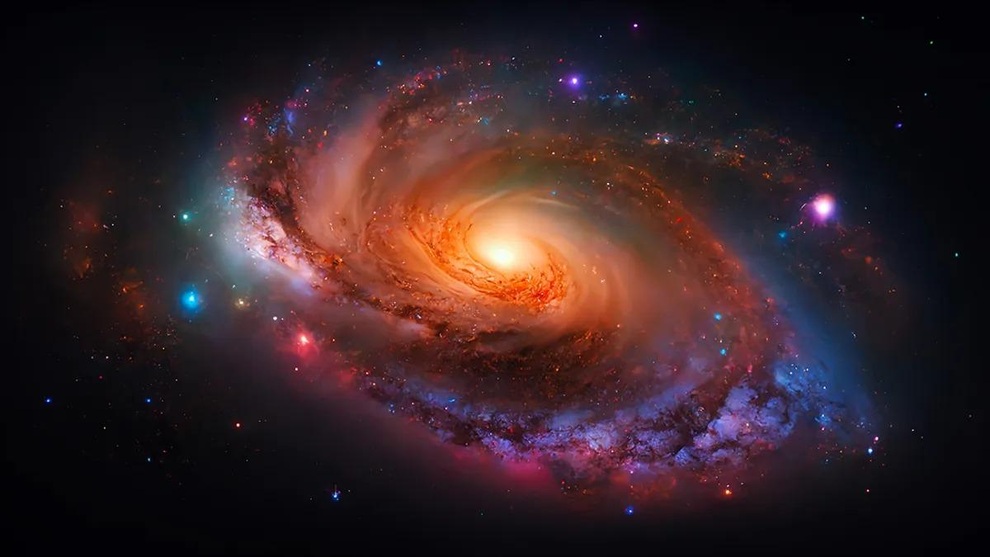
Logical contradictions of the Copernican Principle
The Copernican principle, the foundation of modern cosmology, states that human experience is not an exception, but rather a reflection of the universality of the universe. However, both Earth and the Sun are exceptional cases.
We exist around a G-type star, while M-type dwarfs, also known as red dwarfs, are five times more common and have up to 20 times longer lifespans.
Furthermore, the process of star formation in the universe is predicted to take about 10 trillion years, yet intelligent life has only appeared in the first 0.1% of that time – a fact that has led astronomers to ask major questions about the location and prevalence of life in the universe.
Associate Professor David Kipping from Columbia University used Bayesian statistical models to analyze solutions to this paradox.
Rejecting the "Luck" hypothesis.
To explain this anomaly, David Kipping developed three main hypotheses.
The first hypothesis suggests that stars with very small masses, such as M-dwarf stars, cannot give rise to intelligent beings capable of perceiving, thinking, and analyzing the universe around them, or observing intelligently (like humans), because the physical conditions around them are not stable enough for life to develop. Science calls this concept "observer."
"Observers" are a form of life with intelligence high enough to be aware of themselves and the universe, capable of gathering, analyzing, and interpreting information about the world around them.
The second hypothesis suggests that the “window of existence” for life may have been shortened by a catastrophic event on a planetary scale, making it difficult for civilizations to sustain themselves for long.
The final hypothesis is simpler: perhaps we are simply the result of chance in the vast universe.
However, when applying Bayesian analysis, Kipping strongly rejected the "chance" hypothesis with a Bayesian coefficient of approximately 1,600 - a number considered almost conclusive evidence, as a ratio above 100/1 is usually sufficient to be convincing.
This result shows that it is very difficult to explain our existence solely by chance.
A bleak conclusion: M dwarf stars have no "observers".
After eliminating the element of chance, Kipping found that the most plausible explanation was a combination of the other two hypotheses. However, Kipping's preferred hypothesis was the "deserted M dwarf hypothesis".
This model, which assumes a habitable lifespan of 10 billion years for planets, excludes "all stars with masses less than 0.34 solar masses" as stars that could develop intelligent life with 95.45% confidence.
Simply put, stars with masses about one-third that of the Sun (which make up about two-thirds of the stars in the universe) are unlikely to produce intelligent observers.
Kipping concluded: "The solution that low-mass stars do not develop observers is the best explanation for our existence."
Although life could still exist around these M-dwarf stars, without interstellar settlement, "M-dwarfs would be very quiet places." This finding suggests that, based on the available data, the universe may be much more desolate than we previously hoped.
Source: https://dantri.com.vn/khoa-hoc/vu-tru-co-the-hoang-vang-hon-nhieu-so-voi-chung-ta-tuong-20251021011903789.htm

![[Photo] Prime Minister Pham Minh Chinh holds a phone call with the CEO of Russia's Rosatom Corporation.](/_next/image?url=https%3A%2F%2Fvphoto.vietnam.vn%2Fthumb%2F1200x675%2Fvietnam%2Fresource%2FIMAGE%2F2025%2F12%2F11%2F1765464552365_dsc-5295-jpg.webp&w=3840&q=75)













































































Comment (0)