

Will the floating market eventually "sink"? This is a worry not only for the traders of Cai Rang floating market but also a source of regret for many who cherish this unique "floating culture" of Can Tho City.
Merchants are adventurous and generous...
Before the sun even rises over the Hau River, the Cai Rang floating market is already awake, bustling with activity on the docks and boats. Mrs. "Ba Do," the owner of three small boats, has been busy since 2 a.m. transporting merchants and retail buyers to and from the floating market. Mr. Trang Xen (44 years old), a merchant from Go Quao, Kien Giang, is also busy delivering pineapples to wholesale buyers…
"Are you selling them individually?" I asked Trang Xen, who was blushing at the unfamiliar customer. "Not individually, just giving them away for free," Xen replied with a smile, quickly peeling a ripe, fragrant pineapple and offering it to me. I had heard that the merchants at the floating market were very generous and easygoing, and now I felt I had received a warm answer amidst the early morning market.
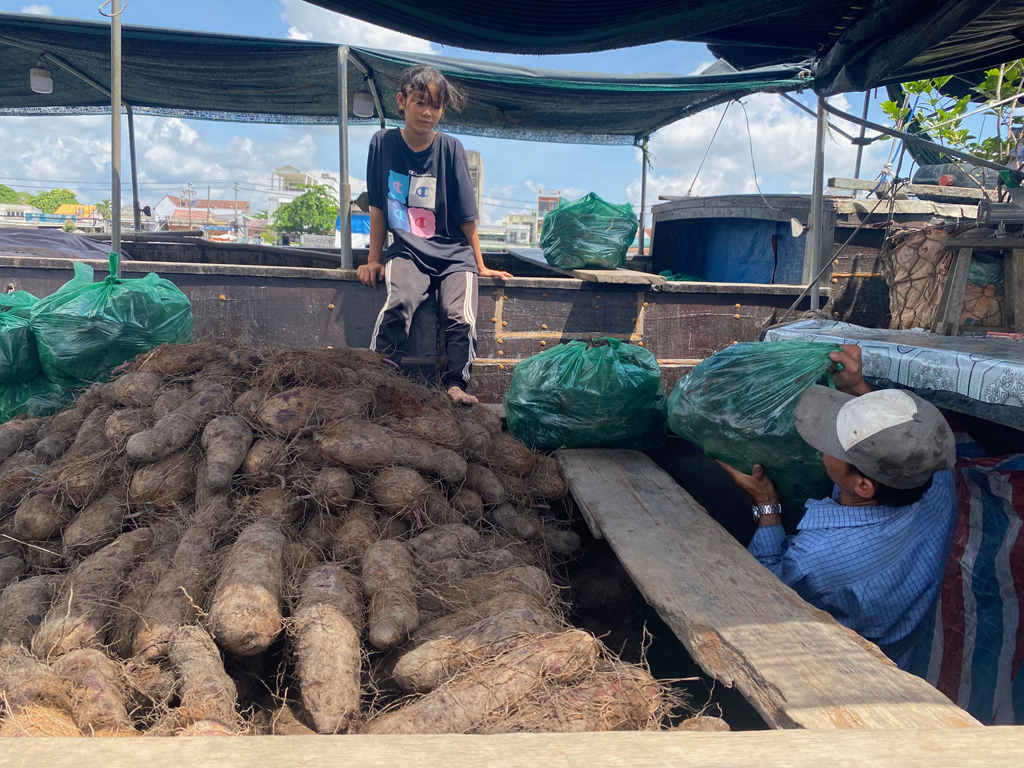
Mr. Thai and his daughter are delivering sweet potatoes to customers.
The stretch of river beneath the Cai Rang bridge is now filled with the lively sounds of boat engines, the calls of vendors selling food, drinks, and groceries from the ferry boats. Occasionally, tourist boats speed past, causing many wholesale boats or small canoes to rock violently as if they were about to... get drunk from the large waves.
The colorful "bamboo poles" (cây bẹo) attached to the bows of the boats are a unique feature of the floating market. These "bamboo poles" are a type of sign on the river, with a characteristic item being sold by the merchants hanging from the tip. There are signs for pumpkins, watermelons, pineapples, sweet potatoes, and more.
Mr. Dang Van Ut (40 years old), the brother-in-law of Mrs. "Ba Do," a hired ferryman, asked me a tricky question: "What does 'hanging without selling, selling without hanging' mean?", then burst out laughing at the bewildered look on the passenger's face. He then explained: "Hanging without selling refers to the poles people use to dry clothes. Usually, whatever a boat hangs on a pole indicates what it's selling – pineapples, pumpkins. But the locals here use boats as homes, living on them, so they also hang things to dry, hence the term 'hanging without selling.' And 'selling without hanging' refers to boats that hang poles with leaves, but they're not selling the leaves; they're selling… the boat. They're selling the boat without hanging the boat itself."
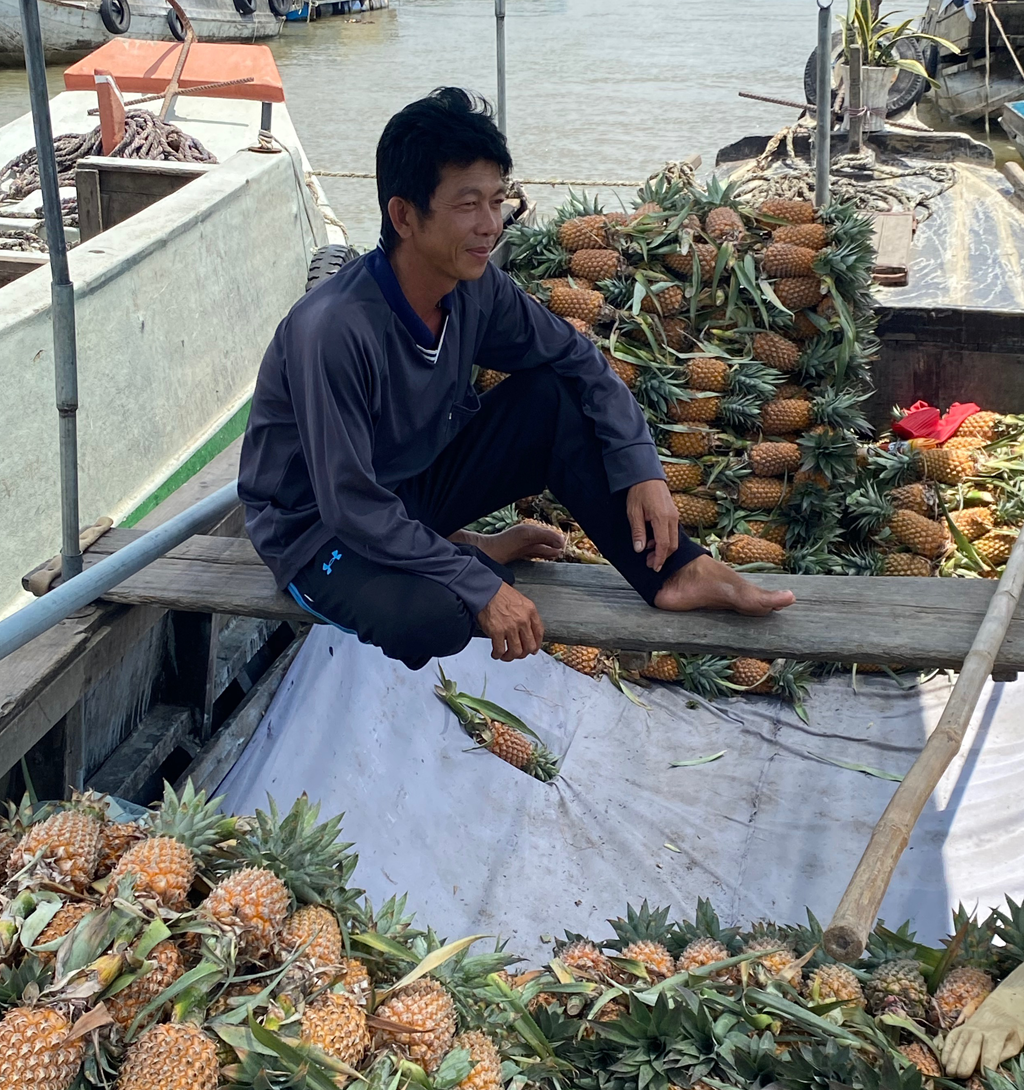
Mr. Trang Xen with his pineapple boat
Uncle Ut's boat glided past an empty, swaying boat on the river, its roof laden with dried palm leaves. He lamented, "The market is so quiet these days, there are so many boats for sale. I have to do all kinds of jobs, ferrying people across the river and driving a motorbike taxi, just to support my wife and two children."
Goods at Cai Rang floating market, both in the past and present, are mainly divided into several categories such as vegetables, fruits, groceries, fresh and cooked food. Another activity that contributes to the market's prosperity is the ferry service carrying people and selling local specialties such as fruits, food, and drinks to traders and tourists. Boats selling rice noodle soup, vermicelli soup, steamed buns, bread, and fruit are considered part of the market's "floating" goods and services, attracting visitors from afar.
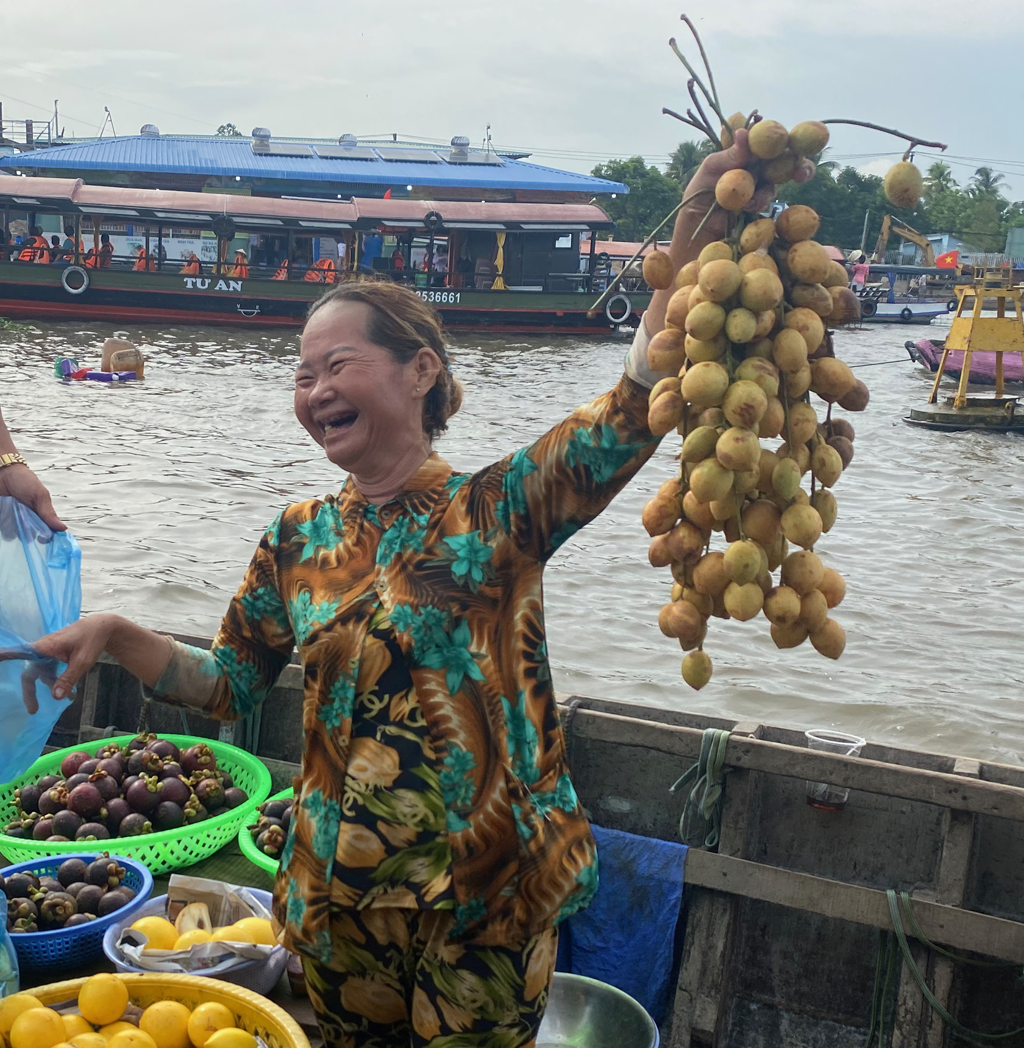
Ms. Nguyen Thi Trang, a fruit vendor on the floating market.
The market scene is desolate, even with many boats.
Nothing compares to the joy of a traveling merchant's life. "Going to the sea, going upstream, rice to the market, water to the river" is a folk song describing the life of a traveling merchant. But when we arrived at the market early in the morning, the scene was desolate, despite the bustling activity of boats and ferries. Most boats were carrying tourists, speeding along the newly built embankment; from the river's surface, all we could see were tall, gleaming white walls.
Trang Xen, with his dark, tanned skin, looks much older than his 44 years. He sits sadly watching the tourist boats go by, his pineapple hold having been unsold for several days now. His family owns nearly 4 hectares of pineapples in Go Quao, Kien Giang. Xen and his brothers all work on pineapple boats. "I find trading less strenuous than farming. Every time I go back home to get pineapples, I leave again immediately; life is mostly on the boat," Xen said.
At the floating market now, Xén and his brother are two of the few remaining traders who buy their own goods and transport them by boat from their farms to the Cái Răng floating market. They usually go to the Kiên Giang region to get pineapples, then travel by boat for about 8 hours continuously to sell them to traders at the floating market. When asked why they don't transport them by road for convenience, Xén said: "These pineapples are very fragile; transporting them by truck is a hassle because they get damaged repeatedly, and that would ruin our capital. And we've been doing this boatwork for generations... We make our profit through hard work."
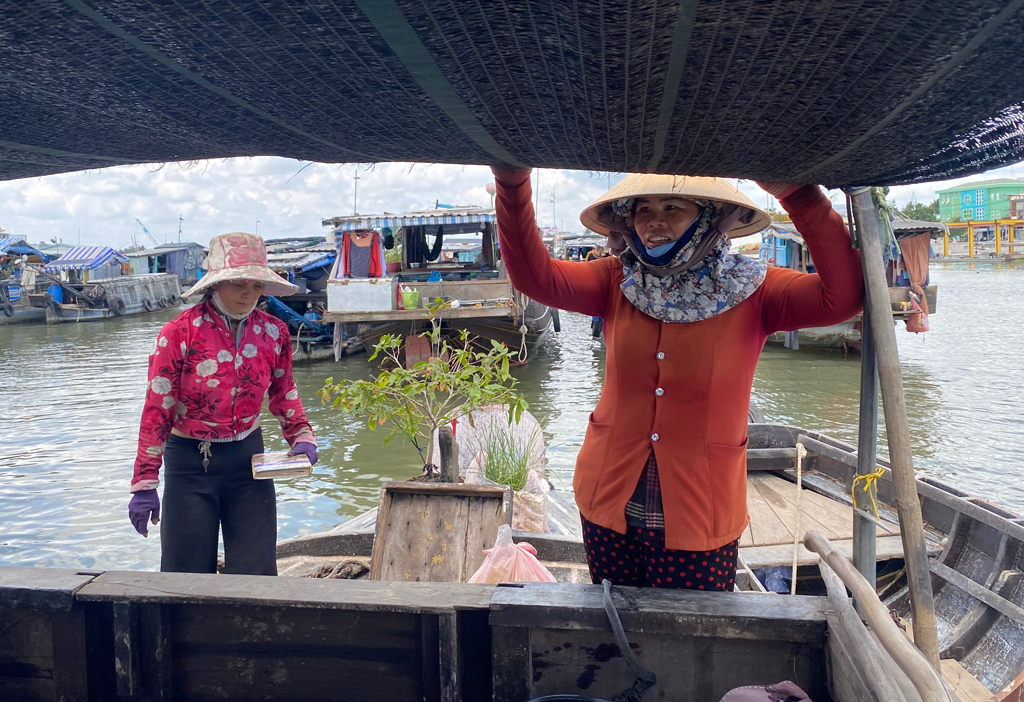
Ms. Nga (left) and her business partner.
Back home, the Xen family's few hectares of pineapples yield around 30,000 fruits each harvest. When their own farm is empty, he goes to other farms to buy at a fixed price (buying at the same price as the farmers for the whole year, bearing the profit or loss). Sometimes the price goes up, so he makes a profit; other times, he worries so much he loses sleep. Like this time, Xen and his brother went to the floating market in two boats to sell about 20,000 pineapples, but after 5 days, they are selling them off at 5,000 dong per fruit to recoup their capital. "We bought them at a fixed price of 10,000 dong per fruit, but we're only selling them for 8,000-9,000 dong per fruit. Usually, we sell them all within a day or two. But the price has dropped so much that this trip has resulted in a loss of nearly 40 million dong," Xen said, gazing into the distance as the market was winding down.
Cai Rang floating market is divided into many distinct "neighborhoods": melon neighborhood, cassava neighborhood, sweet potato neighborhood, pineapple neighborhood, etc. Boat owners mainly come from Hau Giang and Kien Giang provinces. Some traders have been selling goods at the floating market for generations, with their children continuing the business.
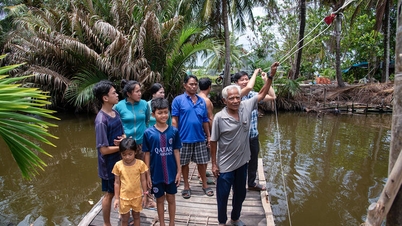
In the sweet potato village lives the family of Mr. Tran Van Thai (43 years old). Mr. and Mrs. Thai own two boats selling sweet potatoes wholesale at the floating market. Mrs. Le Thi Kim Nga (40 years old), Mr. Thai's wife, busily arranges sweet potatoes for wholesale buyers in the middle of the boat filled with earth. Under the scorching sun on the river, even though Mrs. Nga wore a thick coat and covered her face, her tanned skin was still visible. Wiping away sweat, she said: "We have three children, and now one, only 12 years old, has to drop out of school to work on the boat, and the other two are staying with their grandparents on shore to go to school. The market is slow these days, tourism is booming, and business is difficult. We'll probably have to abandon the market and move ashore..." (to be continued)
Cai Rang Floating Market, located in Le Binh Ward, Cai Rang District, is situated in the heart of Can Tho City. The writer Son Nam once quoted a folk verse about the market's bustling atmosphere: "Cai Rang, Ba Lang, Vam Xang, Xa No. I love you, so I'll buy a boat. So you can come and go to find out my feelings…"
Over time, floating markets in the Mekong Delta in general and Can Tho in particular have somewhat declined. To preserve and promote the unique cultural features of this riverine region, in 2016, the Ministry of Culture, Sports and Tourism recognized Cai Rang floating market in Can Tho City as a national intangible cultural heritage.
Source link



















































































Comment (0)