

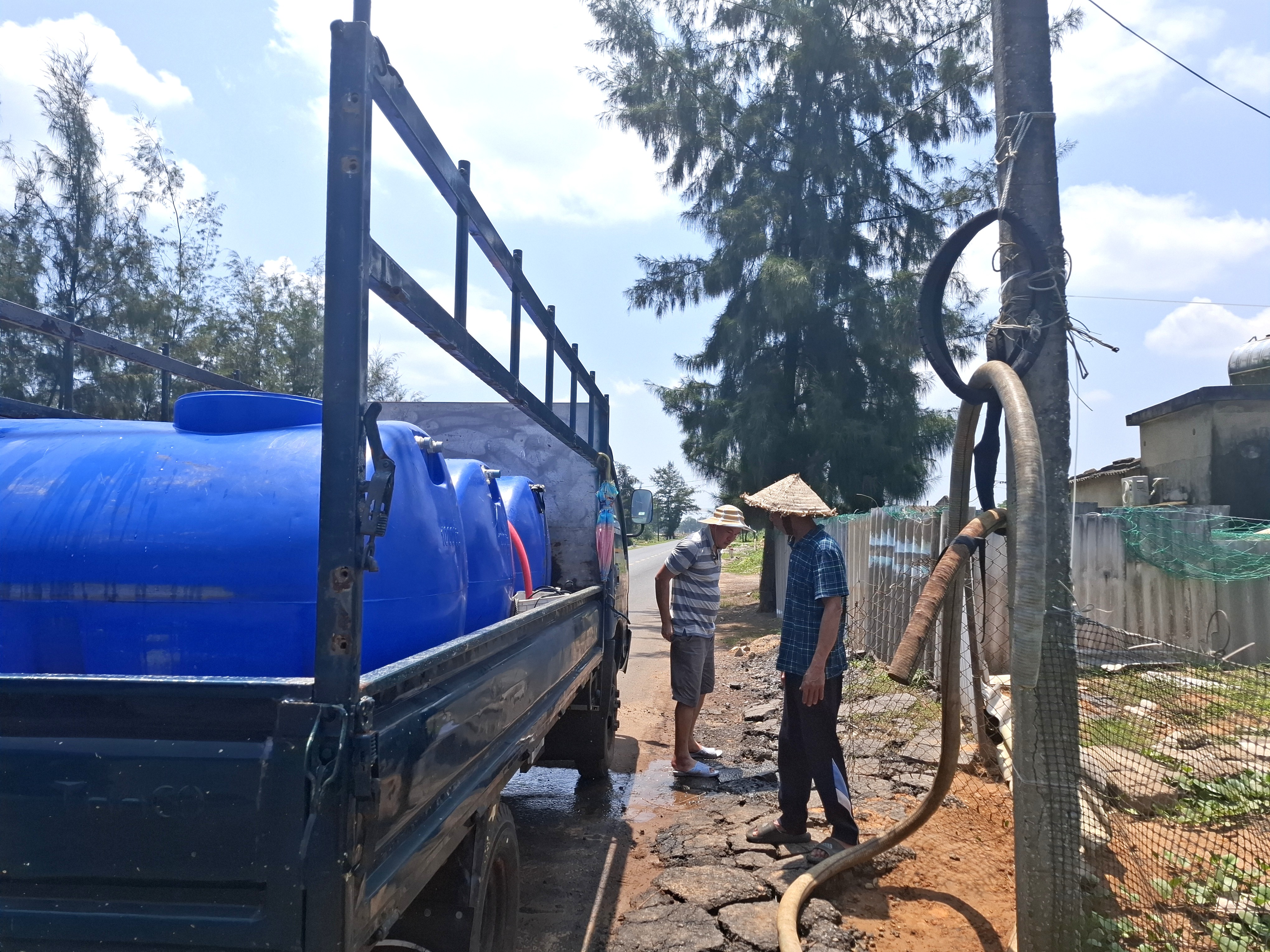
Mr. Hoang Khoa sells seawater to customers - Photo: SH
Under the scorching sun of an early summer day, Mr. Ho Van Hai, from An Duc 3 neighborhood, Cua Tung town, nimbly holds a seawater pipe and hangs it onto the truck bed carrying two large seawater tanks, then quickly opens the tap to let the water flow into the tanks.
Mr. Hai said that many people find the idea of buying and selling seawater difficult to understand at first. But in reality, this profession has existed in coastal areas for decades. The seawater trading business emerged when seafood restaurants and eateries catering to tourists sprung up in the towns of Cua Tung and Cua Viet.
To keep seafood caught from the sea alive for several days in large glass tanks, restaurant owners must use standard seawater and change it daily. The business of buying and selling seawater, initially thought to be just a hobby for many, has become increasingly popular due to the growing demand from seafood restaurants, leading to a gradual increase in the number of seawater suppliers.
Initially, seawater was transported by motorbike in plastic containers. Gradually, the quantity increased, so sellers had to use cars to keep up with customer demand. Every day, seafood restaurants and eateries in Cua Tung and Cua Viet towns use tens of cubic meters of seawater. Hai alone sells about 10 cubic meters of seawater daily; during peak tourist season, he supplies about 15 cubic meters to seafood restaurants and eateries to meet demand. The price of seawater also depends on the distance. For short distances, seawater costs 150,000 - 200,000 VND/cubic meter; for longer distances, the price ranges from 300,000 - 400,000 VND/cubic meter.
Mr. Hai added that the busiest time for those of him who sell seawater is from 8 AM to 12 PM every day. During this time, seafood restaurants and eateries constantly order seawater to change the water in their glass tanks. Failure to deliver the water promptly would affect the survival rate of the seafood.
Morning is also the time when fishermen bring in a lot of seafood to supply restaurants and seafood eateries, so they need natural seawater to prevent fish, shrimp, and other shellfish from dying due to environmental shock. Therefore, even a slight delay means the restaurant owners will call someone else the next time. His work doesn't have fixed hours; whenever someone calls, he rushes to Cat Son village, Trung Giang commune, to get seawater. Sometimes he leaves early in the morning, sometimes in the middle of a hot summer day.
Folding up the section of seawater pump hose that had just been pulled out to the roadside to sell to customers, Mr. Hoang Khoa in Cat Son village continued with his work of feeding shrimp. Mr. Khoa shared that he has been involved in shrimp farming for nearly several decades, experiencing ups and downs. As for selling seawater to customers, he only started doing that a few years ago to earn extra income.
At first glance, many people think this job is simply scooping seawater to sell, but the truth is not that simple. To obtain seawater that meets the standards for seafood restaurants and eateries, the water must be clean and have the right salinity. It's not just a matter of scooping water from the sea and using it; it must be taken from a location with a certain depth, clear water, free of sand and debris, and with the right salinity. Once a suitable location is chosen, a system for pumping seawater connected to reservoirs is then installed.
Currently, Mr. Khoa is installing a seawater intake pipe system nearly 150 meters long in the reservoir. Based on his experience, Mr. Khoa believes that only with this distance can the salinity of the seawater reach 30-32 g/kg (32g/kg). The salinity will decrease slightly depending on the season. The variation in salinity is not very significant because with a properly designed filter to remove debris, sand, and floating organisms, the intake pipe system he installed will always maintain the cleanest water quality.
Currently, most suppliers of seawater to seafood restaurants and eateries purchase it from shrimp farmers. This is because the seawater is pumped hundreds of meters from the shore. The water is then filtered and purified for shrimp farming, ensuring the survival of the aquatic life. Furthermore, during the rainy season, when the seawater becomes turbid and salinity decreases, only shrimp farmers have a reserve of seawater to supply the suppliers.
However, if they collect seawater directly to sell, it's very easy to encounter contaminated water, and the consequences can be unpredictable. If selling seawater leads to the death of seafood due to that very water source, they will have to compensate the seafood restaurants and eateries. Currently, Mr. Hoang Khoa sells about 5-7 cubic meters of seawater daily at a price of 100,000 VND per cubic meter to seafood restaurants and eateries.
According to Mr. Nguyen Duc Vinh, owner of a seafood restaurant at Cua Viet beach, seafood restaurants and eateries in Cua Viet town have to buy several cubic meters of seawater weekly to replace the water in large glass tanks, keeping seafood such as squid, green crabs, and grouper fresh to serve customers.
Although restaurants and eateries are located near the beach, simply carrying buckets or basins down to the sea to scoop up seawater for raising fresh seafood isn't enough. The seawater must be clean and have the right salinity... hence the need for people who make a living by buying and selling seawater.
Sy Hoang
Source: https://baoquangtri.vn/mua-ban-nuoc-bien-o-vung-bien-193545.htm

























































































Comment (0)