

Images from recent exercises show F-22 fighter jets operating from harsh, field locations in Alaska, rather than concentrating at large bases as before. This is seen as part of the US Air Force's "Flexible Combat Deployment" strategy, aimed at dispersing forces to reduce the risk of missile or drone attacks.
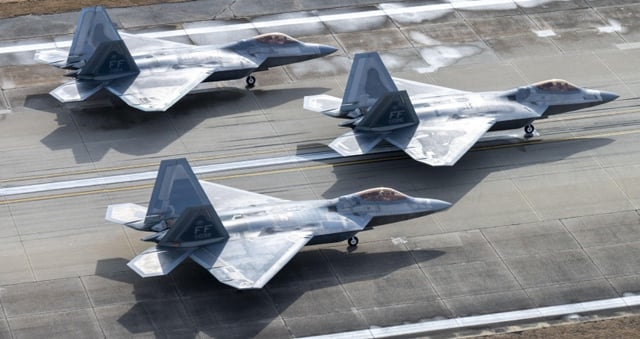
An F-22 fighter jet of the US Air Force. (Source: MW)
Alaska currently houses the world's largest concentration of F-22s. This location allows the U.S. to both closely monitor Russian military activity in the Arctic and quickly deploy forces to the Pacific or Japan if necessary.
In the released videos , F-22s from the 3rd Air Wing conducted emergency response drills in the NORAD Alaska defense area. Military experts believe this reflects a major shift in U.S. air defense thinking, with deployment speed, survivability, and flexibility becoming increasingly prioritized.
Experience from conflicts in Ukraine and the Middle East shows that concentrating many aircraft at large bases makes them vulnerable to cruise or ballistic missiles. This is considered one of the reasons why the US is promoting a dispersed deployment model.
Pressure on Alaska's air defense system is also rapidly increasing. Russia is continuously upgrading the attack capabilities of its strategic bombers with new versions of the Kh-101 and Kh-102 cruise missiles, which have been used in the Ukraine conflict. Meanwhile, China is also expanding its presence in the region, with the first deployment of H-6 bombers for patrols near Alaska in 2024.
Beijing had previously unveiled the YJ-21 air-launched hypersonic ballistic missile for the H-6 bomber, further increasing concerns about U.S. defense capabilities in the Arctic.
Despite possessing world- leading stealth capabilities, the F-22 remains questionable for its suitability for air defense missions in Alaska. This fighter jet is known for its high maintenance requirements and low combat readiness rate. Furthermore, the F-22's range is considered quite limited relative to its size, making it heavily reliant on in-flight refueling for patrolling the vast airspace of Alaska.
The F-22's AN/APG-77 radar was developed in the 1990s, while its cyber warfare and data sharing capabilities are considered inferior to newer fighter jets. Many believe that the F-35 or F-15EX could gradually replace the F-22 in Alaska defense missions due to their longer range, better maintainability, and higher operational readiness.
The U.S. is also facing criticism regarding its air defense capabilities in Alaska. One of the biggest weaknesses is its reliance on the outdated E-3 Sentry early warning aircraft from the Cold War era.
Source: https://suckhoedoisong.vn/my-dan-phi-doi-f-22-lon-nhat-o-bac-cuc-de-doi-pho-nga-169260529102910005.htm




![[Photo] Admire the coral "masterpiece" amidst the million-year-old heritage of Dak Lak province.](https://vphoto.vietnam.vn/thumb/1200x675/vietnam/resource/IMAGE/2026/05/30/1780107638639_y25-jpg.webp)
































































































Comment (0)