

For a long time, there has been a highly effective but laborious method of fishing in Dau Tieng Lake: "building mounds" to catch fish. Fishermen take many dry branches and throw them into the lake to form large mounds. Fish love to take refuge in these piles of branches. After just a few weeks, the number of fish concentrated there can reach hundreds of kilograms.

However, catching fish sheltering in the brushwood piles located four to six meters below the water's surface is no easy task. Fishermen have to cast nets around the piles, dive to remove all the brushwood, and then gradually pull the bottom of the net to haul the catch onto the boat. This is extremely arduous and dangerous work, taking place almost all day in murky water.
Therefore, fishermen have to hire experienced people who can hold breathing tubes to dive deep to remove debris, fill nets, and catch fish. Among the groups making a living from this profession is the group led by Mr. Tran Van Cuong, residing in Tan Thanh commune, Tay Ninh province. To ensure safety while diving, Mr. Cuong assigns two people to always be on duty on the boat.

Accordingly, one person focuses on continuously operating the machine to compress air into the pipe leading down into the water for Mr. Cuong and his colleagues to breathe while diving and tying the brushwood. Another person holds the rope to pull the brushwood onto the boat (for brushwood that is rotten, it needs to be discarded ashore), or to release reusable brushwood to another location outside the net's range.
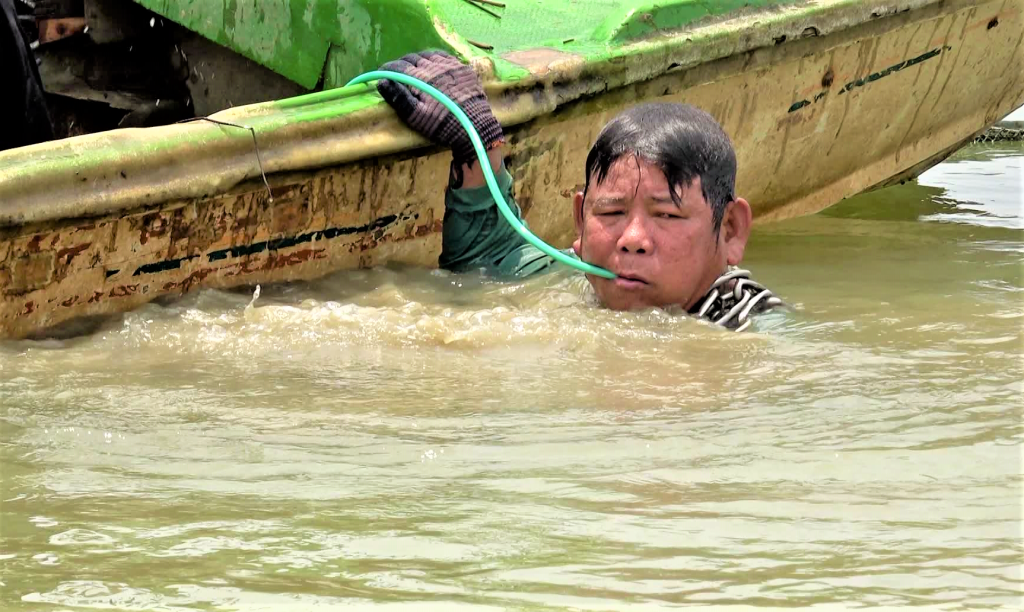
Having worked in the profession for about 15 years, Mr. Cuong recounted that the most frightening aspect wasn't the cold or the fatigue, but the pitch-black darkness at the bottom of the lake. When collecting brushwood, the water is stirred up and becomes murky, making it impossible for divers to see anything. They have to close their eyes and use their hands to feel for sharp branches, gathering them into bundles and tying them together. They then pull a rope to signal the people on the boat to pull the brushwood up. The most crucial thing for divers is to avoid getting their clothes or snorkels caught in the brushwood.


According to Mr. Cuong, closing one's eyes while diving has the advantage of preventing sharp debris from directly piercing the eyes, minimizing the damage caused by dirty water. However, the work progresses very slowly; removing a pile of debris takes almost a whole day, which also means the divers have to remain submerged underwater for many hours.

Mr. Tang Van Don, a diver in the group, said that this job requires long-term training to acquire the skills and experience to work in a high-pressure, dark water environment. Muscle pain, temporary muscle atrophy, ear pain, and cuts and bleeding are common occurrences for divers.


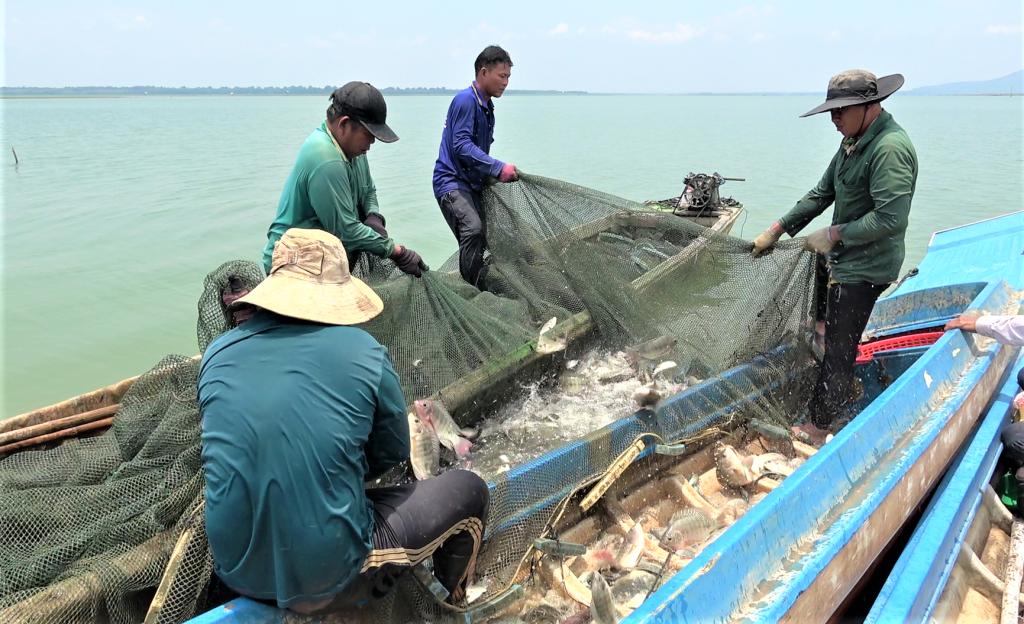
After removing all the brushwood from the net enclosure, Mr. Cuong and his colleagues continued diving underwater to gather the bottom of the net, herding the fish onto the boat, transporting them to the dock, and sorting them for the employer to sell to traders. Each person directly involved in diving to remove the brushwood was paid 340,000 VND per day; and each person on the boat was paid 280,000 VND per day.
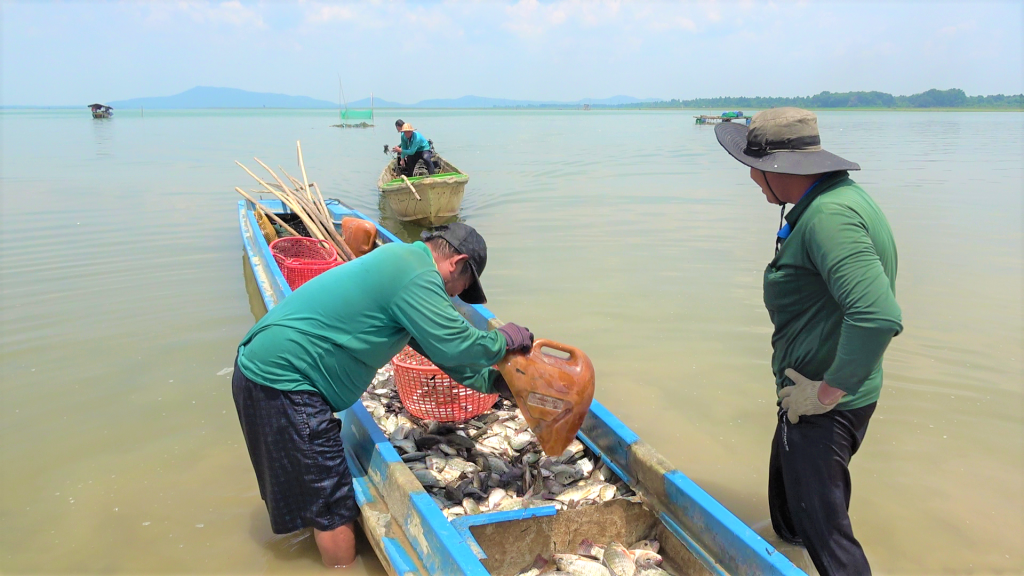

Besides removing brushwood, Mr. Cuong's group occasionally assists locals in salvaging fishing gear and other items that have sunk. The job of diving to remove brushwood is so arduous that not everyone has the courage to pursue it. But for many years, these divers in the lake have quietly clung to their profession, as an indispensable part of the livelihood of fishermen in the Dau Tieng Lake area.
Source: https://baotayninh.vn/nghe-muu-sinh-duoi-day-ho-dau-tieng-146946.html
![[Photo] Capturing the moment the tide recedes at Yen Binh Son rapids - a million-year-old scenic spot in Quang Ngai.](https://vphoto.vietnam.vn/thumb/1200x675/vietnam/resource/IMAGE/2026/05/19/1779175463885_yen9-1199-jpg.webp)
![[Photo] General Secretary and President To Lam presides over a meeting on the implementation of Directive No. 34-CT/TW of the Party Central Committee.](https://vphoto.vietnam.vn/thumb/1200x675/vietnam/resource/IMAGE/2026/05/19/1779187768672_a1-bnd-2350-631-jpg.webp)
![[Photo] National Assembly Chairman Tran Thanh Man attends the groundbreaking ceremony for the National Highway 1A spatial axis project.](https://vphoto.vietnam.vn/thumb/1200x675/vietnam/resource/IMAGE/2026/05/19/1779161360398_ndo_br_bnd-1412-jpg.webp)










































![[Photo] General Secretary and President To Lam receives Indian Defense Minister Rajnath Singh](https://vphoto.vietnam.vn/thumb/402x226/vietnam/resource/IMAGE/2026/05/19/1779184046302_anh-man-hinh-2026-05-19-luc-16-46-58.png)



























Comment (0)