

The buffer zone of the Lang Sen Wetland Reserve is covered in the lush green of melaleuca forests and aquatic vegetation. Flocks of waterbirds fly over the lotus ponds, creating a rare and peaceful scene in the Dong Thap Muoi region.
Mr. Nguyen Van Tam, who lives near the conservation area, said that in recent years, all levels and sectors have paid attention to the conservation of the ecological environment. The water source is stable, there are many fish, and people have been educated, so their awareness of protecting the environment and not hunting wild birds has gradually improved.
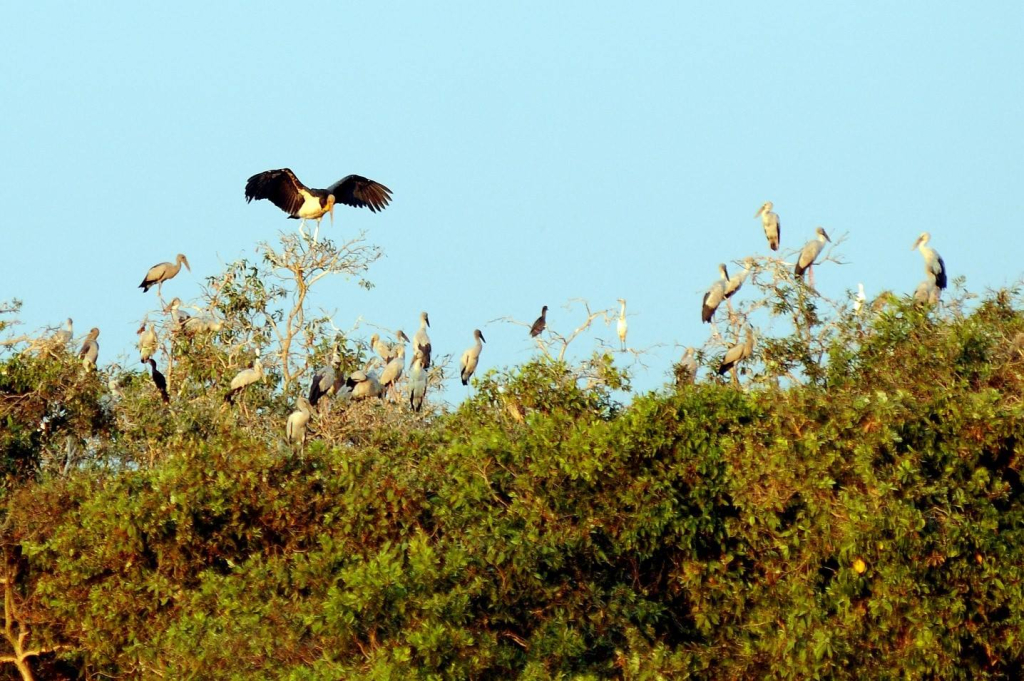
According to the Department of Agriculture and Environment, during the period 2021-2025, the unit implemented the National Action Plan on the Conservation and Sustainable Use of Wetlands. Currently, the province has more than 100,113 hectares of forest and land planned for forest development, of which natural forests account for more than 47,446 hectares and planted forests nearly 38,798 hectares.
Special-use forests and protection forests account for more than 60% of the province's total forest area, concentrated in areas with high biodiversity value such as Lo Go - Xa Mat National Park, Lang Sen Wetland Reserve, Ba Den Mountain National Tourist Area, and Dau Tieng protection forest.
Among them, the Lang Sen Wetland Reserve is considered one of the remaining typical inland wetlands of the Dong Thap Muoi region. The reserve covers an area of over 4,800 hectares, with a core zone of nearly 2,000 hectares. In 2015, it was recognized as the 2,227th Ramsar site in the world and the 7th Ramsar site in Vietnam for meeting international criteria for habitat conservation and the preservation of rare waterbirds.
Currently, the Lang Sen Wetland Reserve is home to more than 20,000 waterbirds, along with many endangered and rare species. The ecosystem here includes mangrove forests on wetlands, seasonally flooded grasslands, lotus ponds, water lilies, and a network of interconnected canals and waterways.
During the period 2021-2025, the province implemented numerous ecological restoration activities in the Lang Sen Wetland Reserve, including planting 30 hectares of new special-use melaleuca forest, restoring 47 hectares of forest in sub-areas 10 and 11, and planting approximately 23,000 native trees such as Terminalia catappa, Barringtonia acutangula, Garcinia cambogia, thorny bamboo, and Ficus microcarpa along the dikes within the reserve.
Simultaneously, tens of thousands of native fish species such as barramundi, sea bass, spotted catfish, barramundi, and giant catfish were also released to replenish aquatic resources and restore the natural ecosystem.
Not only the Lang Sen Wetland Reserve, but also the Lo Go - Xa Mat National Park is an area with a characteristic wetland ecosystem and rich conservation value in the Southeast region of Vietnam. Covering nearly 30,000 hectares, it boasts diverse landforms such as ponds, seasonally flooded plains, natural streams and rivers, and typical forest types of the Southeast region.
The wetland area alone covers approximately 4,533 hectares. Lo Go - Xa Mat National Park is currently home to many rare and endangered animal and plant species such as the black-footed langur, pig-tailed monkey, slow loris, crested myna, and many rare waterbirds such as the lotus heron, small stork, and egret. Notably, this area is also an important stopover point for the red-crowned crane on its migration route between the Mekong Delta and Cambodia.
Biodiversity surveys reveal that Lo Go - Xa Mat National Park is home to 934 plant species and hundreds of animal species belonging to the classes of mammals, birds, reptiles, amphibians, fish, and insects. Approximately 123 species of waterbirds have been recorded.

Along with conservation efforts, the province is also gradually building a database on biodiversity and wetlands. The Lang Sen Wetland Reserve is currently collaborating with the Southern Institute of Ecology to conduct a biodiversity inventory and build a management database under a project funded by WWF Vietnam.
In addition, the locality has implemented many programs to research genetic resources, compile a list of endangered species, restore and breed the brown teal, and promote awareness campaigns to improve community understanding of environmental protection and biodiversity.
Reporting on the implementation of the action plan for the conservation and sustainable use of wetlands, Deputy Director of the Department of Agriculture and Environment Tran Khac Phuc stated that wetland ecosystems not only play a role in nature conservation but also serve as important "ecological buffer zones" that help regulate water flow, mitigate droughts, reduce localized flooding, and adapt to climate change.
According to Mr. Tran Khac Phuc, wetlands also provide livelihoods for people through fisheries, ecotourism development, and other ecosystem services. However, management and conservation efforts still face many difficulties such as a shortage of specialized forest protection personnel, limitations in equipment and funding, and the risk of ecosystem degradation due to the impact of agricultural production and land-use changes.
During the period 2026-2030, the province will continue to review and update the content of wetland conservation in socio-economic development planning, while also promoting surveys, building distribution maps and digital databases connected to the national biodiversity data system.
The province also aims to develop environmentally friendly livelihood models such as ecotourism and ecological aquaculture; research the application of ecosystem service payment mechanisms; and enhance the application of remote sensing and GIS technologies in wetland management.
Source: https://baotayninh.vn/bao-ton-va-su-dung-ben-vung-dat-ngap-nuoc-146909.html
![[Photo] General Secretary and President To Lam presides over a meeting on the implementation of Directive No. 34-CT/TW of the Party Central Committee.](https://vphoto.vietnam.vn/thumb/1200x675/vietnam/resource/IMAGE/2026/05/19/1779187768672_a1-bnd-2350-631-jpg.webp)
![[Photo] Capturing the moment the tide recedes at Yen Binh Son rapids - a million-year-old scenic spot in Quang Ngai.](https://vphoto.vietnam.vn/thumb/1200x675/vietnam/resource/IMAGE/2026/05/19/1779175463885_yen9-1199-jpg.webp)
![[Photo] National Assembly Chairman Tran Thanh Man attends the groundbreaking ceremony for the National Highway 1A spatial axis project.](https://vphoto.vietnam.vn/thumb/1200x675/vietnam/resource/IMAGE/2026/05/19/1779161360398_ndo_br_bnd-1412-jpg.webp)
















































![[Photo] General Secretary and President To Lam receives Indian Defense Minister Rajnath Singh](https://vphoto.vietnam.vn/thumb/402x226/vietnam/resource/IMAGE/2026/05/19/1779184046302_anh-man-hinh-2026-05-19-luc-16-46-58.png)
























Comment (0)