

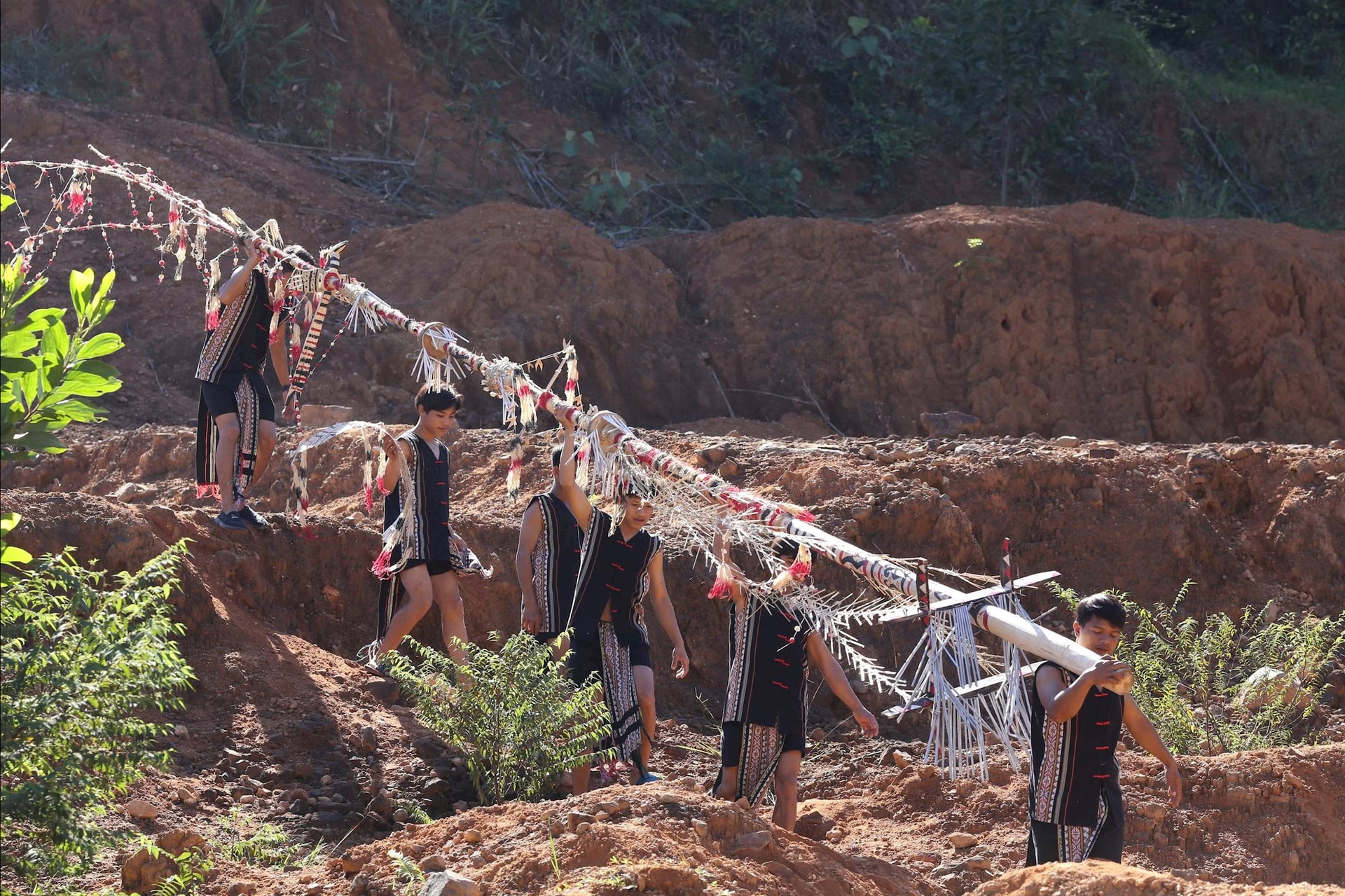
The ceremonial pole (also called the New Year pole) is where the Co people showcase their long-standing artistic values of sculpture, decoration, and form. In his previous studies, ethnologist Nguyen Tri Hung argued that the New Year pole is always closely associated with the spiritual life of the Co people, serving as an environment for the formation, development, existence, and transmission of folk art and other art forms.
The art of carving on the ceremonial pole and gong of the Co people mainly involves carving lines combined with coloring, with lines expressed on a pre-existing or colored background. Researchers believe that for the Co people, this carving is not simply for aesthetic purposes, but rather a way of conveying wishes to the gods, praying for their blessings for a better life.
Associate Professor Vo Quang Trong, Vice President of the Vietnam Folk Arts Association, noted that the Co ethnic group's artisans possess aesthetic talent and artistic creativity, evident in their distinctive crafting and decoration of the ceremonial pole and the set of gongs.
The ceremonial pole is made of wood, but it must be a type of Shorea tree, one that is not damaged by ants or birds, and is not covered in vines. According to some elderly Co people, they choose Shorea trees because they are very sturdy, symbolizing the resilience, strength, and fortitude of the Co people.
The Co people decorate their ceremonial poles in three parts, each with its own unique decoration, carving, and sculpting. According to the records recognizing the Co people's ceremonial pole decoration art and their set of ornaments as an intangible cultural heritage, the most important part of the pole is the middle section, where the Co people focus their efforts to create a continuous system of patterns.
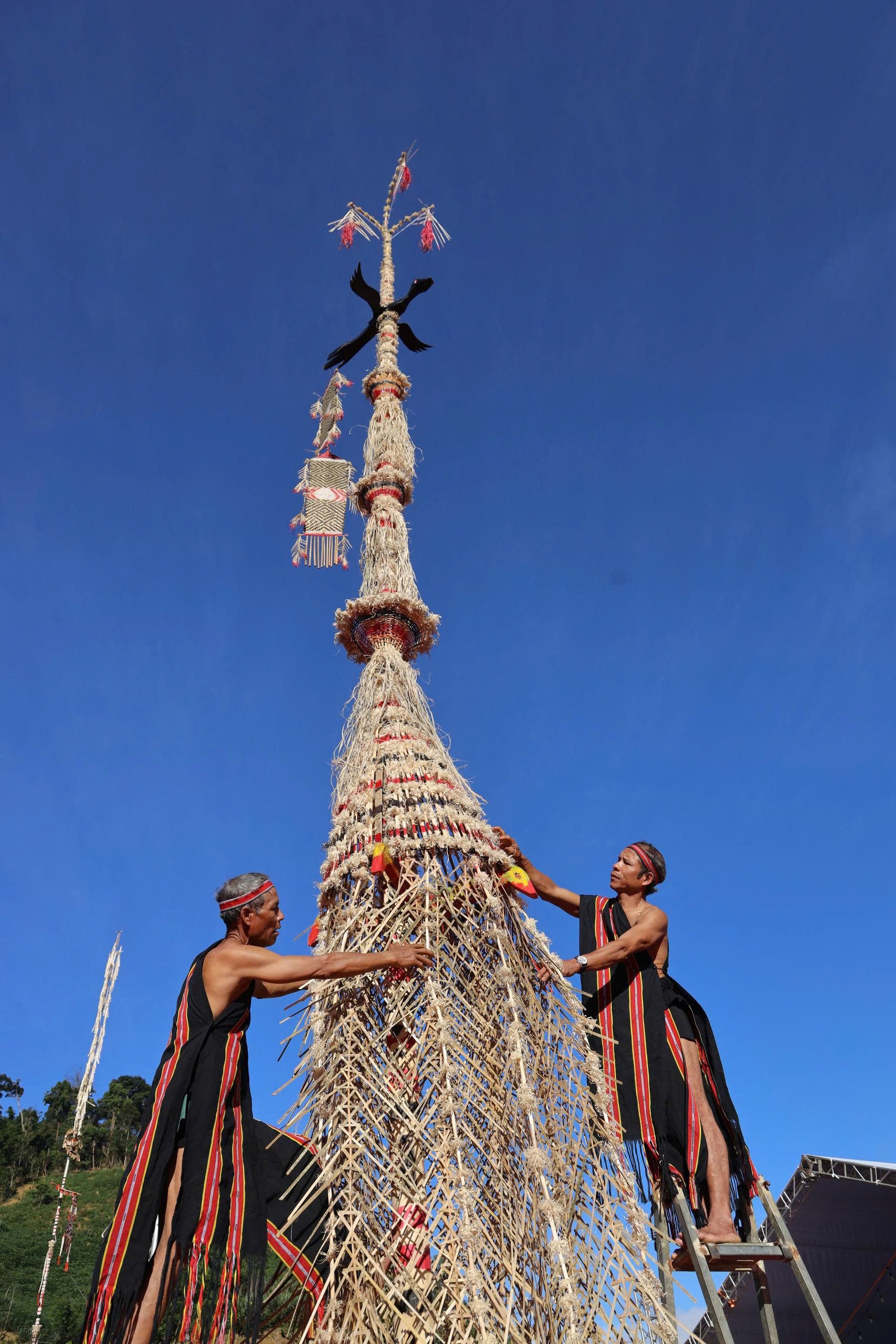
The motifs feature geometric patterns such as circles, triangles, rhombuses, dots, straight lines, and curves, forming floral shapes and four-pointed or eight-pointed stars that appear evenly distributed throughout the center of the ceremonial column. The decoration is concentrated in strips, encircling an axis, or distributed along the edges or in circular patches on the wooden panel.
The larger red circle symbolizes the sun god, while the smaller black circles symbolize the moon god, both adorning the wooden shaft. This is why the Co people always erect the ceremonial buffalo sacrifice pole in the morning. And because of this, the sun image is always facing east.
While the traditional ceremonial pole is considered by the Co people as the focal point of outdoor rituals, the gong set, usually made of wood, is considered the focal point of indoor rituals.
The Co people have four types of wooden gongs that are usually hung inside the house: the gu bla, hung in the center of the house; the gu mók, hung at the entrance; the gu mók tum, hung at the kitchen entrance; and the gu tum, hung in the center of the kitchen. Of these, the gu bla is the most elaborately decorated, often featuring mascots and animals. The Co people divide gu bla into two types: male gu and female gu, which they call gu pô and gu pi in the Co language.
Each piece and branch of the cypress tree is a unique work of art created by skilled Co artisans, depicting and recreating their daily lives and their views on deities, the universe, beliefs, and faith.
Before hanging the ceremonial drums, the Co people also perform spiritual rituals such as offering sacrifices to erect the ceremonial pole. In addition to being hung inside the house, the ceremonial drums are also recreated and hung as decorative points for worshipping deities on the ceremonial pole outdoors.
In his work "Indigenous Culture of the Mountainous Region," ethnologist Nguyen Tri Hung argues that Co artisans often use plants and cardamom from the forest to create colors and paint images of mountains and forests to decorate the ceremonial poles used in buffalo sacrifice rituals. They believe that the image of the mountains and forests is their common home, their friend, and the lifeblood of the Co people in the Truong Son - Central Highlands region. These motifs reflect the Co people's deep connection to their living environment and the mountains and forests.
Recently, the Ministry of Culture, Sports and Tourism further recognized the art of decorating the ceremonial pole and the set of musical instruments of the Co people in Tra Bong (Quang Ngai) as a national intangible cultural heritage.
Source: https://baodanang.vn/nghe-thuat-tao-hinh-tren-cot-le-cua-nguoi-co-3305716.html
![[Photo] Ba Lang An Lighthouse - the "eye of the sea" amidst the "rock museum" of Quang Ngai province.](https://vphoto.vietnam.vn/thumb/1200x675/vietnam/resource/IMAGE/2026/05/29/1780038698840_anh-man-hinh-2026-05-29-luc-14-10-42.png)
![[Image] Pleasant weather helps students enter the 10th grade entrance exam with confidence.](https://vphoto.vietnam.vn/thumb/1200x675/vietnam/resource/IMAGE/2026/05/29/1780034401612_ngay-1-thi-lop-10-minh-duy-8-5009-jpg.webp)































































Comment (0)