

By partnering with numerous major hotel brands worldwide , investors are actively exploring the luxury resort market, promising an exciting competition over the next five years.
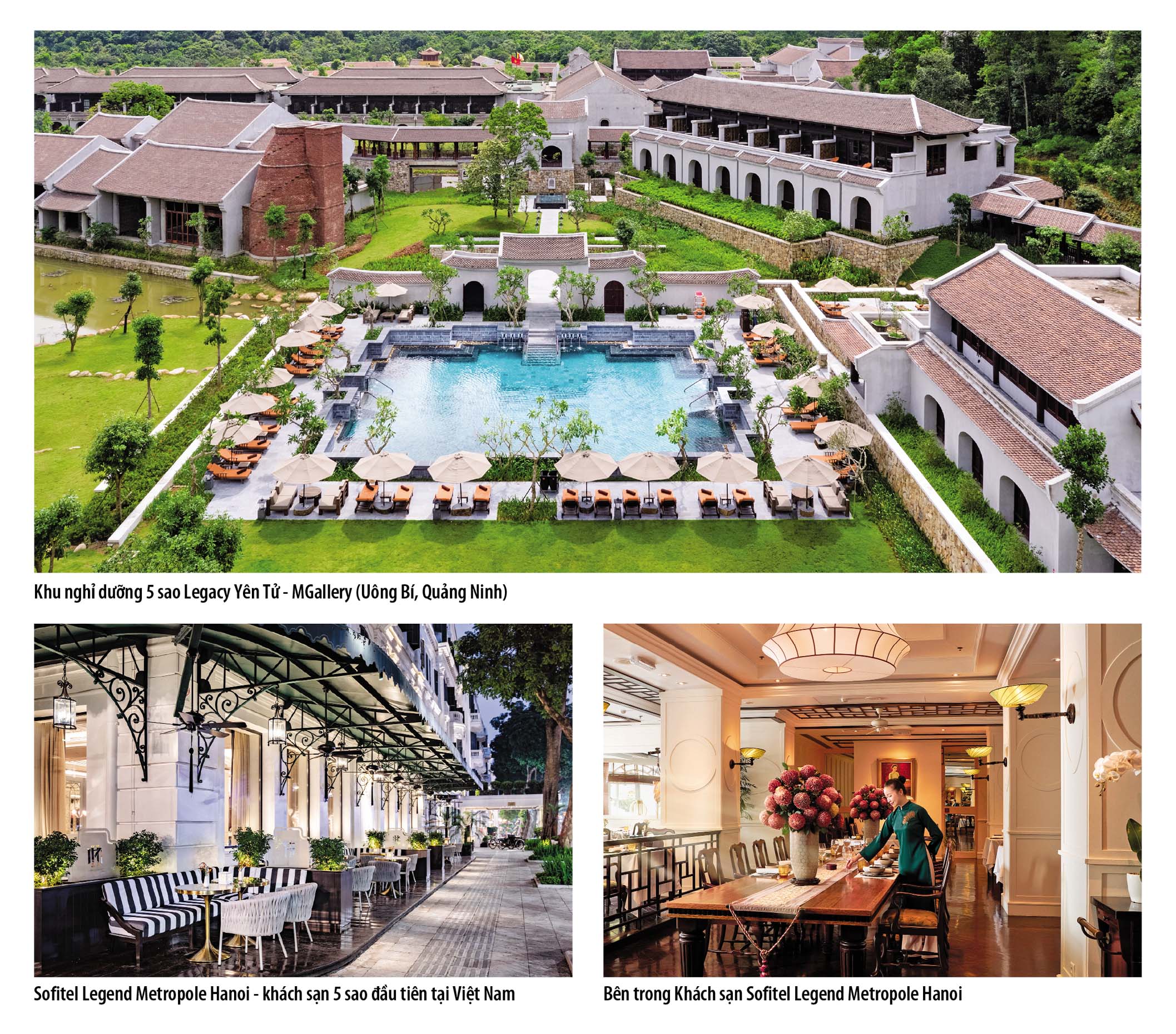 |
Capital contributors, labor contributors
As a senior executive at Accor Group, Mr. Xavier Grange has become accustomed to frequent flights between Vietnam and France. Speaking with a reporter from the Investment Newspaper, he stated that he doesn't often travel to any particular country, but three months ago he visited Vietnam for business. In November 2024, he was again in Vietnam to participate in the signing ceremony of a cooperation agreement between Accor and Doji for the operation and management of the Sofitel Diamond Crown Hai Phong Hotel Project – the fourth Sofitel-branded hotel in Vietnam.
His next trip is scheduled for early 2025.
“In recent years, Vietnam has emerged as an ideal destination for the luxury hotel segment. Not only for Accor Group, but globally, Vietnam is among the top 5 fastest-growing markets in the hotel sector, especially the luxury segment,” shared Xavier Grange, Senior Global Development Director for Sofitel, MGallery, and Emblems.
Over the next five years, the luxury hotel and resort segment in Vietnam will become the market leader, replacing the mainstream hotel segment as it is today.
Sofitel, MGallery, and Emblems are hotel brands within the "luxury" collection managed by the French Accor Group. Accor is one of the world's largest hotel operators with 45 brands, ranging from budget to luxury. Accor's hotel brands are divided into various collections, with "luxury" being the highest, followed by "premium," "midscale," and "economy"...
In Vietnam, Accor's presence dates back to 1991, through the management and operation of Sofitel Legend Metropole Hanoi – dubbed "a miniature Paris in the heart of the capital" and the first 5-star hotel in Vietnam.
Instead of directly investing capital, Accor chooses to partner with property owners, investors, and developers to jointly deliver international-standard resort services. Each hotel chain will feature the unique characteristics of its own Accor brand, with the group providing design consultancy and then taking responsibility for management and operation on behalf of the investors.
However, each hotel possesses unique architectural features and harmonizes with the local culture, rather than developing in a uniform style like many other international hotel chains.
Mr. Xavier Grange revealed that the Sofitel brand has two hotels in Vietnam. Accor Group is in the process of signing agreements with investors to develop two more Sofitel hotels in the future. Similarly, the MGallery hotel brand currently has seven properties and will soon have five more. “The total number of Sofitel and MGallery hotels will almost double in the next five years. This is a surprising rate compared to the average growth rate Accor has recorded in the luxury segment of other countries, which is 8-10% per year,” the Accor representative said.
In the fourth quarter of 2024 alone, Accor signed cooperation agreements with two major Vietnamese investors, Doji Group and Alphanam Group, to develop luxury hotel projects in Hai Phong and Sapa.
Although Vietnam lags behind Thailand in the region in the development of luxury hotels and resorts, this presents an opportunity for investors to seek investment opportunities. “Investors in luxury hotel projects are flocking to Vietnam. I can clearly feel that. Investors believe the Vietnamese market is underdeveloped and ready to invest. Vietnam has direct flights, many beautiful cities, and a vast area stretching from North to South, offering both mountains and beaches. But does Vietnam have many luxury hotels yet? Clearly not,” said Xavier Grange.
The challenge of future competition
According to a McKinsey report published in May 2024, demand for luxury travel and high-end accommodations is expected to grow faster than any other segment of the travel industry. This is partly due to the rise of the global wealthy class – individuals with net worths ranging from $1 million to $30 million. Additionally, demand for luxury travel also stems from the "inspiring" customer group, described as individuals with net worths between $100,000 and $1 million. Many of them are young and willing to spend generously on luxury travel options.
The report also highlighted several characteristics of the luxury customer group, such as traveling more frequently than the general customer group, thus valuing the experience of new destinations rather than popular ones. Vacations involving sunbathing or beach-related activities are the most preferred trips for luxury travelers.
In the Asia-Pacific region, Vietnam is emerging as one of the key resort markets, possessing many ideal conditions for the development of the luxury hotel and resort segment. The number of millionaires in Vietnam has doubled in the past five years (according to research by Bain & Company), becoming a promising consumer force for high-end services. “We estimate that the ratio of Vietnamese guests to international guests at Sofitel and MGallery is 60/40,” said a representative of Accor Group.
According to Savills statistics, Vietnam currently ranks second in the region (excluding China) in the number of ongoing resort real estate projects, after India. With 191 projects providing approximately 49,800 rooms expected to be operational between now and 2028, Vietnam is considered one of the most important markets in the region. Notably, nearly 75% of the projects under development belong to the mid-to-high-end segment, with about 70% of the new supply expected to be international hotel chain brands, especially luxury hotels.
Despite its significant potential, investors in the luxury hotel and resort segment will face several important challenges.
Firstly, there is a shift towards new areas, as some central cities no longer have much room for growth. According to Savills, currently, the majority of luxury hotels are concentrated in Ho Chi Minh City, Hanoi, and Phu Quoc (accounting for approximately 50% of all luxury projects). In the near future, the market will witness the emergence of luxury resort projects in new destinations such as Phu Yen, Sapa, Ninh Binh, and Vinh Phuc. These locations stand out with their unique local culture and natural landscapes, promising to attract many domestic and international tourists.
Secondly, there is competition among hotels. In reality, demand for resort properties is recovering strongly, especially from international tourist markets, but the ability to capitalize on this demand depends heavily on the management capabilities of each hotel.
To increase their competitive advantage in an increasingly fierce market, many owners are considering transforming or upgrading their brands to a higher-end segment. For example, the Hilton Hanoi Opera Hotel (Hoan Kiem District) is being upgraded to become the first Waldorf Astoria-branded project in Vietnam. Similarly, Meliá Ba Vi Mountain Retreat (Ba Vi District) will be repositioned as Meliá Ba Vi Mountain, part of the Meliá Collection.
“Hotel management contracts typically have a term of 10-15 years, and many contracts from the wave of luxury hotel development in 2008-2010 are nearing expiration. Therefore, investors are considering rebranding and upgrading to a higher segment to revitalize themselves,” said Mauro Gasparotti, Director of Savills Hotels.
With luxury hotel projects underway, the most common option chosen by investors is to purchase franchises from international corporations such as Accor, Marriott, Hilton, etc. Through this, high-end resorts and hotels can reap many benefits, such as optimizing profitability due to the experienced management of the franchisee; and upgrading services and operational procedures to international standards.
In particular, the hotel gains access to a global customer base already available in the databases of international corporations, eliminating the need for significant advertising and marketing costs. “We have a large number of loyal customers worldwide. When a new hotel opens, we send them information for their consideration and decision. Sometimes, customers aren't particularly fond of a particular country, like they haven't decided to visit Vietnam yet, but if there's a new hotel with a different design, they might still choose it,” Mr. Xavier Grange revealed.
According to Accor representatives, in the next five years, the luxury hotel and resort segment in Vietnam will become the market leader, instead of the mainstream hotel segment as it is currently. However, the challenge for each hotel is how to increase customer spending. For example, MGallery hotels in Thailand can achieve an average spending of 1,000 Euros per guest, even though MGallery is not an overly luxurious segment, while in Vietnam, although not sharing specific figures, Mr. Xavier Grange said there is still "a considerable gap".
Source: https://baodautu.vn/batdongsan/nha-dau-tu-rot-tien-vao-khach-san-hang-sang-d231465.html
![[Photo] General Secretary and President To Lam presides over a meeting on the implementation of Directive No. 34-CT/TW of the Party Central Committee.](https://vphoto.vietnam.vn/thumb/1200x675/vietnam/resource/IMAGE/2026/05/19/1779187768672_a1-bnd-2350-631-jpg.webp)


![[Photo] Capturing the moment the tide recedes at Yen Binh Son rapids - a million-year-old scenic spot in Quang Ngai.](https://vphoto.vietnam.vn/thumb/1200x675/vietnam/resource/IMAGE/2026/05/19/1779175463885_yen9-1199-jpg.webp)
![[Photo] National Assembly Chairman Tran Thanh Man attends the groundbreaking ceremony for the National Highway 1A spatial axis project.](https://vphoto.vietnam.vn/thumb/1200x675/vietnam/resource/IMAGE/2026/05/19/1779161360398_ndo_br_bnd-1412-jpg.webp)




















































![[Photo] General Secretary and President To Lam receives Indian Defense Minister Rajnath Singh](https://vphoto.vietnam.vn/thumb/402x226/vietnam/resource/IMAGE/2026/05/19/1779184046302_anh-man-hinh-2026-05-19-luc-16-46-58.png)

























Comment (0)