


 |
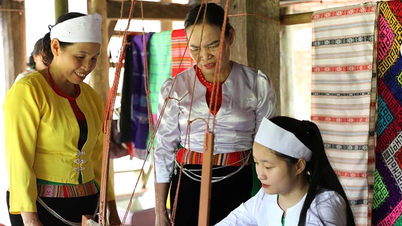
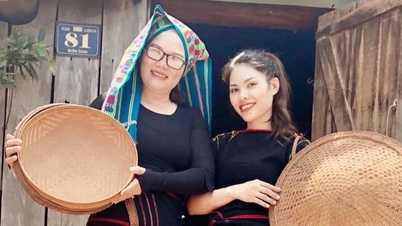
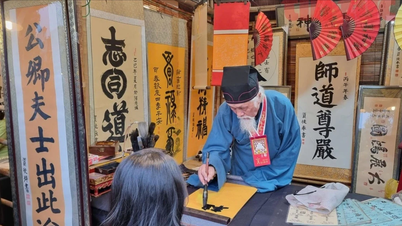
| Young people participate in hands-on experiences with artisans, engaging in cultural activities and traditional crafts at Ngan Home. |
Ngan Home - where culture lives on through experience.
For Ms. Nguyen Thi Ngan, cultural memory is not found in dry, rigid documents, but is vividly present in every home, every object, and every aspect of daily life in the community.
Therefore, upon leaving her position, her greatest concern was how to ensure that these values continue to be preserved and spread in contemporary life.
With that idea in mind, she embarked on restoring the traditional stilt houses of several ethnic groups, including the Tay and Nung stilt houses, which are closely associated with the cultural landscape of Thai Nguyen .
According to Ms. Ngan, stilt houses are not only places to live, but also "living museums," reflecting the worldview , the way of interacting with nature and the community of each ethnic group.
As these houses gradually disappear amidst the wave of urbanization, a part of the cultural memory fades away with them. Therefore, the restoration is not aimed at reminiscing about the past, but rather at helping today's generation understand their roots, thereby appreciating and continuing this legacy.
From restored stilt houses, Ms. Nguyen Thi Ngan continued to build a cultural experience space called Ngan Home - where culture is not just for looking at, but for touching, listening to, and feeling.
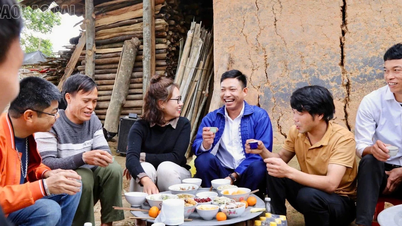
There, visitors can listen to folk tales, watch handicraft demonstrations, enjoy traditional cuisine , or participate in community cultural activities.
Ngan Home's space doesn't prioritize museum-style displays, but rather focuses on intimate, everyday experiences. "Culture only truly comes alive when people participate in it," Ms. Ngan shared.
Therefore, she always encourages the participation of artisans, local people, and especially young people in the activities here. According to her, when young people directly experience and hear cultural stories in everyday language, they will find it easier to understand than dry lectures. From there, a love for culture is formed naturally, without being imposed.
 |
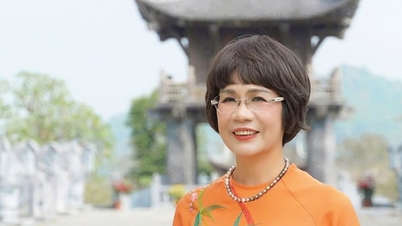
| Ms. Nguyen Thi Ngan shared her story of preserving and spreading national culture in the experiential space at Ngan Home. |
This is also a way for traditional values to find a place in modern life, instead of being pushed to the margins. From a management perspective, Mr. Nguyen Tung Lam, Head of the Tourism Management Department (Department of Culture, Sports and Tourism of Thai Nguyen province), believes that cultural experience models like Ngan Home have a positive impact on preserving and promoting heritage values.
"This is an approach that allows traditional culture to naturally integrate into daily life. When young people participate and experience it, they will naturally develop an appreciation and desire to preserve it, instead of viewing cultural preservation as a distant responsibility," Mr. Lam emphasized.
Foundation for sustainable development
What worries Ms. Nguyen Thi Ngan most is not the lack of resources or mechanisms, but the disconnect in cultural awareness among a segment of young people. She once frankly shared: "If only I had a deeper understanding of culture at the age of 20, perhaps my journey of preserving and promoting traditional values would have begun earlier."
It is from this sense of regret that she conveys a message to today's young generation: cultural understanding does not slow people down, but helps them move forward more steadily in an integrated world. Culture is the root from which each individual defines themselves, and the foundation for the sustainable development of the community.
In the age of technology, where foreign values are rapidly introduced, preserving cultural identity becomes even more crucial. However, according to Ms. Ngan, preservation does not mean isolation or denial of new things.
 |
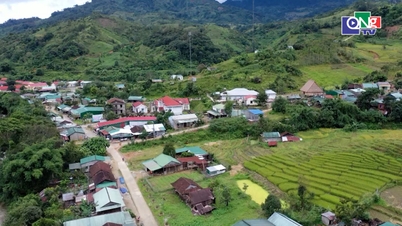
| A panoramic view of Ngan Home - where Ms. Nguyen Thi Ngan has restored a traditional stilt house, creating a cultural experience amidst the rural landscape of Thai Nguyen. |
Conversely, there needs to be a selective approach, absorbing the best of humanity on the foundation of a deep understanding of national culture.
"The 20s are the best time to learn, to experience, and to shape one's character. If 20-year-olds have a deeper understanding of culture, preservation will not only be the responsibility of researchers or management agencies, but will become an inherent need of society," Ms. Ngan emphasized.
From the quiet but persistent efforts of Ms. Nguyen Thi Ngan, it is clear that the journey of preserving culture does not necessarily have to begin with grand gestures. Sometimes, simply rebuilding a stilt house, opening up an experiential space, or telling a story at the right time and to the right people is enough to ignite a love for culture in the hearts of the younger generation – those who will continue to write the story of the nation's identity in the future.
Source: https://baothainguyen.vn/van-hoa/202602/nha-san-ke-chuyen-van-hoa-2b12e46/






















































Comment (0)