

From there, the story was verified by comparing memories with documents and witnesses: meeting the person directly guarding the outer perimeter on the day the photo was taken, comparing documentary photos with the "Two Soldiers" photograph... The goal was to clarify the context of the photograph and who the real people were in that moment that went down in history.
A moment in front of the camera.
According to Mr. Ánh, the House of Reconciliation in Long Quang village was built in the middle of a large sandy area. When the delegation arrived, there were two commanders of the Republic of Vietnam forces: Major Vọng – in charge of psychological warfare for the Marine unit, and another man with the rank of Captain (Mr. Ánh later learned that it was Captain Loan). However, when the journalists prepared to film, the Republic of Vietnam side did not agree, so they only took photographs.
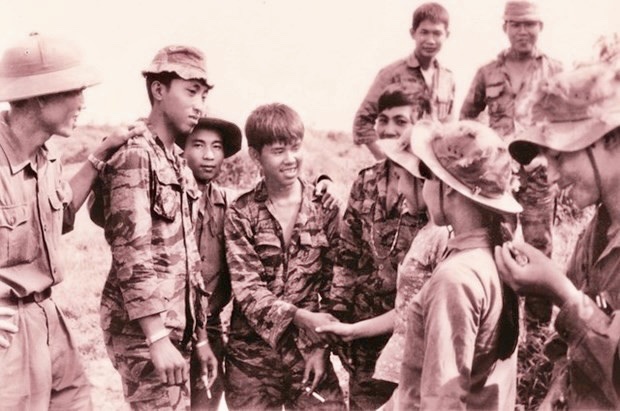
Mr. Ánh recounted: “Before taking the photo of “Two Soldiers” at an outdoor spot near the House of Reconciliation, Mr. Chu Chí Thành suggested that I take a photo with the man wearing the rank of Captain inside the house. Then, when it came time to take the photo of “Two Soldiers,” Mr. Thành suggested it again, and I was the one who proactively put my left arm around the shoulder of the soldier on the other side of the battle lines. My hand rested on Mr. Bùi Trọng Nghĩa's shoulder, while Mr. Nghĩa's hand rested under mine. After taking the two photos, I told Mr. Thành to let them – those on the other side of the battle lines – take a photo with our militia and guerrillas. But when we took the next photo, Mr. Thành still called me in to join them.”
“There are 10 people in the photo (5 on each side). On our side, there is Ms. Nguyen Thi Chinh, Secretary of the Party Committee of Trieu Trach commune, shaking hands with Mr. Bui Trong Nghia; next to Ms. Chinh is Ms. Chien – a guerrilla fighter from the commune. Opposite, on the left side of the frame, a person from the front lines has their left hand on the shoulder of a Marine; between this soldier and Mr. Nghia is another person also from the Southern revolution. I am the person standing between Mr. Nghia and that Marine soldier to my right. Because I was standing in the back row, my body was obscured, only my face was visible. I still clearly remember the location where the photo was taken, on a sandy mound; I was wearing rubber sandals while Mr. Nghia was wearing shoes and was taller than me,” Mr. Anh continued.
Mr. Ánh asserted that, in accordance with directives from higher authorities, no soldiers participated in that photo shoot; its purpose was solely to highlight the revolutionary forces of South Vietnam (the National Liberation Front of South Vietnam, often abbreviated as the Front). However, upon viewing the two photos, many people easily mistake the Front members for wearing uniforms similar to those of regular soldiers.
Regarding this, Mr. Ánh explained: At that time, militias, guerrillas, and civilians all belonged to the revolutionary forces, directly or indirectly participating in combat, so most wore military uniforms – commonly green or khaki uniforms, and bucket hats or pith helmets. The only difference was that the regular, main force troops had more complete military equipment, with ranks and positions usually identified by stars and stripes on the collar (cloth rank insignia sewn onto the collar). Therefore, when looking at the photos, most people think that soldiers were involved, but those who were there at the time knew for sure that there were no soldiers.
Verification from memory to photograph
We continued to question Mr. Ánh: “You were the one who directly guided Mr. Chu Chí Thành throughout the entire journey, from walking to traveling by boat, and it was Mr. Thành himself who invited you to take the photo. So, didn't Mr. Thành ask your name then? Suppose, as time passes and he gets older, Mr. Thành might not remember, but later, when searching for the person in the photo, he could easily go back to Triệu Phong district and ask for information about the district officials who led the delegation to Long Quang – it wouldn't be difficult to find them. In short, logically speaking, if they really wanted to find the person in the photo, that would be the most reasonable way, right?”
Mr. Ánh replied, "Actually, that day I left the District Committee right away and was ahead. While on the boat, everyone was chatting, but the journalists all spoke with a Northern accent and spoke quickly, so I didn't understand everything. As a result, there was little interaction; they mostly talked amongst themselves. Mr. Chu Chí Thành didn't even ask my name."
When we arrived at the Reconciliation House, the atmosphere became tense; the two sides met but didn't know how to handle the situation – it was a very sensitive moment. During filming, only Mr. Thanh's camera was working... Therefore, after more than 30 years, he doesn't remember that I led the delegation there and took photos, but simply assumed I was a soldier and that's why he was looking for me – through veterans, military units, or information in the newspapers.”
To obtain more objective and accurate information, we request that Mr. Ánh take us to the location of the House of Reconciliation, built in 1973 in Long Quang – where a meeting of people from both sides of the conflict took place and commemorative photos were taken.
Mr. Ánh replied: “In 1973, we built many Harmony Houses in the vicinity of Quảng Trị town, and Long Quang was just one of them. I only visited the Harmony House in Long Quang twice: once leading a group to take photos, as mentioned; and the second time leading a performing arts troupe to perform for the soldiers and civilians. Besides that, decades have passed, and the landscape and landmarks have completely changed, so how could I possibly remember everything accurately?”
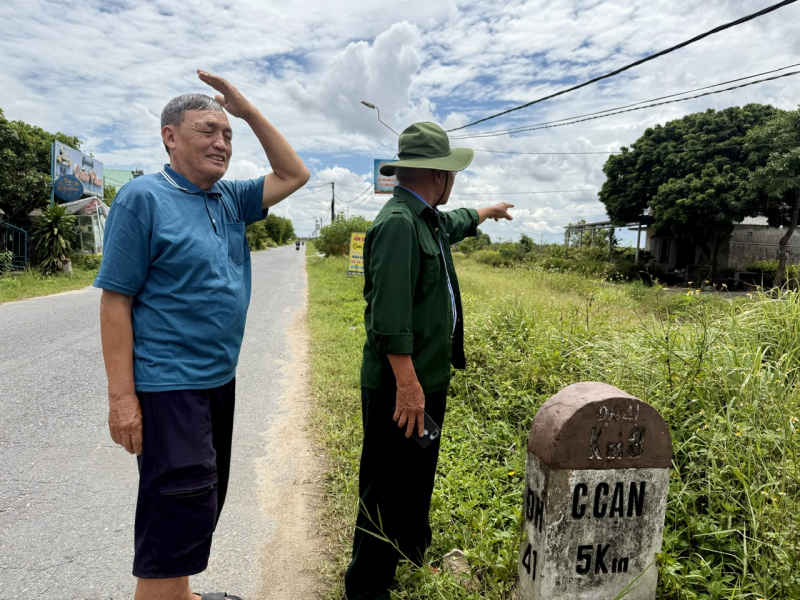
Nevertheless, Mr. Anh and I decided to go to Long Quang. As we passed the Long Quang outpost historical site on the DH41 district road, located in Long Quang village, now Nam Cua Viet commune, Quang Tri province, Mr. Anh suggested we stop the car so we could go in and light incense to commemorate the heroic martyrs...
Through our research, we met Mr. Nguyen Duy Chien, who was a platoon leader in the Trieu Trach commune guerrilla unit in 1973. Upon meeting, Mr. Chien and Mr. Anh exchanged warm greetings.
Mr. Chien confided: “In 2020, after accidentally seeing on television and in newspapers about the photograph "Two Soldiers," which introduced Mr. Nguyen Huy Tao – a regular soldier from the Quang Tri Citadel period – as the Southern revolutionary figure in the photo, I didn't believe it. Because when the group came to take the photo at the end of March 1973, I was directly in charge of the outer perimeter security, so I knew clearly that the participants had to be authorized by superiors and absolutely no soldiers were present. Looking closely at the photograph "Two Soldiers," I saw that the person supposedly a soldier didn't resemble Mr. Tao... Faced with these doubts, plus information about Mr. Anh's reaction, my wife and I visited Mr. Anh's house hoping to find out the truth. However, that day, we saw that Mr. Anh's house was holding a memorial service, and we heard him jokingly ask, "Is there a COVID outbreak in Long Quang?" My wife and I felt offended and turned around immediately without stopping.”
Furthermore, Mr. Chien added that Ms. Chien – the female guerrilla in the photograph of the nine people, as mentioned earlier – is currently living in Dong Tam 1 village, Trieu Co commune (Quang Tri); he also tried to visit her and learn about this story, but she is elderly and her memory is no longer sharp. As for Ms. Nguyen Thi Chinh, the Party Secretary of Trieu Trach commune at that time, she has passed away; there is currently no specific information about the remaining individuals.
To verify the photograph with the person who claims to be the model for the character, we tried to contact Mr. Nguyen Huy Tao but have not yet received a response…
Comparing the 1972 photograph on Mr. Nguyen Huy Tao's personal page with the "Two Soldiers" image, we noticed that the facial features do not match. The verification process will naturally require more time and documentation; within the scope of this series, we will only present objective, verified information and will not definitively assert that the real-life model for the characters is Mr. Le Anh or Mr. Nguyen Huy Tao.
Reaching a final conclusion requires early and systematic involvement from relevant authorities, archival units, and witnesses to accurately answer questions about the integrity of history.
Regardless of the identification results, the value of the photograph "Two Soldiers" remains unchanged: it captures a rare moment of reconciliation and compassion between two people on opposite sides of the battlefield. The photograph therefore endures through time – not only posing the question of "who is who," but also reminding us why, amidst the gunfire, they were able to put their arms around each other.
Source: https://cand.com.vn/Tieu-diem-van-hoa/nhan-vat-va-nhan-chung-noi-gi-bai-cuoi--i782390/
![[Photo] Prime Minister Pham Minh Chinh holds a phone call with the CEO of Russia's Rosatom Corporation.](/_next/image?url=https%3A%2F%2Fvphoto.vietnam.vn%2Fthumb%2F1200x675%2Fvietnam%2Fresource%2FIMAGE%2F2025%2F12%2F11%2F1765464552365_dsc-5295-jpg.webp&w=3840&q=75)

![[Photo] Closing Ceremony of the 10th Session of the 15th National Assembly](/_next/image?url=https%3A%2F%2Fvphoto.vietnam.vn%2Fthumb%2F1200x675%2Fvietnam%2Fresource%2FIMAGE%2F2025%2F12%2F11%2F1765448959967_image-1437-jpg.webp&w=3840&q=75)




























![[OFFICIAL] MISA GROUP ANNOUNCES ITS PIONEERING BRAND POSITIONING IN BUILDING AGENTIC AI FOR BUSINESSES, HOUSEHOLDS, AND THE GOVERNMENT](https://vphoto.vietnam.vn/thumb/402x226/vietnam/resource/IMAGE/2025/12/11/1765444754256_agentic-ai_postfb-scaled.png)




































Comment (0)